

The Year In Review
A look back at the year 2025 shows a bumpy but exhilarating ride.
The country saw major policy reversals and actions by President Donald Trump and his administration and Congress, many of which affected the towing and barge industry along with the rest of the economy. Trump and his team sought to reverse prior immigration and energy policies, reduce the size and scope of America’s aid programs, reshape alliances and trade, halt the push to electric vehicles, support oil drilling, revive and restore America’s declining shipbuilding capacity and pare back government growth—all at the same time.
Underneath the froth of politics, headlines and market uncertainty, the inland navigation industry forged ahead. The sector saw a wave of mergers and acquisitions as a few big players dominated new vessel and barge construction. Ports and terminals, both public and private, invested millions of dollars in expansions and upgrades, some with expanded state or federal grant assistance.
The slow pace of lock and dam repair and reconstruction was highlighted by scheduled closures, along with several major unscheduled closures, despite some notable milestones being reached.
High water and low water challenged cargo movements. Trade disputes saw China stop buying U.S. soybeans from May to November, but strong corn exports from a near-record harvest year buoyed bargeloads.
Consolidations And Mergers
The recent trend of consolidations and mergers continued on the rivers, partly driven by large investment groups. The two biggest names were Canal Barge Company and Campbell Transportation, both with rich histories and strong roots in the river industry. The purchase of Canal Barge Company by Redwood Holdings closed in September. Hines Furlong Line’s acquisition of the river division of Campbell Transportation is expected to close in the first quarter of 2026.
On January 1, TSF Marine (the Simmonds family) acquired The Claw Lid Lifter, manufactured by Oertel Metal Works and invented by Chuck Gifford.
Brennan Marine Inc. announced March 11 it would acquire the assets of Matteson Marine Service Inc.
In June, Maritime Partners announced its intention to acquire Centerline Logistics. Maritime Partners also acquired the Texas-based shipyard West Gulf Marine.
In October, Moran Towing Corporation announced it had acquired Bisso Towboat Company. On October 7, Marine Equipment Solutions announced the acquisition of Humco Marine Products. Turn Services announced its acquisition of St. John Fleeting on November 17.
Following Davie Defense’s completed acquisition of Gulf Copper & Manufacturing Corporation’s shipyard assets, Sabine Surveyors announced it had a newly named parent company: Sabine Marine Group.
Port Fees
Proposed port fees on Chinese-built or -flagged vessels (up to $1.5 million per call)—part of the effort to promote American shipbuilding and curtail the Chinese—threatened to reroute foreign ships to Canadian or Mexican ports, which could have reduced U.S. barge feeder traffic by 10 to 20 percent in affected corridors over one to two years. The fee proposals resulted in retaliatory Chinese moves against U.S. vessels. The Trump administration suspended those fees November 10 as part of the trade agreement with China, but that suspension only lasts one year.
At press time, the Supreme Court is considering whether the Constitution allows Trump the sweeping authority he has been using to impose his broad-based tariffs. In December, Customs and Border Protection announced a total of $200 billion in collected tariff revenues. If the Supreme Court rules against Trump, those revenues will have to be returned to U.S. importers.
Energy Reset
One big Trump administration agenda item was reversing Biden-era energy policies, including support for offshore wind projects. On August 29, U.S. Transportation Secretary Sean Duffy announced the withdrawal of $679 million in federal funding for 12 offshore wind projects and its reallocation to the maritime industry. Several affected states sued, as some wind projects were advanced, and court battles ensued. In December, a federal court ruled in favor of Rhode Island and Connecticut, but Trump’s wind project shutdowns have been generally upheld in court.
Lock Closures, Corps Projects
2024 ended with the Pittsburgh Engineer District awarding a $770 million contract for a new 110-foot by 600-foot lock chamber at Montgomery Locks and Dam in Monaca, Penn.
During a scheduled dewatering for vertical lift gate installation that began January 28, crews at Lockport Lock and Dam on the Illinois River found that the pintle sockets—which act as the bottom hinge for the lower miter gates—were cracked. A repair crew used an innovative carbon fiber wrap to complete temporary repairs, allowing the lock to reopen with only a brief extension to the planned closure. The lock, at Mile 291, is scheduled to close March 31 through May 19 next year to replace the pintle sockets, temporarily closing a key section of the route between the Mississippi River and the Great Lakes, including Chicago.
On February 3, the Pittsburgh Engineer District completed the removal of the former Monongahela River Locks and Dam 3 in Elizabeth, Pa.
In March, the American Society of Civil Engineers upgraded the inland waterways to a C-minus score (from a D+) in its infrastructure report card.
The main lock chamber at Melvin Price Locks and Dam in St. Louis reopened April 15 after being closed from January 1 for the third phase of its major lift gate replacement project.
The Nashville Engineer District announced extensive damage to the main lock chamber of Wilson Locks and Dam on the Tennessee River after it was dewatered. In September 2024, the discovery of cracks in the lower miter gate pintle castings (hinges) and webbing forced an emergency shutdown that lasted until mid-2025. A short, subsequent closure was later carried out for installing a new guard wall next to the chamber.
The Chickamauga Lock Replacement Project, a major Corps undertaking to build a modern, larger lock on the Tennessee River, is addressing issues with the old 1940s lock caused by alkali-aggregate reaction in the concrete. In September, after more than a decade in storage, 12 massive beams for the project were barged to the site.
On April 25, the New Orleans Engineer District suspended its permit for the proposed $3 billion Mid-Barataria Sediment Diversion (MBSD) project at the request of the state of Louisiana.
The operations of the Inland Waterways Users Board were suspended in March as part of a suspension of all advisory committees, and it has not yet been reconstituted. The board gives recommendations to Congress and the Corps of Engineers on how to spend money from the Inland Waterways Trust Fund for construction and major repairs to locks, dams and other navigation infrastructure. The nomination process was reportedly re-started in July, as not enough qualified applicants had submitted their names.
Tariff Whiplash
Economically, 2025 was dominated by Trump’s trade and tariff policies, with each zig and zag sparking multiple news cycles. Trump’s habit of announcing major tariff moves on social media and changing them frequently kept markets guessing and led to complaints about market uncertainty.
In February, Trump ordered a rapid review to determine a schedule for reciprocal tariffs for U.S. trading partners. He cited authorities granted by Congress in previous laws, most often the International Emergency Economic Powers Act (IEEPA), passed in 1977 to give President Jimmy Carter authority to “regulate economic transactions” during “economic emergencies.” Trump’s critics and some judges have pointed out that the word “tariff” appears nowhere in the law.
In March, Trump announced 25 percent tariffs on goods from Canada and Mexico, despite the agreement negotiated among the three during his first term. On April 2—which Trump called “Liberation Day”—he announced tariffs that took effect at midnight. Called the most sweeping set of tariffs since the Smoot-Hawley tariffs of 1930, they imposed universal 10 percent duties on all imported goods April 5, followed by further tariffs on dozens of named countries. Previously announced “sectoral” tariffs on steel, aluminum and autos, along with tariffs on semiconductors, pharmaceuticals, copper and lumber, were enacted separately.
On July 31, Trump finalized adjustments to reciprocal rates for more than 100 trading partners, bringing the average tariff rate to 17 percent. By year’s end, Trump had softened many of his more punitive tariffs, mostly due to dozens of trade deals signed with targeted countries scrambling to retain access to U.S. markets, but partly because of judge-ordered suspensions.
A much-publicized trade deal signed with China in November resulted in a Chinese commitment to continue allowing sales to the United States of rare earths, minerals crucial to a range of computer chips and weapons systems and which the Chinese had halted. The Chinese also resumed buying U.S. soybeans, which they suspended in May, agreeing to buy 12 million tons by the year’s end and 25 million tons a year for three years thereafter. It is not clear whether these totals are being met.
Rain, Rain
In early April, the Ohio River, Mississippi River and Cumberland River basins all experienced historic rainfall in the span of a few days, bringing torrential flooding.
By September, dry conditions resulted in low water and draft restrictions along several river systems, including parts of the Lower Mississippi. Draft and tow-size restrictions were in place during much of the harvest season.
Shipbuilding Revival
Early in the year, Trump issued an executive order focused on the maritime industry that calls for the creation of a Maritime Action Plan and the development of Maritime Prosperity Zones. It includes support for workforce development and more, including sustainable funding far into the future. Many of these action items were added to the Shipbuilding and Harbor Infrastructure for Prosperity and Security (SHIPS) for America Act, reintroduced by four senators and multiple sponsors on April 30. The act is still being considered in Congress at this writing.
On July 4—a date he requested—Trump signed into law his One Big Beautiful Bill Act. It provides the Coast Guard with the largest single appropriation in its history, more than $21 billion. It included $4.3 billion for Polar Security Cutters. $4.3 billion for nine new Offshore Patrol Cutters, $3.5 billion for three Arctic Security Cutters and $1 billion for Fast Response Cutters.
The act also provided $29 billion to revitalize the U.S. shipbuilding and maritime industrial base through investments, including support for workforce training and the expansion of unmanned surface vessel production. It directed the Office of Management and Budget, in coordination with the secretary of transportation, to develop a legislative proposal to establish a Maritime Security Trust Fund to provide a reliable funding source for Maritime Administration programs.
Forming partnerships with shipbuilding nations is part of Trump’s maritime revival strategy. Hanwha, South Korea’s second-largest shipbuilder, acquired Philly Shipyard in a $100 million deal that officially closed on December 19, 2024. Hanwha has pledged to pump billions of dollars into the site. In August, the Trump administration celebrated the christening of the State of Maine, built for the Maine Maritime Academy by Hanwha Philly.
Hyundai Motor Group announced its plan to invest $5.8 billion in a new barge-served steel plant in Louisiana, its first North American steel facility. In September, HD Hyundai Heavy Industries, another division of the Hyundai conglomerate and the largest shipbuilder in South Korea, said it was in talks with multiple companies about buying and operating a U.S. shipyard on the Gulf Coast.
The U.S. and South Korean trade agreement released in November includes $150 billion in Korean investment in the American shipbuilding sector and another $200 billion earmarked for industrial sectors. It cuts American import duties on South Korea’s products to 15 percent from 25 percent. The agreement will bring advanced shipbuilding knowledge and technology to American shipyards in Galveston, Texas (Davie Defense), and Houma, La. (Bollinger Shipyards), slated to build seven U.S.-based vessels. Washington accepted South Korea’s request that $200 billion in cash investments would come in chunks no larger than $20 billion a year to keep Korean currency stable.
South Korea isn’t the only international partner in Trump’s push. On October 9, Trump and Finnish President Alexander Stubb signed a memorandum of understanding to facilitate the U.S. Coast Guard’s acquisition of up to 11 new icebreaker ships, leveraging Finland’s expertise in Arctic shipbuilding. The plan involves building four Arctic Security Cutters at shipyards in Finland. Up to seven additional vessels will be constructed later in the United States using Finnish designs and expertise.
Bollinger Shipyards announced July 28 that it had begun contract negotiations with the U.S. Coast Guard for the construction of 10 additional Fast Response Cutters. The U.S. Coast Guard exercised its contract option in September. Trump announced October 9 that Bollinger Shipyards and two international companies would also design and construct six Arctic Security Cutters.
Gulf Copper & Manufacturing Corporation announced an expanded agreement with HII’s Ingalls Shipbuilding division in November.
The 43-day government shutdown from October 1 through November 12 delayed the announcement of PIDP recipients, but a revised Notice of Funding Opportunity was published in September, adding to the $500 million available, along with a revised application timeline.
Master Boat Builders announced plans December 2 to build a new $60 million defense and government-focused shipbuilding facility.
We Work The Waterways Spreads Wings
In 2025, We Work the Waterways became a free-standing non-profit dedicated to educating young people about America’s working rivers and the career opportunities on and near them. WWW has roots that stretch back to 2004 with the founding of RiverWorks Discover. More recently, WWW became a program of Inland Rivers, Ports and Terminals Inc., before becoming a standalone organization this past summer.
Vessel Christenings, Repowers
The inland navigation industry kept up a busy schedule of new vessel launches, christenings and repowerings as it renewed its towing and barge fleet.
The number of shipyards cranking out towboats for the shallow-draft inland river system has been contracting for decades, from a high of 169 shipyards from 1970 to 1979 to fewer than 50 since 2020. Shipyard consolidation has been in the news quite a bit, mainly the lack of capacity to build military and commercial vessels for the deep-draft sectors. The consolidation is similar for the shallow-draft sector.
Since 2020, shipyards have delivered 228 towboats, with an average of about 43 each year. More than 80 percent of the towboats built since 2020 are less than 3,000 horsepower, and most of them between 2,000 and 3,000 horsepower.
Seven companies have taken one-half of the towboat deliveries since 2020. Maritime Partners has taken about one-fourth of total deliveries since 2020 with Hines Furlong Line, McDonough Marine Service and Ingram each taking about 5 percent.
From here, where does the industry go as the trend of shipyard consolidation continues its march? Will the SHIPS Act bring relief, or will the shallow-draft sector be overlooked?
Ports And Terminals Expanding, Organizing, Investing
More inland ports and terminals than ever are expanding, joining together and taking advantage of state and federal funding opportunities and, in some cases, public-private partnerships.
The Environmental Protection Agency (EPA) awarded the Port of New Orleans a $41 million grant for the Louisiana International Terminal (LIT) sustainability management plan at the end of last year.
The National Defense Authorization Act of 2025, supporting port infrastructure grants, became law at the end of last year, making more money available for the Maritime Administration’s Port Infrastructure Development Program.
The Texas Ports Association released an economic impact study on December 31, 2024, showing that 28 percent of the state’s gross economic product was generated by 23 Texas ports. In January, Ohio Gov. Mike Dewine signed Senate Bill 54 into law, calling for a nine-member Ohio River Commission to direct economic development toward the river and serve as a liaison between government and industry.
On January 3, the Port of Winona, Minn., joined the Corn Belt Ports team, a group of federally recognized ports in the Corn Belt on the Upper Mississippi River.
A group of mayor-led inland ports along the Illinois Waterway joined to form the Illinois River Cities and Towns Initiative in February, and the IRCTI held its inaugural meeting in Peoria, Ill., in mid-November. Chaired by Peoria Mayor Rita Ali and led by executive director Anshu Singh, the IRCTI seeks to leverage collaboration with public and private partners to maximize development and sustainability opportunities.
In May, the Galveston Engineer District and the Trinity River Authority (TRA) unveiled the Port of Liberty Master Plan at a town hall meeting. Also in May, the Tennessee Department of Transportation (TDOT) announced a public-private partnership between Ingram Marine Group, the state of Tennessee and Cheatham County, Tenn., to develop the Ashland City River Port.
The St. Bernard, La., Port, Harbor and Terminal District and Associated Terminals hosted a dedication ceremony in May for the Chalmette Slip Rehabilitation Project.
On June 2, the Corpus Christi Ship Channel Improvement Project Completion Ceremony was held at the port’s executive administration building. On June 17, MarAd hosted a webinar tailored to guide applicants proposing small projects at small ports.
In August, the ports of Baton Rouge, South Louisiana, New Orleans, the St. Bernard Port, Harbor and Terminals District and the Louisiana Gateway Port announced they were joining to form a new “unified marketing strategy,” following a push by Louisiana’s governor, Jeff Landry, to better coordinate port policy in the state.
In September, 10 southern Illinois river ports applied to be formally recognized by the Corps as a port statistical district, citing recent data showing growth in cargo movements. The proposed Southern Illinois Regional Ports Commission would group river ports across 10 counties to boost their economic clout and infrastructure development.
At its September meeting, the Arkansas Waterway Commission announced that it was able to fund every request it received from Arkansas river ports requesting aid. Port Milwaukee’s South Shore Cruise Dock broke ground in September. On September 29, T. Parker Host acquired Impala Terminals Burnside and renamed it Ascension Bulk Terminal.
Tanco Terminals announced October 22 that it would expand its liquid barge facility at Ports of Indiana-Jeffersonville. The Port of New Orleans announced that the U.S. Department of Commerce approved its application to extend Foreign Trade Zone No. 2.
On October 27, Port Houston said it had completed the expansion of the Houston Shipping Channel, known as Project 11. The Alabama Port Authority and APM Terminals Mobile announced Oct. 28 that it would construct a new 1,300-foot container berth at the Port of Mobile.
River Business Growth
Kentucky Gov. Andy Beshear cut the ribbon January 13 on the Mighty Rivers Regional Center, established by Angie Yu, president and founder of Two Rivers Fisheries in Wickliffe, Ky., which will operate across 14 counties in Kentucky, Tennessee, Illinois and Missouri to process invasive Asian carp. Beshear later announced $1.5 million for a third round of funding across six projects and five public riverports. On July 3, he announced the awarding of another $5.7 million to 15 Kentucky riverport projects.
In March, Marquette Transportation Company announced the expansion of its Paducah, Ky., facility with more than $5 million in investment.
Oklahoma Gov. Kevin Stitt and the Oklahoma Department of Commerce announced May 16 that Emirates Global Aluminum (EGA) had selected the Tulsa Port of Inola as the preferred site for a new $4 billion primary aluminum production plant, a massive investment and the first such plant in decades to be opened in the U.S.
Ingram Marine Group announced plans on June 2 to invest $50 million to upgrade its barge-loading and grain-handling facilities in St. Louis.
Superior Ag broke ground on its new Ohio River fertilizer terminal near Rockport, Ind., in July. On the same day, the Federal Energy Regulatory Commission accepted Gulfstream LNG’s application for a Louisiana liquified natural gas export terminal.
Welspun Tubular LLC announced plans August 11 for a $150 million expansion of its facility in Little Rock.
Panama Canal Issues
BlackRock agreed early in Trump’s term to take over the operation of two Panama Canal ports previously operated by CK Hutchinson Holdings Limited for a deal between $19 billion and $22.8 billion. The Chinese government intervened, though, and Panama’s attorney general is investigating the legality of CK Hutchinson’s contracts. Even as court fights continue over the status of the contracts, Panama is planning an ambitious 10-year upgrade to the canal, including a new reservoir, to deal with recurring drought conditions that reduced vessel transits by 29 percent during fiscal year 2024. Liquefied natural gas (LNG) transits were down 66 percent, while dry bulk transits were down 107 percent. LNG transits have not returned to pre-drought activity.
In September, canal authorities rolled out a transformation plan backed by a $5.21 billion fiscal allocation for 2025-26 and reported preliminary FY2025 revenues near $5.7 billion with 13,404 transits. Those revenues will enable major new works, including a $1.6 billion Rio Indio reservoir to secure water for lock operations.
Corn Exports Boost Barge Tonnages
Corn exports for the 2024-2025 marketing year reached a record 2,875 million bushels (about 73 million metric tons), up roughly 15 percent from the previous year, while total U.S. grain and soybean exports climbed to 147.6 million metric tons. Major buyers like Mexico and China ramped up purchases, with early 2025 data showing a 3.4 million metric ton spike in Gulf exports mid-year. Corn use for ethanol rose to 5.6 billion bushels, but exports outpaced this, funneling more volume to Gulf ports.
River Voices, River Milestones
The year was chock full of anniversaries, honors and recognitions for river veterans, and also many leave-takings and retirements. It was the 250th anniversary of the Corps of Engineers, the 235th anniversary of the U.S. Coast Guard and the 70th anniversary of the United States Soybean Export Council. Bergan Marine celebrated its 50th year in operation, and the Tennessee-Tombigbee Waterway celebrated its 40th birthday.
Adm. Linda Lee Fagan, the commandant of the U.S. Coast Guard, became the first military leader to be fired by Trump’s administration. In March, industry veteran Marty Hettel announced his pending retirement and reflected on his long and varied career in the pages of The Waterways Journal. Hettel became well-known in the industry for his advocacy work on the Inland Waterways Users Board.
Cathy Hammond, CEO of Inland Marine Service, was awarded the Mike Rushing Legacy Service Award April 7 by the Towing Vessel Inspection Bureau (TVIB). A retirement luncheon was held April 14 for Kris Mullins, chief of staff for the Mobile Engineer District. A change of command ceremony held at the Towing Vessel National Center of Expertise in Paducah in April marked Lt. Cmdr. Terri Parris’ retirement after 27 years of military service. Lt. Cmdr. Nick Olmstead assumed command.
In May, Patrick Sutton was elected chairman of the board of directors for the American Waterways Operators (AWO). Conrad Industries received the Shipbuilders Council of America’s (SCA) Excellence in Safety Award. Eastern Shipbuilding Group, Inc. was awarded the 2024 American Equity Underwriters Inc. (AEU) Safety Award.
Also in May, The Waterways Journal’s own staff writer, Shelley Byrne, was named port person of the year by the Paducah Propeller Club. Darin Adrian was named the club’s maritime person of the year. Conrad Industries received the Shipbuilders Council of America’s (SCA) Excellence in Safety Award.
Orion Group Holdings announced Alison Vasquez as its new executive vice president, chief financial officer and treasurer June 10.
In September, state Rep. Mark Wright of Louisiana received Global Maritime Ministries’ Crystal Lighthouse Award, and Sgt. Logan Tillery received the Rev. John P. Vandercook Service Award.
Inland Rivers, Ports & Terminals named its new president, Lucy Fletcher, at its annual conference September 30. Turn Services announced the retirement of its president, Mario Munoz. The National Rivers Hall of Fame awarded Jerry Enzler the 2025 Achievement Award.
The International Propeller Club presented Sean Duffy with a lifetime achievement award October 15.
Ed Weilbacher retired in December, ending 14 years of service to the Kaskaskia Regional Port District in his second career as executive director, during which he oversaw significant expansion and growth.
Ken Eriksen of Polaris Analytics and Consulting contributed to this report.
————
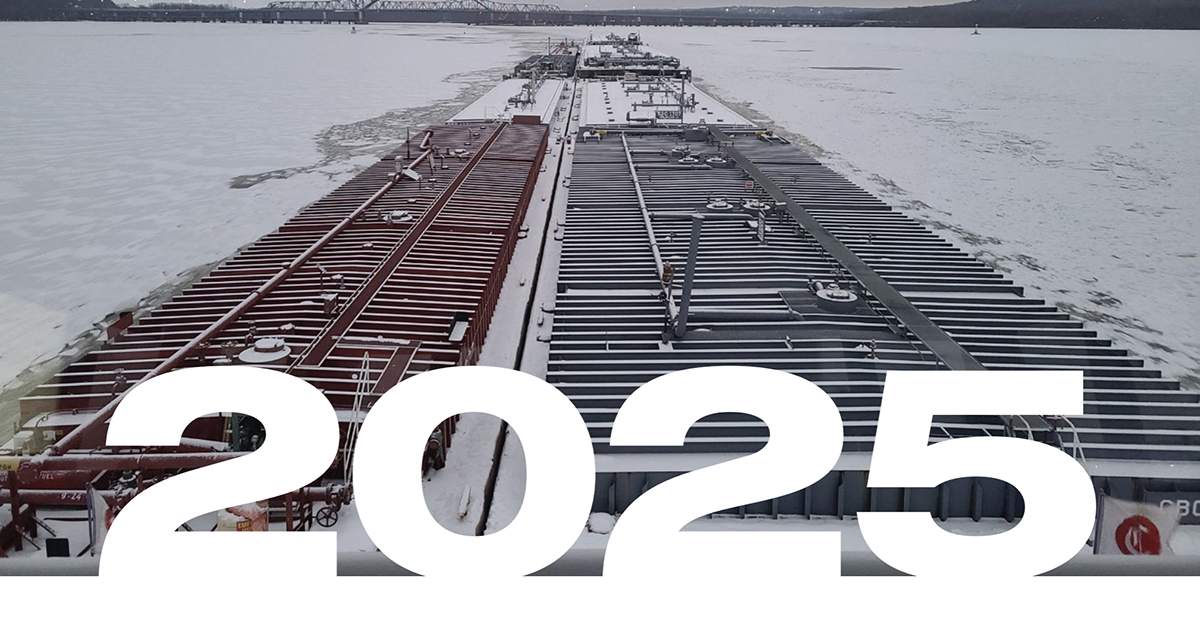
Featured photo caption: Arctic fronts brought ice to the Illinois River in January, as captured in this photo of a barge tow taken January 14 north of Peoria Lock by a Canal Barge Company mariner. (Photo courtesy of the Illinois River Carriers’ Association)