
Brown, Hill Address Corps’ ‘Wicked Math Problem’ At Waterways Symposium
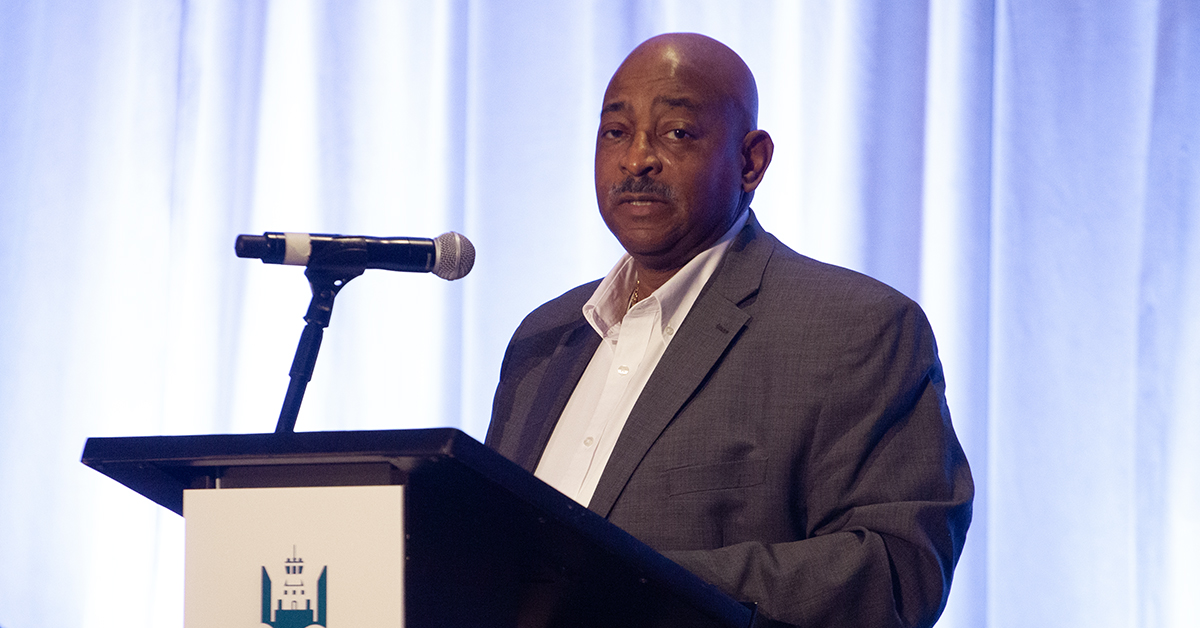
Theodore “Tab” Brown, chief of the Programs Integration Division of the Corps of Engineers’ Directorate of Civil Works, and Stephen Hill, director of operations and regulatory programs for the Corps, led one of the most interactive and infrastructure-focused sessions at this year’s Waterways Symposium, held December 8-10 in Nashville, Tenn.
Brown, who started with the Corps in 1983, and Hill, who is responsible for strategic oversight and execution of the Corps’ annual operations, maintenance and regulatory functions, both addressed critical challenges facing the Corps of Engineers as the agency seeks to maintain aging navigation structures and build new locks and dams.
“We have a wicked math problem,” Brown said. “And that wicked math problem is there’s not enough money. There are lots of needs and not enough money.”
A large part of that “wicked math problem” is the fact that 80 percent of the inland waterway infrastructure in the United States is more than 50 years old.
“The cost of repairing locks is not getting any cheaper,” he said.
There’s also the issue of the time it takes to deliver new construction projects, with several lock projects notoriously taking close to three decades to complete.
Brown said Lt. Gen. William H. “Butch” Graham, the 56th chief of engineers and commanding general of the Corps, has emphasized getting the engineering, project management and business right for projects. Getting the engineering right—in other words, proceeding with projects with better, more mature engineering and design—would help avoid some of the cost overruns that have plagued lock projects of late.
“We’ve had some ‘uh oh, aww shucks’ moments with respect to costs increases of late,” Brown said.
One of those moments came at Kentucky Lock, where the total estimated cost has ballooned from an initial $533 million in 2003 to close to $2 billion at present. The project timeline could extend past three-and-a-half decades. Brown said the latest estimated cost increase at Kentucky Lock led Graham to move oversight of the project from the Nashville District to the Corps’ Inland Navigation Design Center.
“They’ll be the designer of record for every project moving forward,” Brown said.
Brown also noted Graham’s desire to complete new construction projects in the eight-to-10 year range.
With regard to plotting the Corps’ new construction and major maintenance agenda, Brown discussed the Corps’ Capital Investment Strategy and the expected reconstitution of the Inland Waterways Users Board. Moving forward, Brown said “there are hard choices that have to be made” in terms of what comes after the current big four projects (Chickamauga, Kentucky, Montgomery and Lock and Dam 25). To move forward effectively, the Corps and Congress will need a change in approach with regard to funding.
“Through the years—and I can tell you because I was involved in different ways—we were undisciplined in terms of focusing on particular projects,” Brown said. “We would get a little bit of money for this project, a little bit of money for that project, and we wouldn’t build anything efficiently.”
Brown also wondered whether policymakers might consider pausing new starts until the Chickamauga, Kentucky, Montgomery and Lock and Dam 25 projects are all complete.
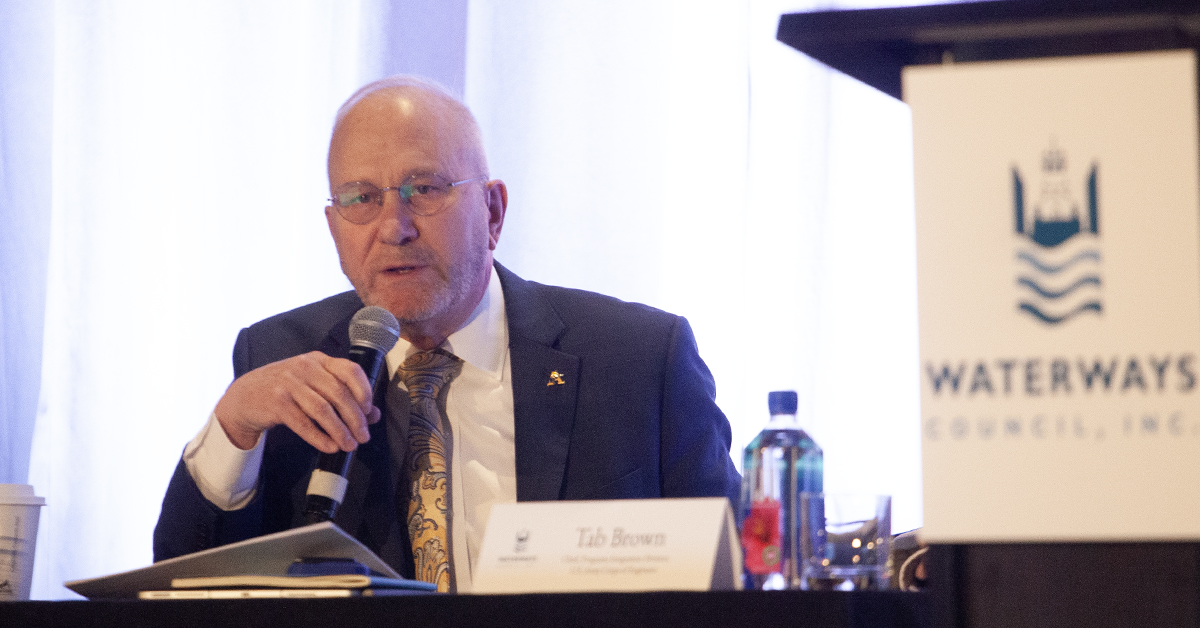
Damon Judd, president and CEO of Marquette Transportation, commented that, with much of the nation’s waterway infrastructure more than 50 years old and in view of recent lock failures and emergency closures, “From my perspective, I feel like we’re kind of in crisis.” Judd then asked Brown how he saw things.
“From the Corps’ perspective, do you think we are in crisis mode, and do you think there is significant change that needs to occur, or do you think we’re overreacting in our perspective on that?” Judd asked.
Judd also referenced the HDR study, discussed the previous day, that proposed a number of strategies for the Corps and Congress to improve project delivery. (see WJ, “WCI Holds Annual Waterways Symposium, December 22)
“I think we’re not in full-on crisis mode, but we’re seeing signs that are really concerning,” Brown said.
Hill took a different tack than Brown.
“I think you asked a great question,” he said to Judd. “I’ve never seen a better time for change than where we’re at right now. I’ve never seen us more broken than where we’re at right now.”
Echoing Brown’s “wicked math problem,” Hill pointed to his estimated total cost for Capital Improvement Strategy projects: $70 billion. What does the Corps typically get in appropriations in an average year? For construction, that number is just $1.6 billion, Hill said.
“We can either change and face the facts, or we can keep lumbering along the way we’re doing,” he said.
Like Brown, Hill pointed to getting the engineering right for projects. Hill also said steps have to be taken to increase construction capacity if the nation is going to make progress on its project backlog.
Spencer Murphy, general counsel at Canal Barge Company and a former member of the Inland Waterways Users Board, asked how the Corps could change the way it calculates the benefit-cost ratio for projects to capture more of a project’s actual benefits to the nation.
Murphy specifically mentioned the Inner Harbor Navigation Canal Lock (IHNC) Replacement Project in New Orleans and the Bayou Sorrel Lock Replacement Project, also in Louisiana. Both structures are also part of the Mississippi River and Tributaries Project, but at present the Corps considers only their benefits to commercial navigation.
Hill specifically addressed the IHNC replacement, which comes with an estimated cost of $4.6 billion, including community mitigation work. Hill said bundling the lock and community mitigation in one huge project is extremely problematic from a feasibility standpoint.
“The Corps is not in a position to do $5, 7 or 10 billion projects that bundle everything together,” Hill said. “I think the [New Orleans] District realizes that at this point. I think we can use industry’s help to say, ‘Is there another way to package this? Is there another way to look at this?’”