
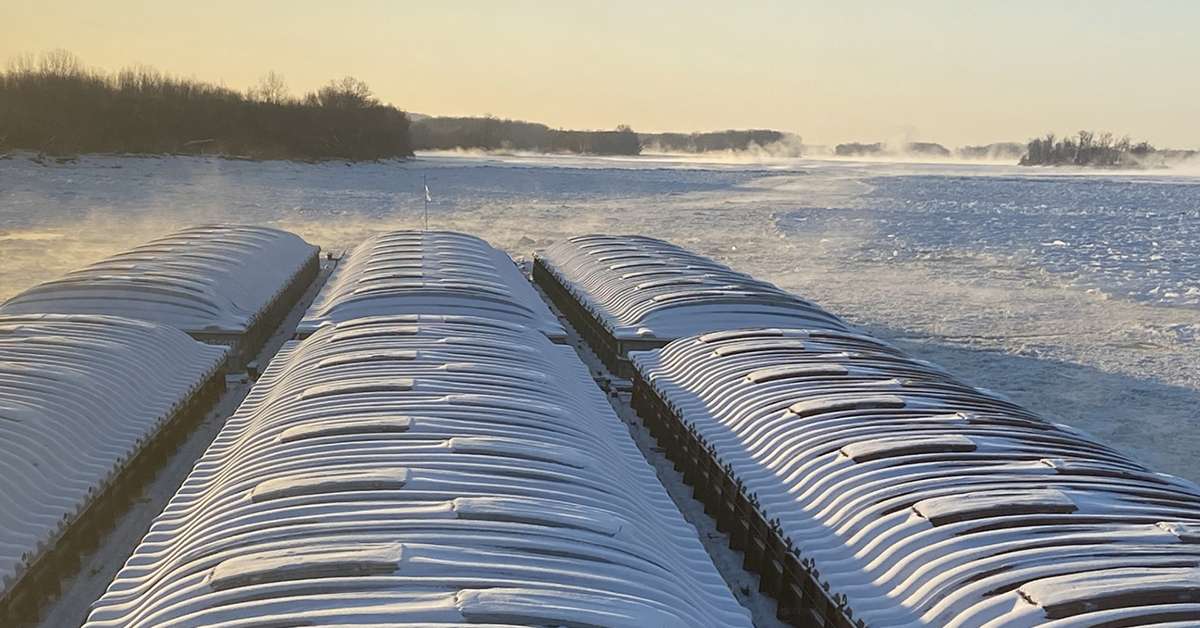
Prolonged Freeze Disrupts River Traffic
A winter storm that hit much of the inland waterways system January 24-26 continued to cause impacts a week later, with below-freezing temperatures persisting in many areas.
Ohio River
One of the worst hit regions was along the Ohio Valley.
Shane Checkan, general manager of Industry Terminal and Salvage in Industry, Pa., serves as the vice president of the Waterways Association of Pittsburgh and the navigation committee chairman.
“We haven’t seen the likes of prolonged weather like this or snow like this since 2015 or 2018,” Checkan said. “I’ve been referring to this as a once a decade-like wave we’ve been getting here. It’s not very common to have it sustained this long.”
The snow began in Pittsburgh on January 25 with 12 to 14 inches falling throughout much of the city and even more north of it, Checkan said. Many river-related businesses were unable to operate the next day, he said. Until roads could be plowed and salted, employees were largely stuck at home.
There was nothing in the 10-day forecast that showed temperatures rising above the freezing point, he said. Lows have hovered around 0 to –10 , with highs in the teens, at best. That has meant ice has continued to form, building up on ice walls and preventing equipment from working as designed.
“It’s been really significant on us,” Checkan said. “It’s getting to the point where the lockages are getting tough.”
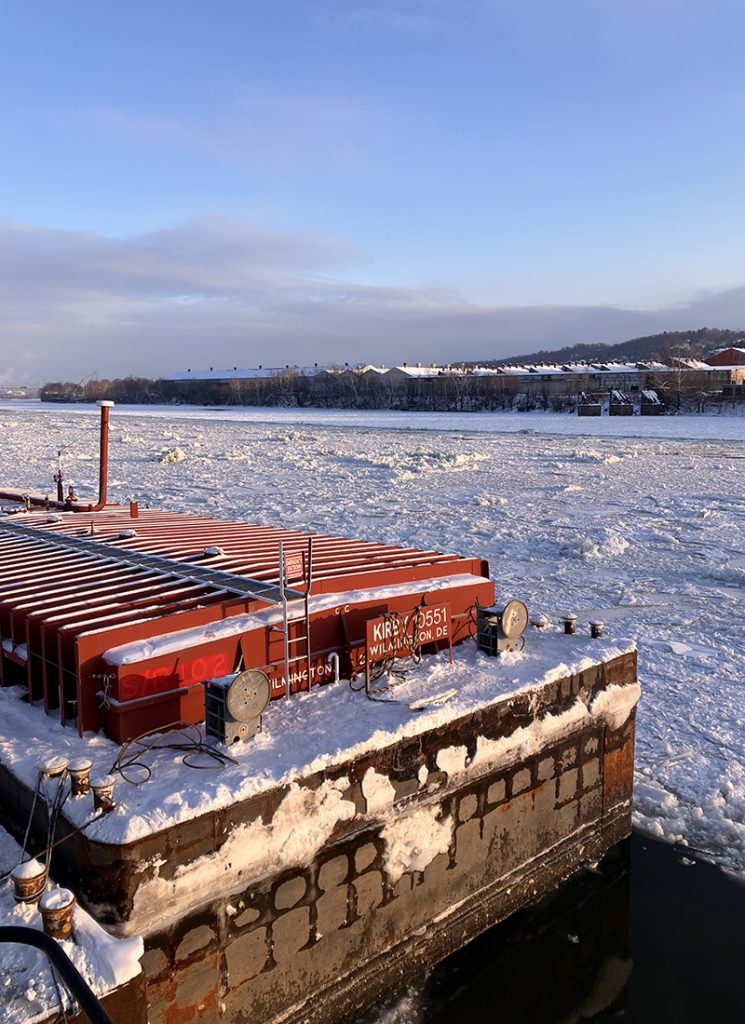
Seventy-foot width restrictions were in place January 29 at Montgomery, Dashields and Emsworth locks, Checkan said.
The Coast Guard officially shut down the Allegheny River with a full river safety zone along its 72-mile length the same day. It extended through March 1. While the safety zone is in place, vessels will not be allowed to transit the river without Coast Guard permission.
Checkan said he remained in close contact with the Pittsburgh Engineer District and the Coast Guard.
“I’m a big believer in ‘Prepare for the worst and hope for the best,’ ” he said.
Downriver, some locks had to shut down temporarily. On January 27, the Coast Guard’s captain of the port for the Ohio Valley sent an advisory warning that the Willow Island Locks and Dam, Mile 161.7, and Belleville Locks and Dam, Mile 203.9, were inoperable due to ice accumulation. Crews were working to clear the ice to regain functionality. As of January 29, however, Willow Island Lock was closed due to hydraulic systems freezing, with no estimated timeline for reopening, Checkan said in an emailed update to industry.
Illinois River
Illinois River Carriers’ Association (IRCA) captain committee chair Terry Bass said captains were reporting 5 inches of broken ice at some places on the river on January 26.
“The Illinois is pretty much ice from one end to the other end,” he said. “With these sub-arctic temps, it’s not helping any, and there’s another front supposed to come down this weekend, so that’s probably going to add to it.”
That ice wasn’t so thick that tows couldn’t move, he said, but added that it was “still creating havoc as far as pushing against it. It’s slowing guys down bigtime.”
On the other hand, he said, he worried that if a warming trend melted all that ice at once, it could lead to ice gorges, where the river becomes blocked by accumulating ice that can then break free and sweep downriver all at once.
“The river just jumps up, and you go from one extreme to the next,” he said.
LaGrange Lock and Dam, Mile 80.2, announced a 105-foot width restriction on January 26. With conditions continuing to deteriorate, 89-foot width restrictions were instituted January 28 at both Marseilles (Mile 244.6) and Starved Rock (Mile 231) locks.
Ice couplings were required at all of those locks along with those at Dresden Island (Mile 271.5) and Peoria (Mile 157.7). Helper boats were also required in both directions at all of those locks except Dresden Island, where they were only required for northbound cuts. Brandon Road Lock and Dam (Mile 286) was less affected than the other locks along the waterway, but, even there, due to ice forming in the floater recesses on the left descending side, all tows were required to lock on the right descending side of the chamber.
Mississippi River
Bass said ice was flowing in the river as far south as Hickman, Ky., at Lower Mississippi Mile 922.
On the Upper Miss, Lock 24 (Mile 273.4), Lock 25 (Mile 241.4), Mel Price Lock (Mile 200.78) and Lock 27 (Mile 185.5) announced 105-foot width restrictions. Locks 25 and 27 also had 1,000-foot maximum tow lengths to help deal with ice accumulating in the navigation chambers.
“I wouldn’t say that it’s going to get worse, but it’s definitely not going to get any better,” Bass said. “If you’re seeing some of the pictures coming out, it looks like you could shove out of Mel Price and walk to Grafton to the mouth of the Illinois faster than you could shove a towboat up and never get your feet wet.”
Bernie Heroff, St. Louis district co-chairman for the River Industry Action Committee (RIAC), said most fleets in St. Louis were shut down on Jan. 24-25. On January 26, many fleets were using two boats working together for jobs that would usually only use one.
Between Cairo, Ill., and St. Louis, it was becoming a struggle for 6,000 hp. boats to turn seven-long northbound tows in the flowing ice, Heroff said. In a weather conditions email, American Commercial Barge Line said there were significant delays with towing work between St. Louis and Cairo and that dock spots were limited.
Farther north, at Lock 22 (Mile 301.2), a 70-foot-wide restriction was put in place January 28 because the miter gates could not be fully recessed due to ice buildup. The lock was also unable to pull unpowered cuts.
It had been extremely difficult to get loaded barges over the lower sill at Lock 22, Heroff said in an email to industry.
“I don’t expect it to improve until temps are above freezing,” he said. “Plan for a helper boat to get cuts out of the chamber southbound, or run with singles until conditions improve.”
On January 28, Heroff said he received a report of a 25-barge southbound tow stuck in ice at Upper Mississippi Mile 112. It was back underway hours later, but Heroff warned “If the arctic air continues, this will become a common occurrence, or traffic will be halted altogether.”
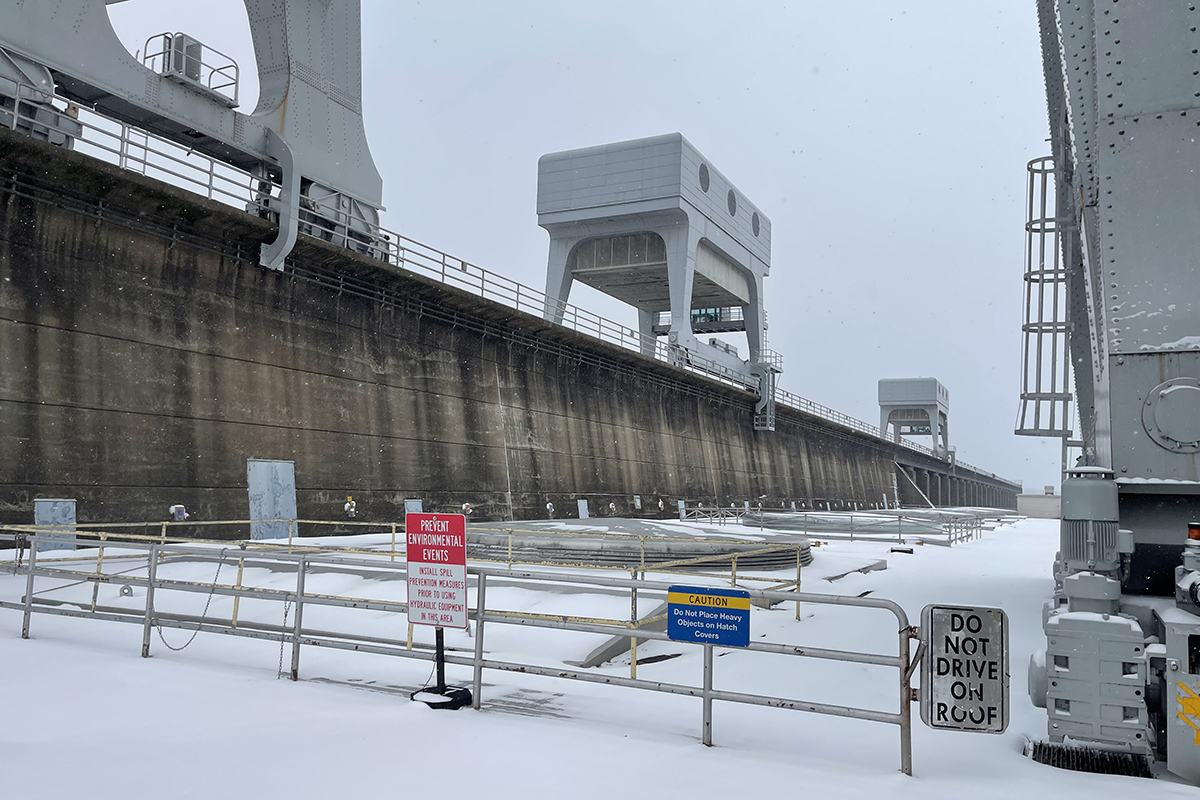
Tennessee-Tombigbee Waterway
From the evening of January 26 through the morning of January 28, all 10 locks on the Tennessee-Tombigbee Waterway were open daylight hours only.
“The cold weather has caused some of the mechanical electronic parts of the lock not to work very good,” said Mitch Mays, administrator of the Tennessee-Tombigbee Waterway Development Authority. “They’re having to heat them up to get them to work correctly.”
Two railroad bridges, including one near Pennington, Ala., were a concern as railroad officials feared ice accumulation could cause them to lower and not be able to be raised January 25. The bridges were quickly back in service, however.
On the southern end of the waterway, the main concerns were some high water and fast currents after 3-4 inches of rain fell, Mays said.
Farther north on the Tennessee, freezing rain was an issue, downing trees and power lines.
Pickwick Lock (Mile 206) closed because of weather conditions but had reopened by 3 p.m. January 27. It was experiencing extended delays, however, as was Wilson Lock at Tennessee Mile 259.
Cline Jones, executive director of the Tennessee River Valley Association and Tennessee-Cumberland Waterway Council, indefinitely postponed the groups’ annual meeting, which had been scheduled for January 27-28 in Franklin, Tenn.
The Tennessee Valley Authority (TVA) reported on social media January 26 that it was working to restore high-voltage lines connecting its supply of electricity to local power companies in middle and west Tennessee and northern Mississippi, reporting that the last line had been restored to service the morning of January 28. TVA added that the region received twice the normal precipitation from snow, ice and heavy rainfall, resulting in higher than usual flows in some of its reservoirs.
The Coast Guard issued a safety alert January 26 due to high water in the vicinity of the Tennessee River Gorge (Miles 446 to 454.5), saying that heavy rainfall had caused releases from Chickamauga Dam (Mile 471) to go above 46,000 cubic feet per second (cfs). The Coast Guard advised commercial traffic to transit through the gorge with caution and said mariners should be aware of hazardous conditions, including strong currents, increased drift and severe outdrafts.
“Please consider horsepower capability and tow size when navigating this area,” the Coast Guard alert read. “Operators should regularly check their fleets and immediately report barge break-aways to the U.S. Coast Guard.”
The alert was to remain in place until Chickamauga Dam reduced flows to below 46,000 cfs.
Stressing Safety
On waterways around the nation, maritime leaders all stressed safety during the winter weather.
Bass said those working out on barges should be sure to have their hand-held radios with them at all times, to notify the wheelhouse if going outside and to never go outside alone, instead using the “buddy system.”
“It’s no joke because it’s life-threatening,” he said.
Bass said it was important to hold onto safety railings and watch to avoid stepping in any slick spots. Even spots that were safe the night before may have re-frozen, he said.
Some employees may never have worked outside through the winter before and may be from parts of the country where it doesn’t get as cold, Bass said. Managers should ensure they are wearing proper clothing and footwear, he said.
As freezing conditions continue, Checkan said it is important not to become complacent about safety measures.
Crews must take warmup breaks to avoid the risk of hypothermia and frostbite, he said. Proper gloves and other personal protective equipment are essential, he added.
To minimize the risks of slips and falls, take the time to clear snow and ice and shovel walkways, he said. Move slowly and deliberately.
“Just because you get used to it, or it’s around for a long time doesn’t mean you shouldn’t be just as serious about mitigating those risks,” Checkan said.
To minimize the risk of falling overboard, avoid walking on the edges of barges, Heroff said. Instead, choose to walk along the interior.
“It’s been a little while since we’ve had these extreme snow and ice conditions,” he said.
Despite the forecast for the next few days, better weather is bound to be ahead, Heroff said. He noted that the normal high for the second week of February in St. Louis is 40 degrees, saying, “Spring is just around the corner.”
Featured image caption: Snow and ice blanket barges and river alike January 25 on Upper Mississippi River below Lock 21. (Photo courtesy of River Industry Executive Task Force)