
ESG Lays Keel For New Corps Dredge
Panama City, Fla.-based Eastern Shipbuilding Group (ESG), along with the U.S. Army Corps of Engineers and Royal IHC, held a keel-laying ceremony January 22 at the shipyard’s Allanton, Fla., facility for the forthcoming dredge Donnelly. The dredge, designed by Royal IHC, will replace the Corps’ venerable dredge McFarland.
“As the shipbuilder for the Donnelly, this keel laying represents an important production milestone for our team and a clear demonstration of the progress being made on this vessel,” said Joey D’Isernia, chairman and CEO of Eastern Shipbuilding Group. “Our workforce is executing this program with a strong focus on quality, safety and schedule performance, and we are proud to be building a hopper dredge that will support the U.S. Army Corps of Engineers’ mission for years to come. We value the close collaboration with USACE and Royal IHC as we move forward with construction.”
The Donnelly, under construction since last April, is a medium-class hopper dredge that will be part of the Corps of Engineers’ minimum fleet of hopper dredges. Besides the outgoing dredge McFarland, the Corps’ fleet of hopper dredges also includes the Essayons, the Yaquina and the Wheeler. The Essayons was commissioned in 1983, and the Yaquina was commissioned in 1981. Both work the West Coast. The Wheeler, commissioned in 1982, is part of the New Orleans Engineer District and primarily serves the Gulf Coast region. Built in 1967, making it the most aged dredge in the Corps’ hopper fleet, the McFarland’s typical area of responsibility ranges from the Delaware River and Bay, along the East Coast and on the Gulf Coast, including Southwest Pass, the Mississippi River’s deep-draft access channel.
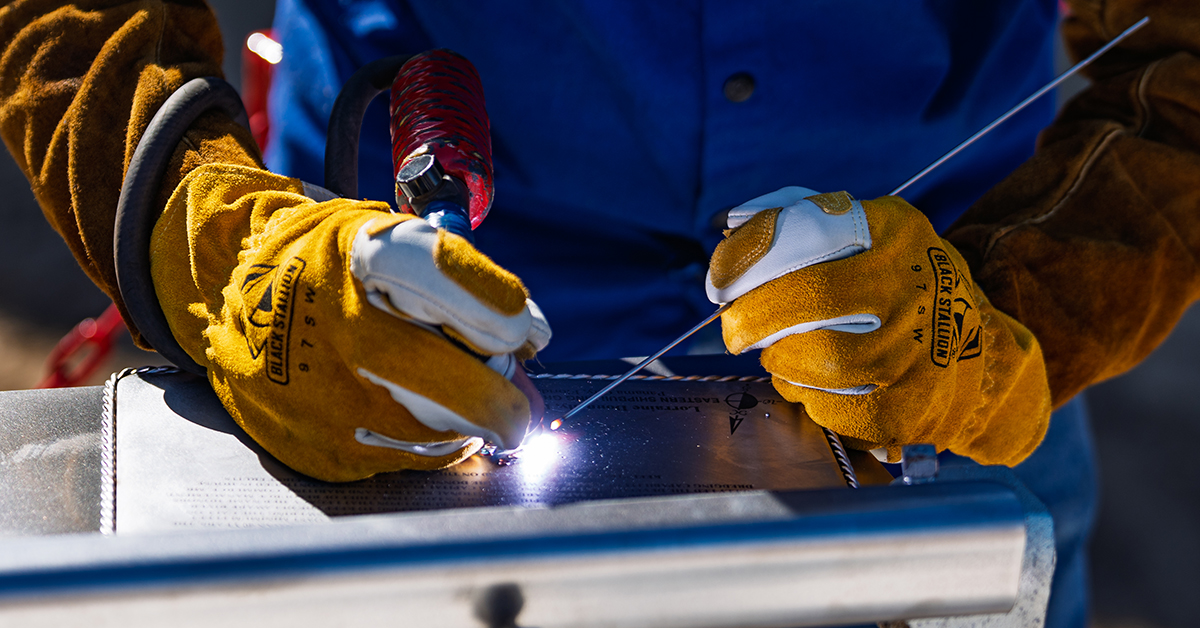
The keel laying for the Donnelly commemorates the assembly of the initial modular construction units. Historically, shipbuilders would carve their initial into the keel of a vessel to validate that the keel was properly laid and of excellent quality. In the case of the Donnelly, the ship’s sponsor’s initials were welded into the keel authentication plate by Trace Taylor, welder with ESG. Overseeing the weld was Russ Donnelly, representing the family of Ray Donnelly, the ship sponsor and vessel namesake.
Work on the Donnelly is being carried out in close coordination with the Corps of Engineers’ Marine Design Center, Eastern Shipbuilding Group and Royal IHC, the designer of record. The new dredge is on track to be placed into service in Fiscal Year 2028.
Last summer, the Corps of Engineers announced the dredge would be named the Donnelly after the late Ray Donnelly, who retired as chief of resource management for the Philadelphia Engineer District in 2020. He previously received the Army Engineer Association’s de Fleury Medal (Bronze Order) in recognition of his 44-year career with both the U.S. Navy and the Corps of Engineers. Donnelly was a key leader in the Corps of Engineers’ resource management community and conducted a detailed analysis of the four Corps-owned hopper dredges and the impacts of recapitalization on the national Civil Works program. He was also instrumental in the financial management of the Hopper Dredge McFarland.
The dredge Donnelly will measure 320 feet by 72 feet with a hull depth of 28 feet. With an empty hopper, the Donnelly will draw 11 feet, 3 inches. With a full hopper, the dredge will draw 25 feet, 6 inches. The hopper aboard the Donnelly will have a capacity of 6,000 cubic yards, and its maximum dredging depth will be 65 feet with the drag arm at a 45-degree angle.
Featured image caption: Trace Taylor, welder with Eastern Shipbuilding Group, welds Ray Donnelly’s initials into the dredge Donnelly’s keel authentication plate. (Photo courtesy of Eastern Shipbuilding Group)

