
Vessel Design, Building Techniques Have Changed Over The Decades
In 1902, Arthur J. Dyer bought out his partner’s interests in the H.T. Sinnot Company and formed the Nashville Bridge and Construction Company. According to the Tennessee Encyclopedia, Dyer was an 1891 graduate of Vanderbilt Engineering School and had worked for several bridge companies before entering a partnership with Sinnot. Following another reorganization in 1903 or 1904, it became known as the Nashville Bridge Company (Nabrico). The company was headquartered in downtown Nashville, and as the name implied, it was focused on the building of bridges (in particular, those that moved, such as bascule-type bridges).
In 1915, the firm constructed a small floating derrick hull for the U.S. Engineers. That contract marked a shift in the company toward marine construction. In 1923, Nabrico built the sternwheel towboat Harvey (see The Waterways Journal, February 12, 2021) for T.L. Herbert & Son. This 240 hp. boat was recognized as being the first fully diesel boat built for the inland rivers. In 1925 and 1926, respectively, Nabrico delivered the twin prop diesel boats Kosmortar and Kings Landing to the Kosmos Portland Cement Company (see WJ, May 22, 2023).
Throughout the ensuing decades, Nabrico continued building, not only quality vessels, but also craft that were so attractive that rivermen could tell a Nabrico-built towboat at a quick glance. In 1963, a young farm boy named Ron Nokes from Lebanon, Tenn., near Nashville, obtained a job as a draftsman at Nabrico. He married his high school sweetheart soon after, and, other than a two-year stint in the U.S. Army, he was employed by the firm and its subsequent owners for decades. He eventually moved into sales and retired at age 75.
When he first started at Nabrico as a draftsman, Nokes said the company was particularly protective of the towboat designs.
“I was only allowed to work on barge drawings when I first started,” he said.
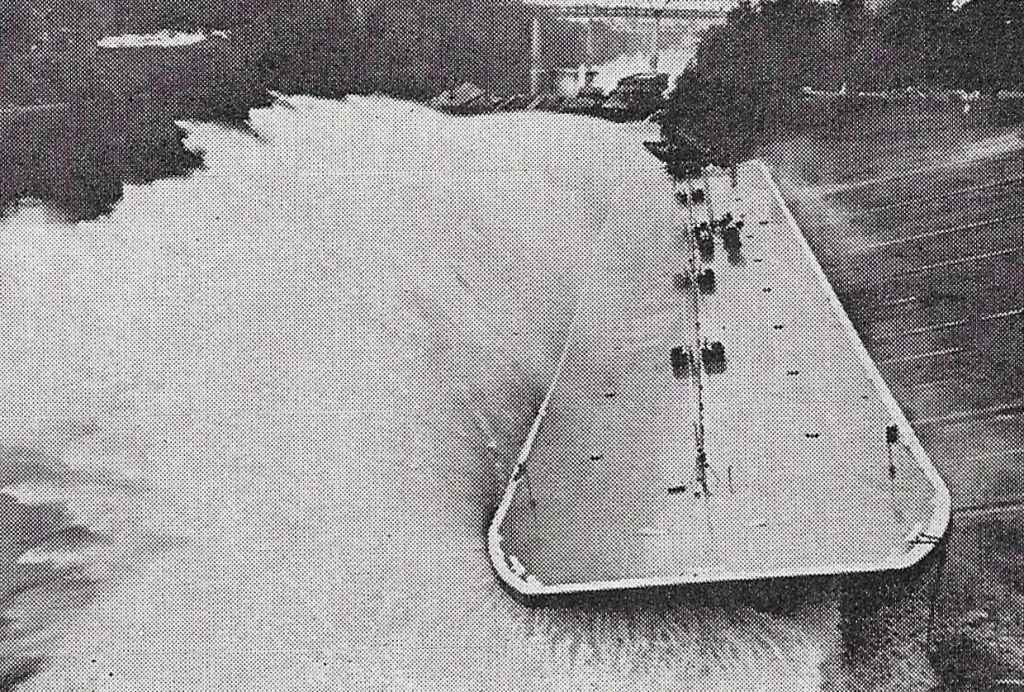
The typical Nabrico towboat of that era had a shapely hull with sides that were gently sloped from the deck line down toward the knuckle, a uniquely designed tunnel stern and a sharply modeled bow.
The Nabrico barges, in particular the rake end tank barges built, were also of a distinctive design. These were known as “spoonbill” barges, with a bow designed to move through the water with a bare minimum of resistance. The design had been model tested and was widely acclaimed by companies that bought them. One good customer, in particular, was Chotin Transportation.
When asked about the difference in vessel construction today versus 50 years ago, Nokes said that the well-proportioned contours of the boats and barges built then took time to draw, lay out in the mold loft and then build. The barges built then were of a single skin design, and the double skin barges currently required of necessity have to be built somewhat bulkier, eliminating the ability to effectively build the “spoonbill bow.” Technological improvements in welding and construction techniques allowed Nabrico to go from building 24 barges per year to 80-plus annually after 1995 under the ownership of Trinity Industries Inc. and, later, Arcosa.
One area that has changed dramatically, Nokes said, is the safety aspect, both in the construction of the vessels and the equipment now necessary on tank barges for the protection of crew, tankermen and the environment. This equipment involves closed systems, vapor control, sealed gauging systems and sealed tank domes, just to name a few.
Nokes credits men such as Ed Shearer and Kent Hoffmeister for teaching him much about the business in his early days. He was promoted to manager of estimating in 1978, then, additionally, to sales manager in 1985. In 1990, he was promoted to director of technical services, overseeing the engineering department, in addition to estimating and sales. When Trinity Industries bought Nashville Bridge in 1995, Nokes was promoted again, this time to vice president of sales for tank, hopper and specialty barges, a position he continued to hold after Arcosa took over in 2018 until his retirement in 2020.
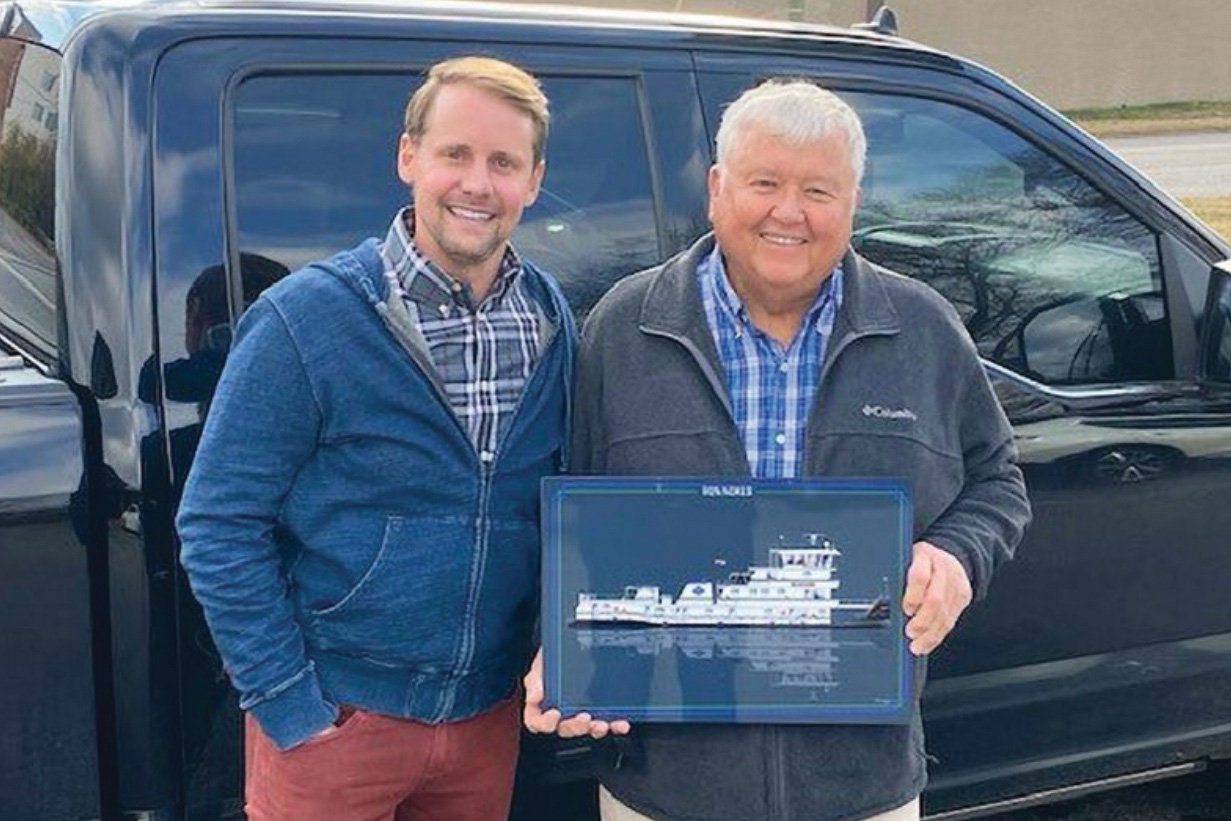
In 2021, Kent Furlong, president and founder of Hines Furlong Line, honored Nokes by naming a new 4,000 hp. towboat after him. The mv. Ron Nokes, built by Steiner Construction, Bayou La Batre, Ala., is currently operating under a long-term bareboat charter to Kirby Inland Marine.
Featured photo caption: Kent Furlong (left), president and founder of Hines Furlong Line, presents Ron Nokes a plaque of the mv. Ron Nokes. (WJ file photo)