
42nd GNOBFA Conference Includes Some Changes
This year’s River and Marine Industry Conference of the Greater New Orleans Barge Fleeting Association — the 42nd straight meeting of what has been called the “Super Bowl” of maritime law conferences — saw a few changes from past conferences at its annual event April 22 to 24.
It was the first conference that maritime attorney Maurice Hebert had not attended (due to health reasons) since he was first recruited to take a leading role in supervising it, introducing speakers and panelists and managing its agenda in 1981. Even when he “retired” as the conference’s seminar moderator, turning over hosting duties to his son — maritime attorney and Jones Walker senior partner Marc Hebert — Maurice Hebert still attended, worked with Marc on the agenda, hosted or took part in an occasional panel and/or asked questions from the audience.
This year, he sent a brief message read by seminar co-director Alan Savoie. Jones Walker partner Jeff Tillery took over Maurice’s duty as moderator of a panel on mediation on April 23. Maurice Hebert, who opened a practice as a mediator after retiring as a litigating attorney, turned 89 on April 27.
DHS Shutdown Continues
Another major difference was the absence of active Coast Guard or Corps of Engineers personnel from the panels, due to the ongoing partial shutdown of the Department of Homeland Security that has curtailed some activities of active-duty personnel.Retired Coast Guard Rear Adm. Richard Timme, now a civilian maritime consultant residing in Alexandria, Va., did speak during the last session of the opening day on April 22. Timme’s 32-year-long and distinguished career in the Coast Guard included stints as commander of Coast Guard Sector Ohio Valley, captain of the port and commanding officer of Marine Safety Unit Pittsburgh, deputy incident commander and federal on-scene coordinator representative during the Deepwater Horizon spill response and program reviewer in the Office of Budget and Programs. Timme extended his stay to take the place of two other Coast Guard personnel who were scheduled to be on the last panel on the morning of April 24.
Louisiana Update
Andrew Kilshaw, commissioner of the Office of Multimodal Commerce at the Louisiana Department of Transportation and Development and a former senior policy adviser to Louisiana Gov. Jeff Landry, spoke on the efforts of his office and the Louisiana Ports and Waterways Investment Commission to get Louisiana’s ports to coordinate more closely. Marc Hebert helped to establish the commission and served as its first chairman.
“Economic development has changed in the past few years,” Kilshaw said. “There’s now a widespread recognition that it doesn’t happen without the maritime industry in this state.”
He said a unified marketing plan was expected for five ports on the Lower Mississippi River in May that will serve as a model for all the state’s ports. It was Landry’s goal that Louisiana’s ports stop competing against each other and work together to take better advantage of funding opportunities.
Louis Wattigney Tribute
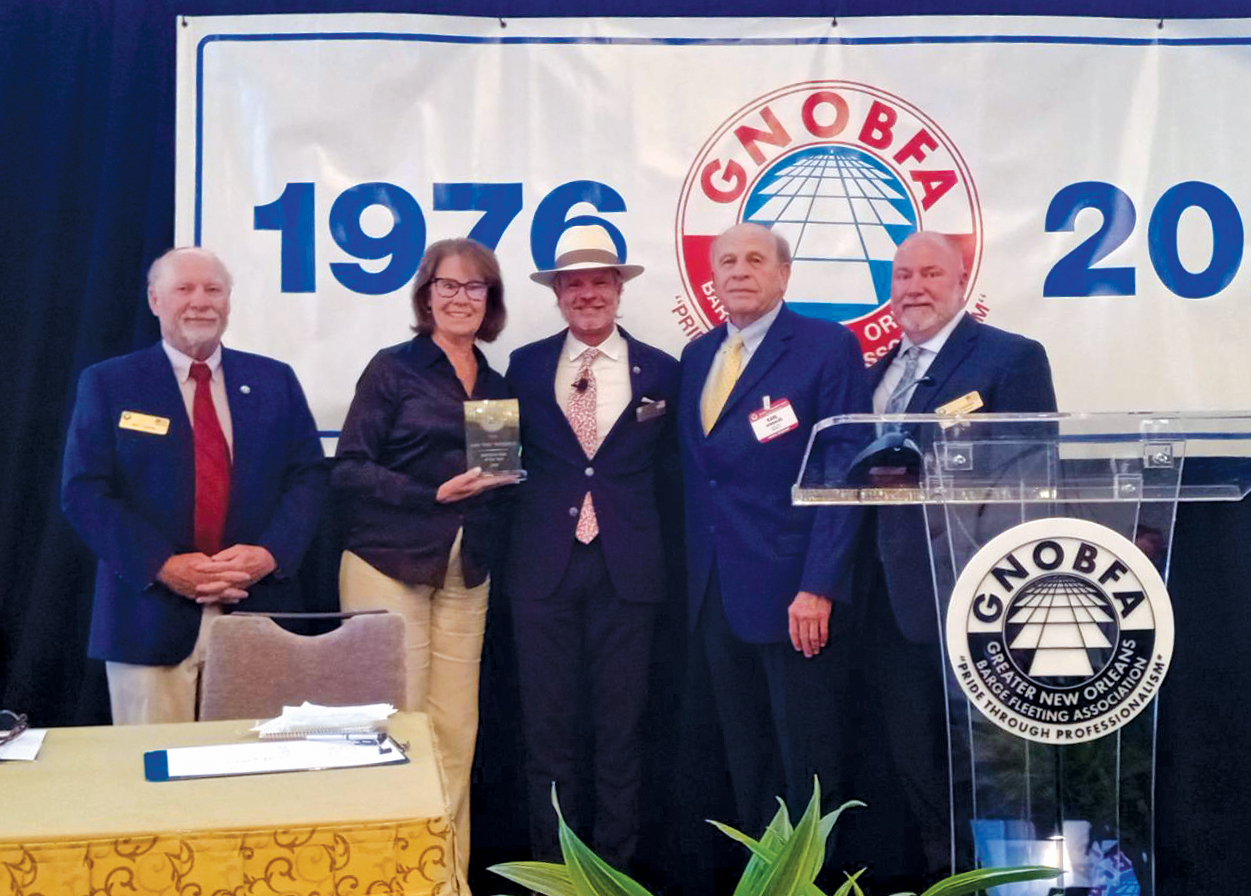
As part of the program, GNOBFA awarded the GNOBFA Maritime Man of the Year award to Capt. Louis “Toby” Wattigney posthumously. Wattigney died from a heart attack while at his hunting camp last October 12 (WJ, Nov. 7, 2025). During his tenure as president, he served in leadership and advisory roles across Louisiana’s maritime community, including with the New Orleans-Baton Rouge Steamship Pilots Association (NOBRA) board of examiners and board of directors, the American Pilots Association, Big River Coalition, Louisiana Pilotage Fee Commission, Maritime Navigation Safety Association (MNSA), New Orleans Board of Trade, Propeller Club of the U.S. Port of New Orleans, University of Louisiana Maritime Academy Advisory Council, Open Waters Louisiana and the World Trade Center Transportation Committee.
Marc Hebert called Wattigney’s widow, Cathy, to the stage to present her with the award. Kilshaw also acknowledged the impact of Wattigney’s career throughout the maritime industry.
Maritime Law Update
The first panel featured Raymond Waid, a shareholder at Liskow & Lewis; Samuel Blatchley, partner at Eckland & Blando; and Donald McLean of Bauer Moynihan & Johnson in Seattle, Wash. They offered an update on recent developments and court rulings in maritime law. On March 3, the Ninth Circuit Court of Appeals rejected an appeal from the 71-year-old captain of the dive boat Conception, Jerry Boylan, who was sentenced to four years in prison for negligence in May 2024 for the deaths of 34 people in a fire on the boat in 2019.
Waid explained the importance of jurisdiction and trial venue for limitation of liability cases. McLean pointed out that an Oregon law prevents limitation of liability issues from being raised in court. Waid urged, “Venue is destiny!” In multiparty suits, the vessel owner may get to pick his or her venue.
Blatchley discussed how arbitration is being increasingly upheld by courts in cases involving Jones Act seamen. Where the Federal Arbitration Act (which excludes seamen’s contracts from its enforcement provisions) is not involved, states are free to favor, disfavor or even ban arbitration, but the trend is toward allowing or requiring more arbitration.
In Kozur v. F/V Atlantic Bounty, LLC (2020), the U.S. District Court of New Jersey upheld an arbitration clause in a seaman’s employment contract, compelling arbitration for Jones Act, negligence and unseaworthiness claims. The court rejected arguments that such clauses are invalid in seaman employment contracts. In Trejo v. Sea Harvest Inc., a court ruled that where the Federal Arbitration Act did not apply, state law regarding arbitration clauses may rule.
Blatchley noted that the employer pays for seamen’s arbitration. The “in forma pauperis” doctrine still assumes that seamen are “paupers” and wards of the court. He predicted that the arbitration trend will spread.
From the audience, attorney David Flotte pointed out that under arbitration employers may lose certain rights and limitations they enjoy under maritime law. “I love arbitration, but not in seamen’s cases!” he said.
Coast Guard Update
Timme spoke on recent changes to Coast Guard regulations affecting vessel owners. He noted that recent changes by the administration have “chilled” the Coast Guard’s leadership. A May 2025 directive from the Department of Homeland Security eliminated 12 out of 45 total flag officer (admiral) positions. Some political appointees have been put in senior positions.
However, the Coast Guard received almost $25 billion in the One Big Beautiful Bill last year, the single biggest investment in its entire history.
“Most folks in line for shipbuilding money have some nexus to the Department of War, but that will eventually include almost everyone,” he said.
He said some senior Coast Guard leaders believe that the Coast Guard has ceded too much vessel inspection authority to third-party organizations. About two-thirds of inland companies have chosen the TPO/TSMS method of maintaining a certification of inspection (COI). With this option, if a vessel deficiency is found (unless it is serious), there are more delays and steps to follow with the TPO before a vessel is halted.
With direct Coast Guard inspections, the Coast Guard may halt a vessel on the spot if a deficiency is found. Timme noted that with the ongoing personnel shortages, there are more junior inspectors less inclined to bend rules or stretch a point. On the other hand, the TSMS/TPO option might carry more risk if something goes wrong after certification. The Coast Guard is also getting pressure from an administration that wants it to focus less on marine safety and more on warfighting and border interdiction.
“We are not growing the inspection workforce, but the demand is growing,” Timme said. He sees inspection rules becoming looser and more flexible. Autonomous vessels and lithium batteries are two areas in which the Coast Guard is developing new regulations.
Maintenance and Cure 101
Attorneys Karen Shields and Kristi Post, representing the company and plaintiff sides of the court room, gave an update on maintenance and cure, a perennial topic. The Jones Act remedy provides lost-income compensation regardless of fault to injured seamen along with medical benefits. “M&C has changed a lot over the years,” Marc Hebert noted in moderating the panel, but he said certain aspects still apply. Medical payment obligations are incurred until “maximum medical benefit” for the seaman is achieved. However, a seaman with “robust insurance” may receive zero benefits if his insurance covers treatment.
Panelists agreed with a questioner that insurers should not get involved in any medical decisions pre-treatment. Employers are free to investigate the injury, but denial of payment based on a “cursory investigation” has been ruled against. However, they said that analysis is fact-intensive and can take time.
Much of the panel discussion focused on back and spine injuries. Shields noted, “We use neurosurgeons more and more.” Post said that questionnaires given to employees or potential hires must use precise language. One asked about “back trouble.” “What is ‘trouble’?,” she asked. Questions on forms about neck and back pain should be asked separately, not together.
Medical Panel
Neck and back injuries dominated the “doctors’ panel,” which included past GNOBFA presenter Brian M. Bourgeois, an occupational medicine specialist in Gretna, La., who has been in practice for more than 20 years; neurosurgeon Najeeb Thomas; and neuropsychologist Lauren Rasmussen, whose medical specialty occupies a unique niche at the intersection of several related disciplines.
ourgeois stressed the need for all medical practitioners to develop a “human relationship” with patients at all times. “The best outcome for all concerned is for the injured employee to fully recover, go back to work and be left alone,” he said. The goal of occupational medicine, he said, is to provide a bridge from pre-employment physical throughout his entire history. An occupational medicine practitioner can ask medical questions that the employer cannot.
The discussion ranged over how to assess and measure pain, whether and when to call for an MRI or other interventions and how to judge when maximum medical improvement has been reached.
Bourgeois said it’s important for the employer to keep an injured employee working in any capacity, even if not the original one. The longer injured employees sit home and brood, the less likelihood they will return to work.
Featured photo caption: Officers of the Greater New Orleans Barge Fleeting Association present an award to the widow of Capt. Toby Wattigney at the 42nd River and Marine Industry Seminar in New Orleans. (Photo by David Murray)
(Coverage of the River and Marine Industry Seminar will continue in next week’s issue of The Waterways Journal.)