
Woodruff Sketches Industry Priorities At IMX
Remarking that now is a pivotal time within the industry, Matt Woodruff’s opening statements at the recently concluded Inland Marine Expo (IMX) in Nashville, Tenn., drew some attention.
Woodruff, longtime vice president of government affairs at Kirby Corporation and a veteran of many inland committees and bodies, currently serves as chairman of the board of The American Waterways Operators. He anchored the IMX with a wide-ranging talk titled “Bring It In: Industry Priorities.”
Woodruff was introduced by Kent Furlong, president of Hines Furlong Line (HFL), one of the longest-standing family brands in the inland river transportation industry, with more than 150 years and five family generations of presence on the inland waterways. Today, from its headquarters in Nashville, Tenn., HFL operates on nearly every stretch of the inland waterways while continuing to specialize in leasing towboats, tank barges and hopper barges to third parties.
After the introduction by Furlong, Woodruff began by giving an overview of the “alphabet soup” of associations that advocate for the interests of those who work and serve the inland waterways and rivers. The Waterways Council Inc. concentrates on the funding and maintenance of the lock and dam infrastructure that is the framework for waterborne commerce, while The American Waterways Operators focuses on operational matters and working closely with the United States Coast Guard on regulations.
Research Foundation
The National Waterways Foundation is a pure non-profit research organization that provides the intellectual foundations of non-partisan research on rivers and waterways. It partners with universities and think tanks to produce objective, non-partisan studies on topics connected with the rivers and waterways. The well-known and often-cited statistics on the efficiency of barge transportation by ton-mile, for example, were produced by the Texas Transportation Institute as part of an NWF-commissioned study.
Last August, the NWF released a study on inland waterways employment that is meant to be a guidance document for high-school counselors, Woodruff said, as well as parents of students. “It’s a dining-room table discussion document that can help families and young people make decisions.”
“People in rural communities can work on the rivers and don’t have to permanently leave those communities, even if they have to be on the boat for weeks at a time, he said. He mentioned one towboat captain who lived in a small town and was asked to be the mayor because he was the highest earner in the town.
Port associations and labor unions, whose members build and maintain the locks and dams, are also part of the broad coalition that supports waterborne commerce. Woodruff pointed out that the members of this coalition don’t always have the same reasons for supporting the waterways. “We look for synergies where synergies make sense,” he said.
Jones Act Call To Action
The AWO is unequivocally opposed to the waivers to the Jones Act announced by President Donald Trump’s administration, ostensibly to ease oil and gas prices due to the ongoing conflict in the Strait of Hormuz. “The waiver is an existential threat to the Jones Act,” Woodruff bluntly said. He said he doesn’t believe that the President himself opposes the Jones Act, but he named influential White House adviser Kevin Hassett, who directs the National Economic Council, as “Jones Act enemy Number One.”
He noted that America’s Maritime Partnership is leading a concentrated campaign to assure Trump and his advisers that the waiver contradicts Trump’s stated desire to revive the U.S. merchant marine and shipbuilding capacity. The message, he said, is “Mr. President, you got bad advice.”
The campaign features television, connected TV, radio and digital advertising and will air in the nation’s most prominent maritime states, including Louisiana, Mississippi, Florida, Virginia, Alabama, Georgia, South Carolina and Tennessee, among others.
The campaign’s first ad, titled “End the Waiver,” features a captain of a Jones Act vessel reminding the audience that American maritime is the quintessential “America First” industry. The ad ends with a call for the president to end the waiver and “put Americans back to work.”
According to the AMP, total fuel moved under the waiver over the first 60 days amounts to roughly 11 hours of national consumption. Those immaterial benefits are a result of foreign carriers being able to operate free from compliance with U.S. immigration, minimum wage and taxation laws, among other regulations, the organization has said.
“There is no evidence to date that the waiver has had any meaningful impact in gas prices,” Woodruff said. “It’s less than a penny a gallon.”
Like most Jones Act supporters, Woodruff said he wasn’t automatically opposed to case-by-case limited Jones Act waivers in situations where American-flag vessels genuinely aren’t available to respond to emergencies like natural disasters. The current waiver is broader, enacted under a national defense justification. However, Woodruff stressed that the waiver didn’t suspend the requirement that foreign-flag shippers taking advantage of the waiver adhere to all U.S. laws and regulations—including withholding and tax laws.
He said attendees who want to join the fight could find out more —including links for sending letters to their Congressional representatives — at endthewaiver.com.
Corps Troubles
The WCI was founded, Woodruff said, at a time when the Corps of Engineers was under broad attack by environmental groups that wanted to remove all locks and dams. The lock and dam delivery system faced massive cost escalations, overruns and delays of the Olmsted Lock and Dam, which finally became fully operational in 2018.
“A lot of things we said needed to be done in 2011 have not been done,” he said. “Kentucky Lock will be worse than Olmsted!”
He reiterated that dams without locks that are used and enjoyed by millions of recreational boaters and other beneficiaries are fully funded by the federal government, whereas of all the users of locked dams, only the navigation industry is expected to contribute to their cost. “Let’s just cost-share the lock portion of the dam, not the rest of it!” Woodruff said.
Coast Guard Performance
The AWO is actively concerned about consistency among Coast Guard districts in vessel inspections, as well as licensing bottlenecks at the National Maritime Center. The NMC is still catching up after an extended period when it was shut down due to the partial shutdown of some federal agencies over Congress’ budget, Woodruff said. He said the Coast Guard is recapitalizing the system, adding, “We should see results soon.”
Woodruff said he wondered how much of the cost differentials in operating American versus foreign vessels are due to unnecessary and burdensome regulations. “The Coast Guard must move at the speed of industry and move into the 21st century,” he said.
Woodruff’s opening keynote at IMX was a clear call to action.
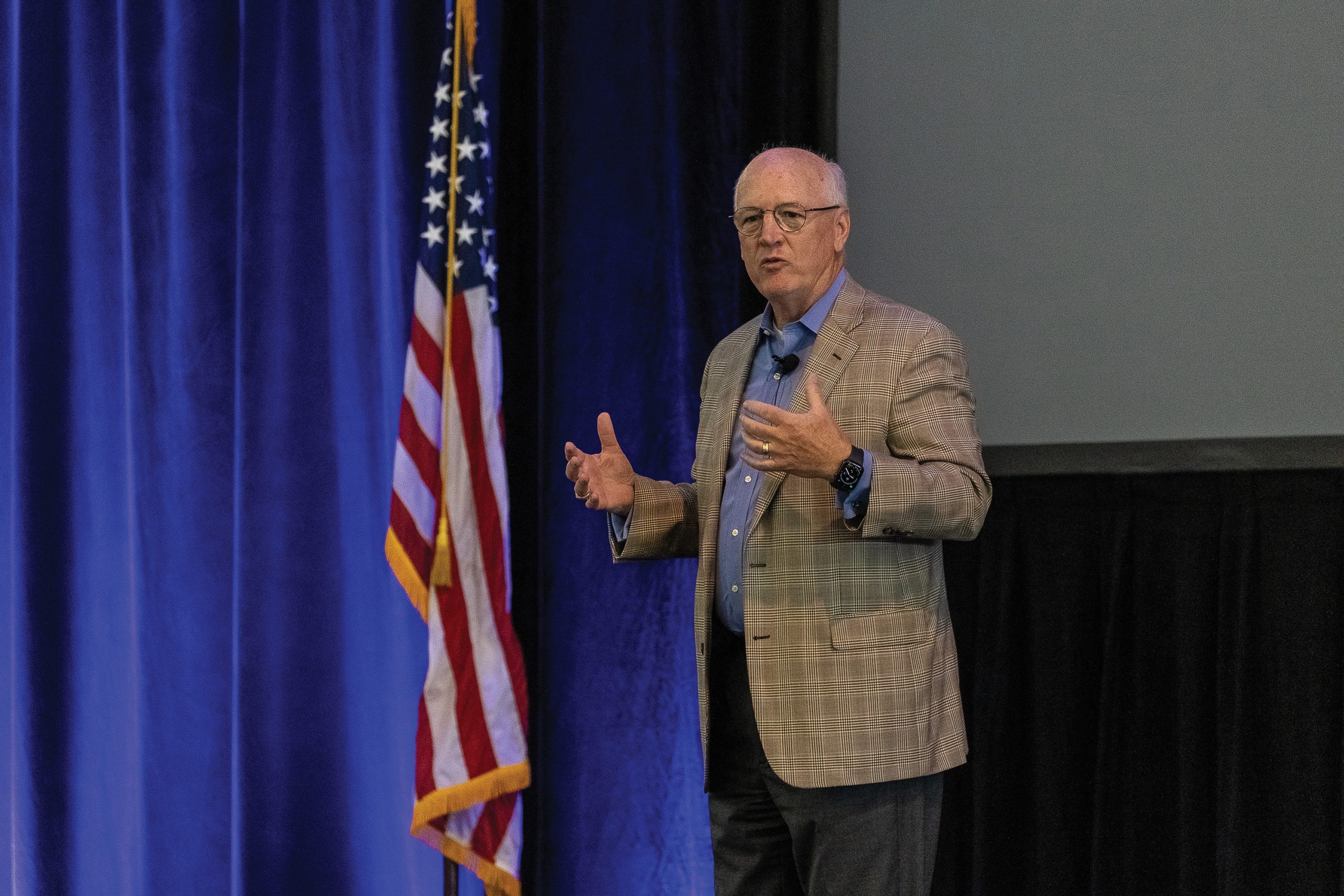
Featured photo caption: Matt Woodruff, vice president of public and government affairs for Kirby Corporation, delivers opening remarks during the 2026 Inland Marine Expo in Nashville, Tenn. Woodruff discussed key issues affecting the inland waterways industry, including maritime policy, workforce development and the importance of maintaining a strong U.S. merchant marine and domestic shipbuilding base. (Photo courtesy of ECN Photography)