
FreightWeekSTL Highlights Industry Needs
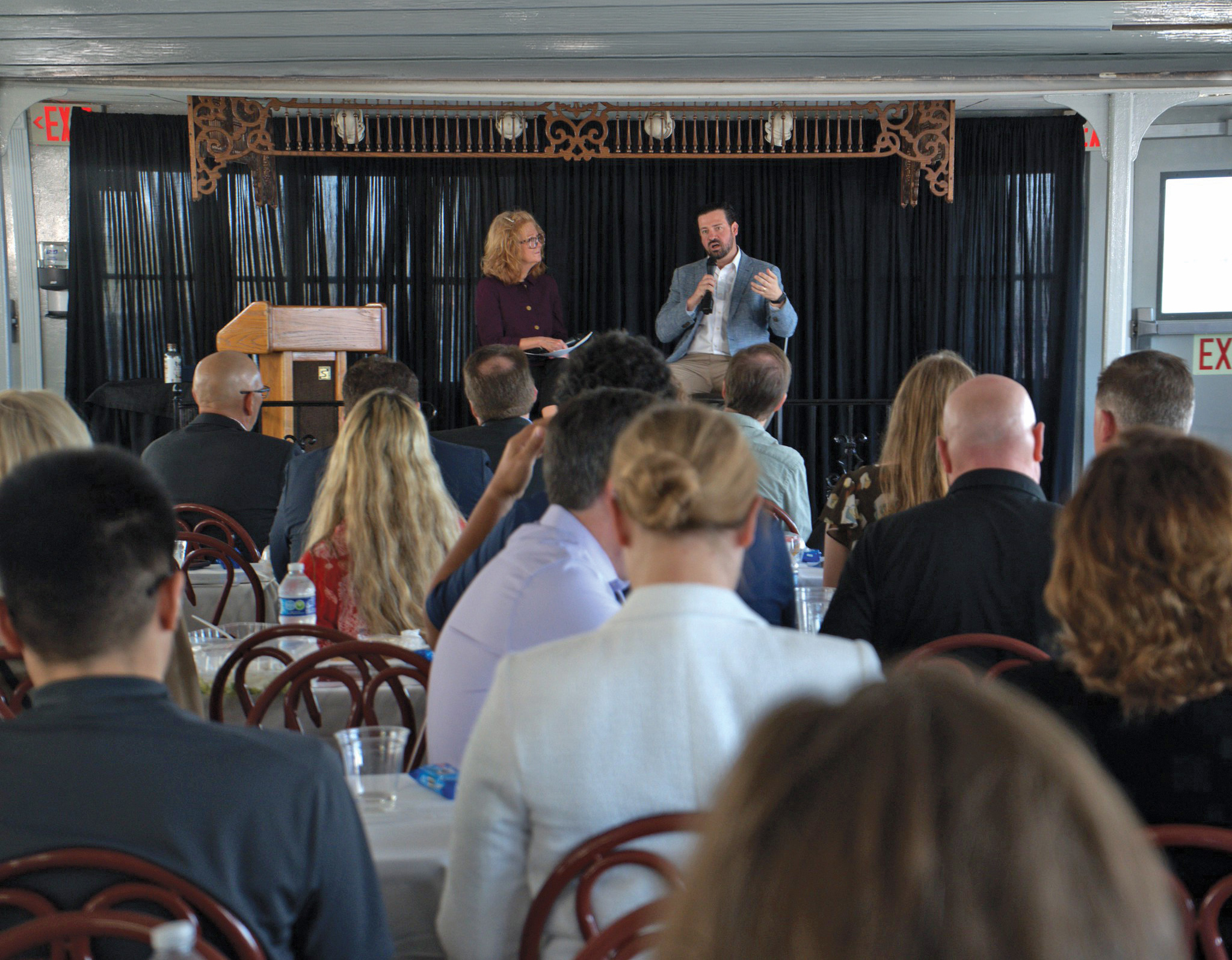
FreightWeekSTL welcomed transportation professionals across multiple modes for its annual week-long conference from June 8 to 12. This year’s keynote speaker, Tracey Zea, president and CEO of Waterways Council Inc. (WCI), spoke to audience members regarding the importance of freight on the river while aboard the Tom Sawyer riverboat for the 2026 Freight Summit on June 10.
Zea spoke of increased out-year tonnage forecasts in the Upper Mississippi River and the Gulf, specifically in regard to petroleum. He also cited the importance of Lock and Dam 25 in St. Louis, Mo., as an important project WCI would like to see completed. The project has been authorized since 2007, and it was funded to completion in the 2021 infrastructure package, but the project ran into cost overruns, requiring another $1.5 billion.
“Getting (projects) done in an efficient manner will help our farmers, will help our aggregates, will help with fertilizer, and here at WCI, we believe that’s probably the most important project here for the next five years to get completed,” Zea said.
It is necessary for the Corps to receive large amounts of funding, Zea said, for projects to be completed in a timely manner and to prevent situations like the 28-year construction of Kentucky Lock and 24-year construction of the Chickamauga Lock.
“We have to get away from that because, if that continues on, this nation will not have an adequate transportation system,” Zea said. “We’ll start seeing locks and dams fail. So, we need to prove to Congress that with this lock here at Lock and Dam 25, if you give the Corps the money, they can actually construct these facilities in a timely manner.”
According to Zea, it can be difficult to get Congress to fully understand the importance of river infrastructure. He described it as an “out of sight, out of mind” phenomenon and explained that government officials need to fully understand the impact infrastructure has on the economy. When locks and dams are repaired and completed, the amount of tonnage passing through increases, and surrounding businesses flourish. A more reliable transportation system brings in new investments, new terminals, new commodities and new jobs.
Zea spoke next about unscheduled closures and the disastrous effects they have. Failures and closures like the ones seen at the Wilson and Demopolis locks lead to business closures, lost jobs and a shift in tonnage rates. Zea said that unexpected closures and failures can be mitigated through scheduled maintenance closures. Businesses are able to plan for alternative transportation so commodities can still get to market, and closures during busy seasons can be shortened significantly.
“It’s critically important that we do have downtime for these locks so that work can get done,” Zea said. “We saw over the last five years the Illinois River shut down for 90 to 120 days two different times so that they could do maintenance, and we saw backlog get reduced significantly.”
When it comes to new innovations on the river, WCI is keeping a close eye on artificial intelligence (AI). While it is nearly impossible to automate most jobs on the river, positions such as towboat captain and lock operator are beginning to see shifts. Zea stated the primary concern when making these kinds of positions remote is safety.
“The lock operator is your line of defense for safety,” Zea said. “If a deckhand falls in, that is the person that is your first responder. That is who’s going to help. So, while we promote efficiency, we hope that it’s done in a safe manner and not done wholesale where we put our mariners at risk.”
Zea’s biggest piece of advice to FreightWeekSTL attendants was not to be afraid to approach Congress for funding, and large amounts of it at that.
“You can’t nickel and dime with $10, $20, $30 million,” Zea said. “You have to get people extremely comfortable with submitting $250, $300, $400, $500 million that’s going to real infrastructure. The more people that ask for these large sums and these earmarks, the better office infrastructure and this freight network will be.”
Ag Coast Of America
Danielle Spradley, representing St. Louis County Executive Sam Page, presented a proclamation declaring June 11 as Ag Coast of America Day in St. Louis County. Issued by the city of St. Louis, the proclamation recognizes the area of St. Louis as a transportation hub vital to regional and national commerce.
According to the St. Louis Regional Freightway, St. Louis is the largest freight hub among comparatively sized midwestern cities, with inbound and outbound freight totaling more than 389 million tons moving by river, rail, road and air.
“With this proclamation, we recognize the St. Louis region as the Ag Coast of America, home to the most efficient inland port system in the United States, and a critical hub within the global supply chain,” Spradley said. “Our riverfront uniquely brings together industry and tourism, from the iconic Gateway Arch and riverboats that welcome millions of visitors each year to the working Mississippi River that keeps goods moving across the country and around the world, part of a powerful freight network that includes rail, roads and runways.”
The proclamation is also recognized by Jefferson and Franklin Counties in Missouri, and Madison and Monroe counties in Illinois.
“Our riverfront remains a vibrant engine of growth for the entire bi-state region, and that growth will continue thanks to $9 billion in priority infrastructure investments being championed by the St. Louis Regional Freightway,” Spradley said. “In recognition of this growth and its positive impact for the region, I am proud to declare June 11, 2026, as Ag Coast of America Day in St. Louis County.”
Show Me Careers Conference
From under the Gateway Arch, FreightWeekSTL attendees and St. Louis educators sailed down the Mississippi River on June 11 to hear four industry professionals discuss their companies’ employment opportunities for young adults. The panelists included Dr. Nicole Adewali, principal owner of ABNA Engineering; Bill Kinzeler, senior vice president and general manager of Ingram Infrastructure Group; Adam Mahlandt, general manager of Terminal Railroad Association of St. Louis; and Brad Reinhardt, global sales director at Watco.
Kinzeler, as well as the other industry leaders, stressed that training for nearly all positions is provided on the job. He also described Ingram’s internship program and apprentice programs as a great way to get started in the industry for students who haven’t yet graduated.
For young people concerned with the rising use of AI, all panelists assured audience members that when it comes to freight industries, most positions are far away from becoming automated.
“It’s a great opportunity for those that don’t want to go to school, but want to build a career,” Kinzeler said. “In the world of AI, you’re not going to AI these jobs. It’s an outdoor sport. AI is not going to open a rail car anytime soon.”
Adewali expanded on the value of apprenticeship programs, stressing their importance for students who wanted to get their foot into the industry, yet also continue their education.
“The benefit for participating in some of these apprenticeship programs is that they’re paying for some community college credits towards an associate’s degree, and they also provide some additional training as you would in a construction pre-apprenticeship program,” Adewali said.
Though a college degree is not necessary to land a job at Ingram, the company offers a reimbursement program for employees who decide to go back to school.
Kinzeler, Mahlandt and Reinhardt encouraged young people to apply for positions without stressing about their educational background. While Kinzeler pointed out that any background in mechanical engineering would be helpful for a position at Ingram, it isn’t necessary, he said. Adewali outlined entry-level positions at ABNA Engineering, such as surveying jobs, but encouraged applicants to have a strong background in math, even if necessary calculations are becoming computerized.
“You want somebody who’s building a bridge to know whether the answer that comes out of the computer is supposed to be one hundred, a thousand or a million,” Adewali said.
Above all, each leader stressed that a willingness to learn and a good attitude was the highest prerequisite their companies prioritized when hiring new workers.
“There is a huge gap in this industry between kids in their early or mid 20s up to their mid 50s,” Kinzeler said. “We call it the rule of 30: everybody’s under 30 or over 30 years’ experience. The only thing that’s going to hold a student back in this industry is just a lack of effort. If they come in, they’re willing to learn, willing to try hard, the opportunities are there, and most of the companies are going to be willing to train.”
Featured photo caption: Tracey Zea, president and CEO of Waterways Council Inc. (WCI), in conversation with Mary Lamie, executive vice president – multimodal enterprises for BiState Development, during the June 10 FreightWeekSTL keynote address. Zea spoke about the importance of approaching government officials for adequate infrastructure funding as well as the necessity of routine lock and dam maintenance. (Photo courtesy of St. Louis Regional Freightway)