
A River Towboat With An Ocean Name
The Jones and Laughlin Steel Company, better known as simply J&L, had roots in the Pittsburgh area going back to 1852. The firm was founded by Benjamin Franklin Jones and Bernard Lauth as the American Iron Company. James Laughlin bought out Lauth in 1854, and the company was reorganized as J&L in 1861. By at least 1865, the firm was utilizing the area waterways and had a self-propelled steam prop barge named Parana that carried limestone and pig iron.
In 1892, J&L purchased the sternwheel steam towboat Joseph W. Gould, renaming it Titan, a name that would be prevalent in the company fleet as long as the company existed. As J&L grew, so did the river fleet. Though the boats carried the J&L name on the sides, they were listed as being owned by the Vesta Coal Company, a J&L subsidiary. About 1900, J&L purchased a brand-new boat that had been built for the Combine. This boat had a wood hull that was 133 by 23 feet. It was named Sailor, a rather strange name for a towboat on the Western Rivers. J&L must have liked the name since it remained on the vessel.
In 1902, the firm had a steel-hull craft named Vesta built by the Rees firm at Pittsburgh. Rees built a near duplicate towboat for J&L, in 1905, named Henry A. Laughlin. It built another, similar boat for J&L in 1908 and named it B.F. Jones, Jr. A slightly larger sternwheel steam towboat was delivered by Rees to J&L in 1914 and was named Aliquippa. This boat was very similar to the W.P. Snyder Jr., now a floating display on the Muskingum River at Marietta, Ohio.
In 1919, Dravo Contracting Company, Neville Island, Pa., built the Warren Elsey for J&L. It was named for Capt. Warren Elsey, J&L master of transportation for many years. According to Way’s Directory of Steam Towboats, this boat was christened by Elsey’s granddaughter, Miss Olive Taylor Elsey, and his son, Capt. Phil C. Elsey, came out as master on the boat.
The Sailor of 1900 worked 23 years for J&L before being retired and partially dismantled at Floreffe, Pa., in 1923. It was later taken to Aliquippa, Pa., and used as a floating hospital during a smallpox outbreak. After this, the remainder of the boat was burned.
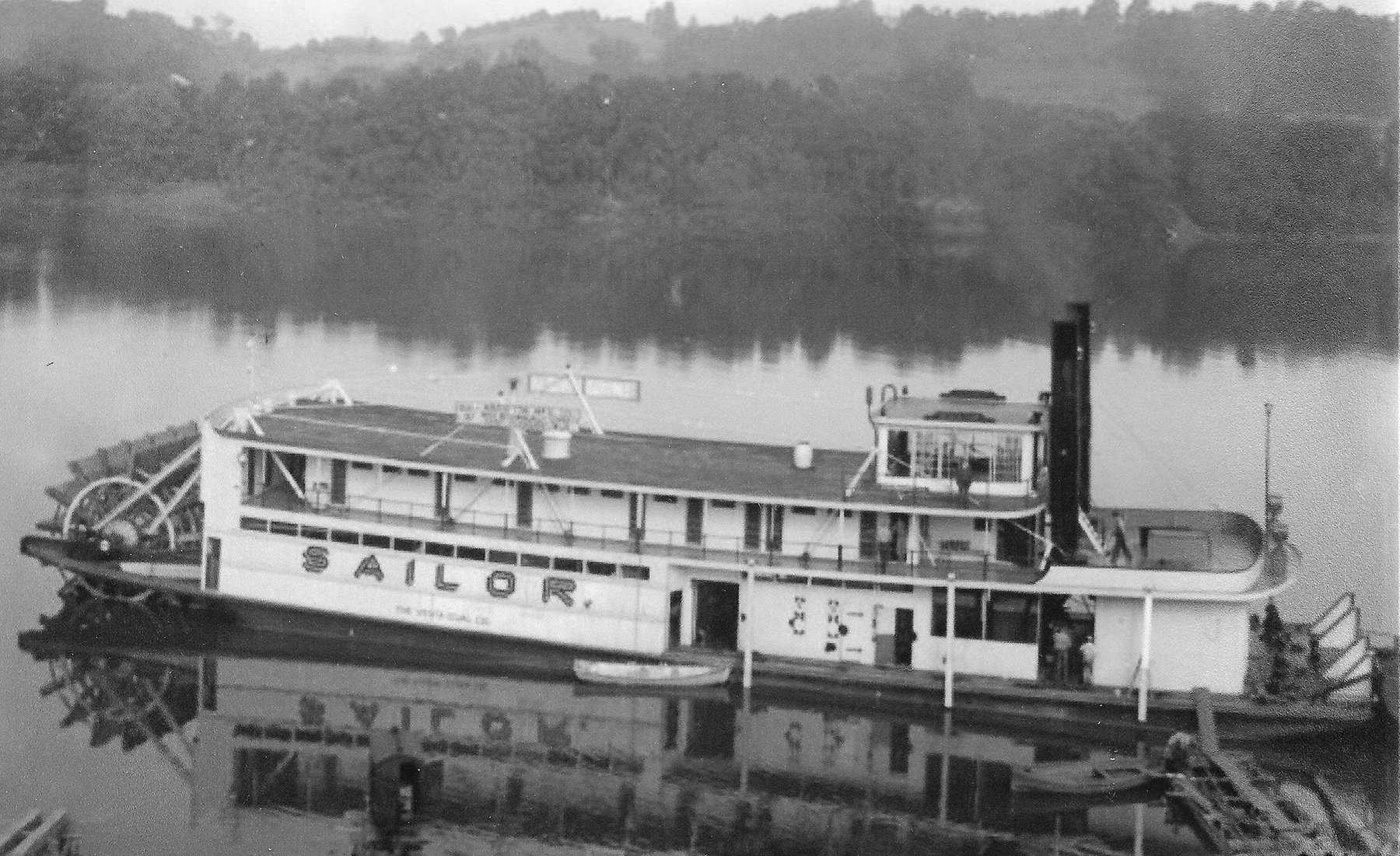
In 1924, the Marietta Manufacturing Company, Point Pleasant, W.Va., delivered a new towboat to J&L. This boat was sternwheel with a steel hull that was 133 by 36 feet. It had condensing engines that were 16’s, 32’s with an 8-foot stroke. While Way’s directory said that it had four boilers, the Inland River Record would always show it with “five return flue boilers.” The boat burned coal and was rated at 850 hp. In honor of the recently dismantled boat, the new craft was named Sailor.
The new Sailor was feted at the time it came out as being the “little Sprague” of the Monongahela River. On that stream, it was said to have the biggest paddlewheel, biggest pilothouse, biggest engineroom and more power than other boats of the Pittsburgh pools. Capt. James A. Rankin came out as master of the new boat and stayed as such until he was promoted to assistant superintendent of the J&L fleet in 1927.
In 1930, J&L welcomed two new steam sternwheelers to its fleet. These were the Titan and Wm. Larimer Jones, built by the Howard yards at Jeffersonville, Ind. These two boats had the physical appearance of being larger than the Sailor, but in fact were slightly narrower and had smaller engines that were 14’s, 28’s – 8-foot stroke rated 700 hp. In 1931, two modern steam propeller towboats were built by Ward at Charleston, the 7,500 hp. Henry A. Laughlin and Vesta (last two vessels built at that yard) and were delivered to J&L. The Sailor remained the most powerful J&L boat.
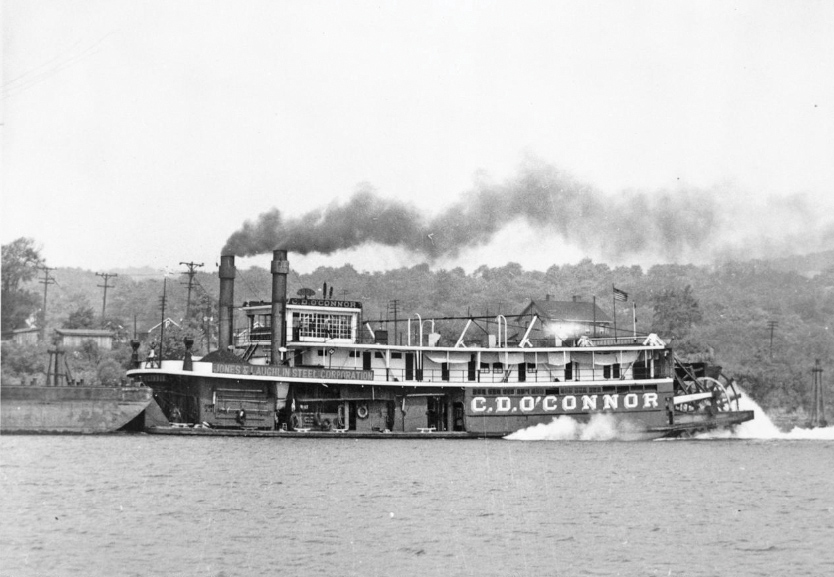
In 1942, the Sailor was placed on the J&L marine ways at Floreffe, Pa., for considerable hull replacement. In the winter of 1950-51, it was again at the Floreffe facility for an extensive rebuilding. When it reentered service in January 1951, it carried the name C.D. O’Connor to honor the former master of river transportation for J&L.
The September 6, 1952, issue of the WJ stated in the Pittsburgh Notes column by J. Mack Gamble that Mon Valley residents had been curious recently after seeing the C.D. O’Connor being towed upstream stern-first by the J&L steamer Wm. Larimer Jones. It was noted that the O’Connor was being taken to Floreffe for repair after suffering damage to a wheel timber. While not mentioned in this article, Way’s Directory elaborates that the boat had been in a collision with the OBL Expediter while “dragging” or dredging the landing at Rutherglen Street above Pittsburgh.
The Pittsburgh column of the WJ for September 13, 1952, said that the J&L diesel prop towboat Trojan “has been equipped with the radar formerly on the steamer C.D. O’Connor.” The same column in the September 20 issue said that the steamer Warren Elsey had been repainted at Floreffe and “will replace the C.D. O’Connor, which is out of commission because of a damaged cylinder beam, the injury to which happened when the boat was scraping out the Rutherglen Street landing.”
The point of this, and as Capt. Fred Way was known to say, “pointed like a period,” is that the O’Connor never ran again. This was probably due in large part to the fact that J&L had three new 1,400 hp. diesel prop boats under construction at St. Louis Ship, the first of which was due out in November.
There would be one more towboat in the Pittsburgh area named Sailor in years to come, this one diesel and with no connection to J&L, but that will be a column for another day.
Featured photo caption: The Sailor new at the Marietta Manufacturing Company in 1924. (Photo courtesy of the Capt. Bill Judd collection)