

Making The Old New Again: Verret Rebranding Honors Legacy
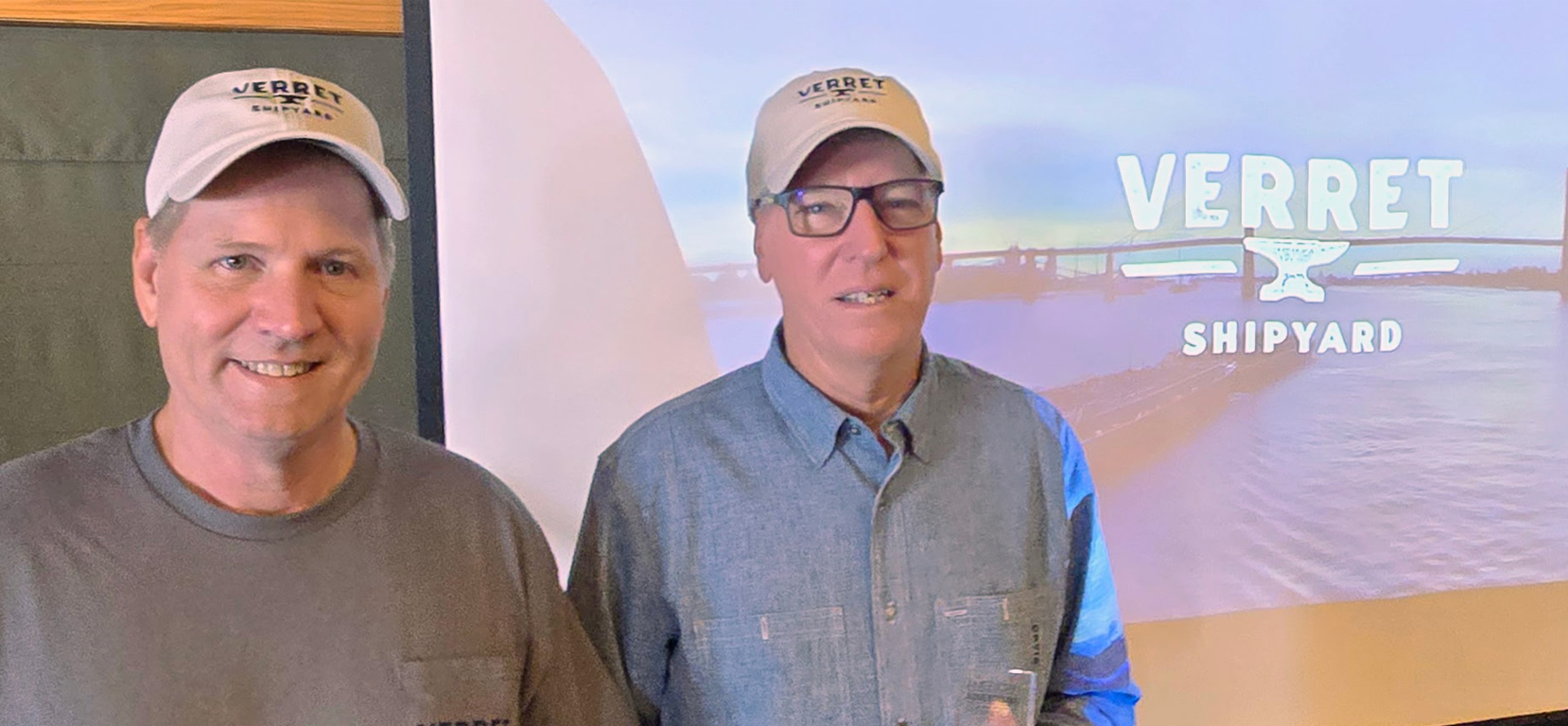
Ted Verret, the third-generation owner-operator of Verret Shipyard in Plaquemine, La., on the Morgan City to Port Allen cutoff, seemed excited about the turnout. Even on a rainy Friday, the meeting room at the Woodson Camp down the street from the shipyard filled up, as did space with tables under the temporary tent outside. The invitation was simple: “Join us for a lunch and a launch. This time it’s a brand, not a boat!” As the hundred or so employees, contractors, clients and vendors gathered around to hear Verret welcome them, it was obvious he and his team have done something special here along the waterway at Mile 42, Port Allen route.
The shipyard has a well-trained crew of employees and contractors totaling about 80. Verret’s work is steady, so much so that he has enlisted the help of three additional yards to handle some of the overflow. Verret had a large drydock built to increase repair work, and new construction keeps the available space in his main yard full almost year-round.
Verret Shipyard enjoys a well-deserved industry-wide reputation for building strong and well-finished towboats and for providing excellent service to their customers, for both new construction and repair jobs. People who know Verret see him as a country boy with an old-school mentality for quality, responsibility and a strong faith in God’s providence over his company. It’s not uncommon for his team to receive or even create vessel plans by hand before turning them over to a marine architect for rendering to AutoCAD. They pray before meals, support each other in tough times and celebrate one another’s achievements in the yard and in their personal lives. It’s that hands-on, eyes-on, personal touch and family atmosphere that has been the Verret difference for more than 80 years.
Moving that reputation and difference into the future is his next challenge, so Verret enlisted the help of David Day, owner of the Baton Rouge-based marketing firm The Day Group, to help with what came to be called a rebrand. A new logo, website and brand video was developed to provide a new look for Verret Shipyard’s public image, and each was on display in the Woodson Camp that day. The video even won its category in the American Advertising Awards. Since many of his team are of Hispanic descent, Verret played the video a second time with dialogue captions displayed in Spanish. More than 20 employees stayed for the second playing before heading outside for the barbecue and returning to work.
WWII Blacksmith Beginnings
The beginnings of Verret Shipyard date to World War II. Since much of the nation’s economy focused on the war, locals who needed parts for their farm equipment turned to Verret’s grandfather, CP Verret.
The elder Verret was an accomplished blacksmith and machinist and, using an old anvil, could fashion repair parts that were not available on the open market. CP Verret would later move to the oil field as a gauger and welder. Soon he returned to the current location of Verret Shipyard to operate a Gulf Oil distributorship alongside a blacksmith and welding shop.
As the oil industry grew, Verret Shipyard began building steel deck barges that were towed with wooden tugboats. By the late 1950s, Verret Shipyard was in operation, eventually building steel towboats.
In the process of creating the new logo, Day picked up on the anvil’s significance, and he and his design team chose the anvil as the symbol for the rebranding. The Verret team loved it.
“We want to show that we acknowledge and honor our past, but we’re prepared for the future,” Vice President Patrick Ledet said. “We think this image does just that.”
T-shirts and ball caps with the anvil graphics and Verret logo were handed out in recognition of the event.
Verret said that in the Plaquemine area south of Baton Rouge, there is a wealth of skilled workers whom he employs, some second generation, some with 30 years with the company. He supplements them with documented skilled sub-contractors from all over the world.
“When these sub-contractors identify as part of the Verret Shipyard family, they take pride in their work,” Verret said, adding, “It shows up in the finished product.”
For years, most of the Verret new-build yard was occupied with high-quality boats built almost exclusively for Blessey Marine Services. But as the company grew, it diversified its client base and has survived downturns, shortages, droughts, politics, competition and every other challenge that has come its way. The company now works with clients from its own back yard to those from around the world.
As Verret Shipyard grew, John Wayne Businelle of Pelican Shipyard, just a mile or so down the road, graciously offered the help of his facility to assist Verret in handling its overflow. The Verret family has had a strong relationship with the Businelle family for generations.
Verret also has developed a strong working relationship with Spartan Marine in Fort Smith, Ark., on the Arkansas River. It was there that the shallow draft drydock was built, with an inside measurement of 160 by 74 feet. It was later towed to Plaquemine.
And then there is Rodriguez Shipbuilding Inc. in Coden, Ala. That company assists Verret with building components for new construction. According to Verret, it’s partners like these and many others that have contributed to the success of Verret for decades.
“Well, I’ve finished my politicking,” Verret said with a smile. “Now, I’m going to finish my lunch.” As the final guests were filing out, Verret sat down at the long cypress table to finish his box of barbecue brisket, potatoes au gratin and baked beans. It was obvious he builds more than boats and barges. He’s building lives and livelihoods.
“It’s my life,” he said. “I got a wheel to pull from a boat that was supposed to be here at 7 a.m. but got held up by the locks. That job should have been done before lunch.”
Throughout the entire event, Verret still had on his blue work shirt, which he says he’ll never give up.
For more information about Verret Shipyard, visit VerretShipyard.com.