
Corps Of Engineers Targets Accelerated Project Delivery
Saying the Corps of Engineers is “pivoting hard toward delivery,” Maj. Gen. Jason E. Kelly spoke about how to increase efficiency in designing and constructing inland waterway projects.
Kelly, the Corps’ deputy commanding general for civil works and emergency operations, was one of the first speakers September 2 at the Inland Rivers, Ports and Terminals (IRPT) annual conference in Kansas City, Mo.
The conference took place September 1–4, with the theme of “Navigating What’s Next.”
Among his major announcements, Kelly noted that the Corps is moving forward with the reestablishment of the Inland Waterways Users Board and that he expects that to take place, he thinks, by January. The board, which includes industry advisers that prioritize inland waterways construction and major rehabilitation projects, has not met for two years. It was paused, along with several other federal citizens advisory boards, when President Donald Trump took office, as has previously taken place during a change of presidential administrations.
“I hope to have an interim engagement with industry before we establish it,” Kelly said.
He spent most of his remarks talking about the steps the Corps has taken over the past year to improve project management and engineering.
“If we are truly going to prioritize building infrastructure, not paperwork, the Army Corps of Engineers has to change the way it does business,” he said. “We’re making fundamental changes to create a more standardized, efficient approach to our inland waterways construction program. We want to improve execution, and we’re setting some hard targets to get there.”
Among those changes, he said, is how the Corps handles project design maturity.
“For too long, we’ve found ourselves in a cycle of starting construction before the blueprints are truly finished,” he said. “That inevitably leads to delays, cost overruns and rework. That stops now.”
New baseline rules require 35 percent design maturity during the feasibility phase to establish the basis of design, 100 percent of the design complete prior to the start of construction and the design work starting three to four years before construction begins, he said.
He later clarified that establishing the basis of design will include understanding the real estate that will be required, utility needs, geotechnical analysis and risk management, “and as a result, we’ll render better cost estimates,” he said.
“Measure twice, cut once,” Kelly said. “It’s a simple concept, but enforcing it will save us from the rework that has historically bogged down our delivery timelines.”
The Corps plans on constructing two major projects at a time and to complete that work within an eight-year window.
“We’re not interested in dragging projects out over multiple decades,” Kelly said. “We want to get in, get it built and get it operational for industry.”
The Corps’ Inland Navigation Design Center will be the designer of record for critical new inland construction projects, Kelly said, adding, “They are the gold standard.”
“But we’re also revisiting our entire inland program delivery model to ensure absolute clarity on governance through the entire lifecycle of a project,” he said. “We’re currently looking at courses of action that will fully integrate USACE headquarters into the program management of the planning, design and construction phases. We’re breaking down the silos across our directorates so that we’re operating as one aligned vertical team. We’re also making sure that our funding strategies align with our operational realities. Our priority projects are laid out in our Capital Investment Strategy. This gives us a baseline scenario for funding over the course of the next 20 years.”
He described the Corps’ Inland Program Plan as a tactical playbook that is updated constantly to reflect “the reality on the ground,” including changes in appropriations, Inland Waterways Trust Fund revenue, Water Resources Development Act (WRDA) legislation, updated total project costs and contractor performance.
“This playbook gives our divisions and districts the real-time guidance they need to keep projects moving forward,” he said.
That plan is already showing results, he said, noting that the design of the 1,200-foot lock chamber at Upper Mississippi Lock and Dam 25, a centerpiece of the Navigation and Ecosystem Sustainability Program (NESP), was designed to completion in June.
The Corps must also minimize lifecycle costs for operations and maintenance, he said.
“We are currently at a critical inflection point on the rivers,” Kelly said. “Many of our hydraulic steel structures are reaching the end of their design life.”
The use of innovative materials, including fiber-reinforced polymer, or FRP, can help, he said. While initial construction costs are similar to steel, FRP has a faster fabrication timeline and is more durable in a marine environment, he said.
“We’re also at the beginning stages of implementing resilient lock and dam operations,” Kelly said. “By modernizing our controls, we’ll have the capability to operate several facilities efficiently from a control tower.”
Remote operations will enable centralized, coordinated lock operations, reducing delays, strengthen safety through advanced monitoring and real-time decision support and provide a practical solution to ongoing workforce challenges, he said.
“Ultimately, investing in these technologies supports a more integrated, responsive and sustainable waterway system,” Kelly said.
He closed by stressing the importance of collaboration.
“The Army Corps of Engineers delivers the navigation mission, but we only succeed by collaborating with our federal, state and local partners, and most importantly, with stakeholders like the people in this room,” he said.
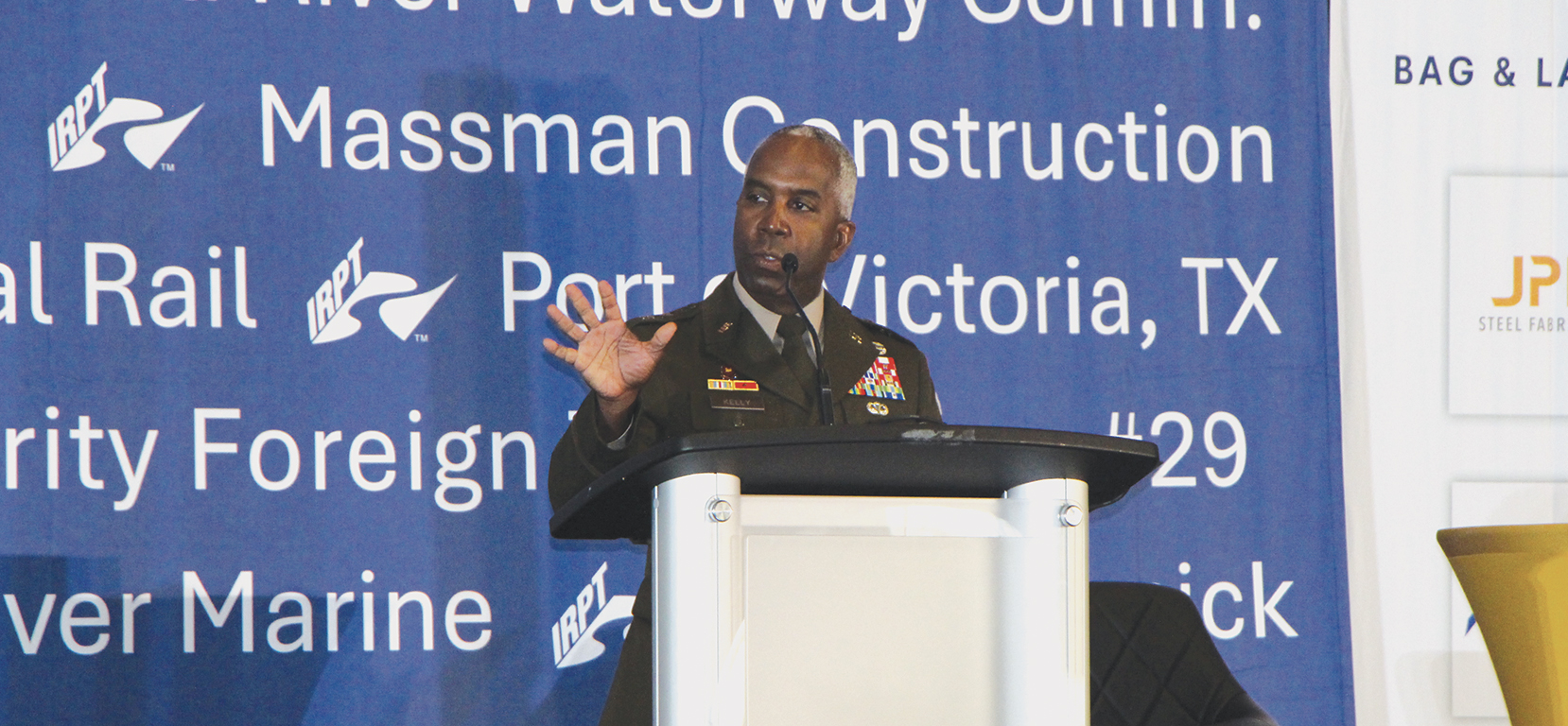
Featured photo caption: Maj. Gen. Jason E. Kelly addresses the Inland Rivers, Ports and Terminals annual conference September 2 in Kansas City, Mo. (Photo by Nelson Spencer, Jr.)