

Curtin Maritime Advances Electric Harbor Tug Program
For George Miller, the path into harbor towing did not run through a wheelhouse or a shipyard. The ZE program lead at Curtin Maritime came aboard only four weeks ago after building an alcohol distribution company from the ground up, working as a portfolio manager and trader at a private firm and starting out in his family’s commercial laundry in Las Vegas, Nev. What sold him on the Long Beach, Calif., operator was not a traditional career ladder — it was the boats.
“This is not only a cool company, but the whole idea of the electric tugboats is just a great idea,” Miller said. “So that’s what drew me in.”
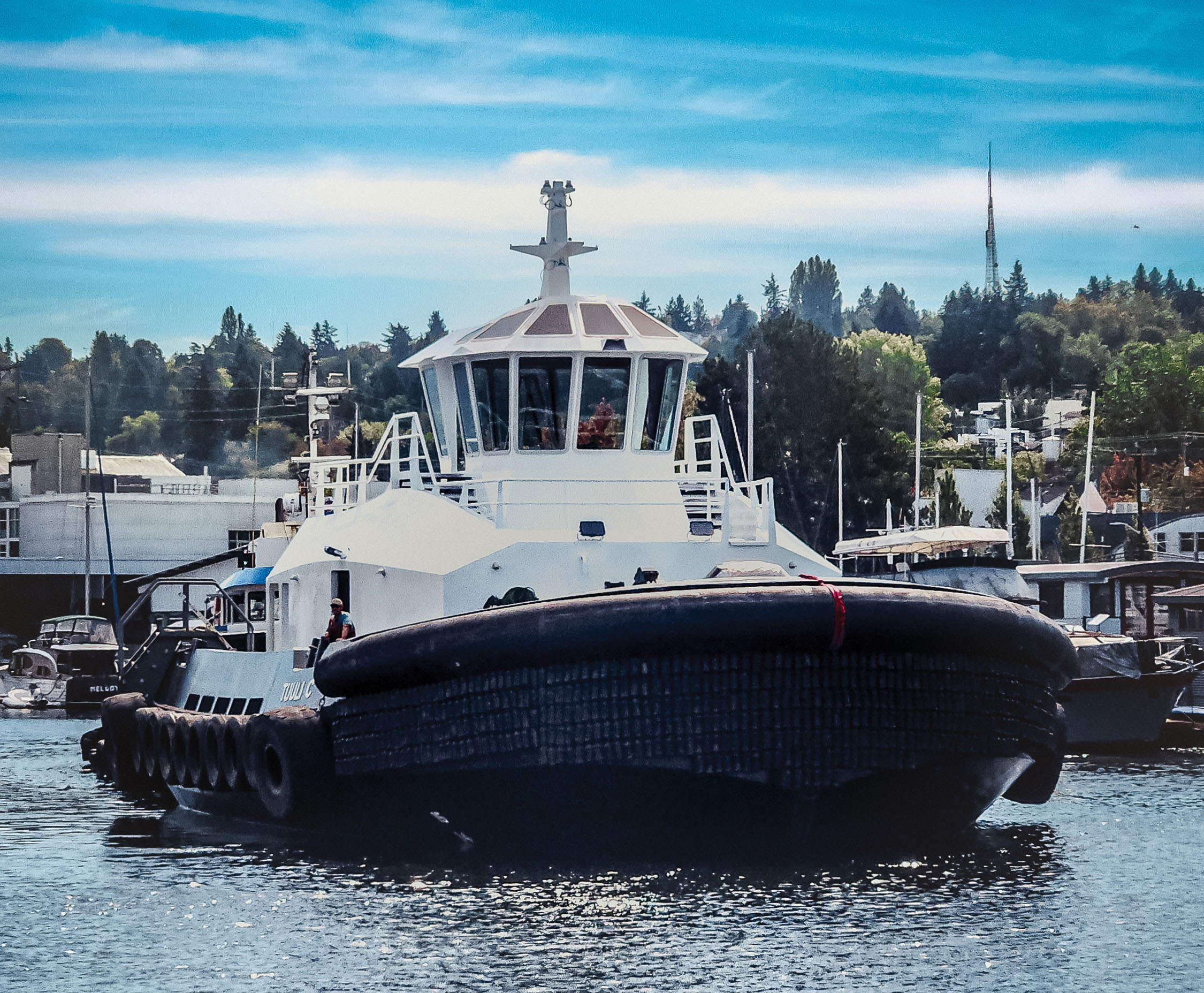
That idea is now moving from the building hall into open water. In an interview with The Waterways Journal, Miller walked through the program as Curtin Maritime’s first battery-electric ship-assist tug, the mv. Tuuli C, enters sea trials this fall at Snow & Company. The Seattle, Wash., based shipyard is building an eight-vessel zero-emission harbor tug fleet for the Ports of Los Angeles and Long Beach. Curtin has committed about $200 million to the boats and charging setup. Trade coverage has separately put an Arc contract for the eight-tug power packages at about $160 million. The first boat is due in California at the end of the year.
Partners, Design And The First Hull
Curtin, founded in 1997 by Capt. Martin Curtin, frames the tug program as the next step in a corporate-wide cleaner-technology push that already includes hybrid-electric clamshell dredges DB Avalon and DB Catalina and the fully electric dredge tender the mv. Isla C. Those dredges, which can plug in for zero-emission work at the dock, gave the company a head start on battery-electric equipment before it ordered a full class of harbor tugs. Curtin’s pitch is that ship-assist work, with its short, intense pulls and predictable harbor days, suits a battery boat better than a long river haul would. Curtin holds a 50 percent ownership stake in the Snow & Company shipyard, a stake the company says helps keep construction and delivery on track.
Los Angeles-based Arc is supplying the batteries and electric drive package. Miller called Arc the “technology nerve center” for the program. Snow’s naval architecture team, led by Jay Edgar, designed the tug with Curtin’s operating input and Arc handling the electric systems. Motive Energy is designing and building the charging infrastructure. Propulsion is Schottel azimuth drives: the mv. Tuuli C is an ASD tractor tug with two 2,000 hp. Schottel units, more than 4,000 hp. and about 55 short tons of bollard pull.
The tug measures 80 feet, 9 inches by 42 feet, 3 inches and carries a 6 megawatt-hour battery bank. Miller said the battery room looks “like a server room,” with rows of packs on racks lowered into the hull and wired in below. If a couple of packs fail, crews can swap them out so the boat is not left with diminished power.
“What’s interesting about that, too, is if you lose a battery, you can hot swap it out,” Miller said.
The company launched the mv. Tuuli C on May 5. The second 55-ton hull launched August 18, with sea trials for that vessel targeted for early 2027. Larger classes follow later in the build sequence.
Harbor assist, Miller argued, is a good fit for batteries in a way long-haul work is not. He has driven an electric car for three years. It is fine for around town and daily driving, he said, but not the best choice for long trips. Diesel is not going away for line-haul vessels that need range. Around ports, though, a full shift on a charge is a workable solution.
“Once it’s in practice, once people get a chance to really utilize it, they’ll see the benefits,” Miller said.
A Floating Gas Station
Harbor assist work is only as reliable as the charging behind it. Curtin is working with Motive Energy on a barge-based charging platform rather than waiting for fixed shore infrastructure at every berth. Miller likened it to “pretty much like a floating gas station,” able to charge up to four boats and utilize its own on-board power generation through clean fuel generators. This creates autonomy from the grid as well as not applying additional stress to the port’s existing energy needs.
Curtin and Motive materials describe a barge with a large onboard battery buffer and four high-power fast chargers. A Port of Long Beach site is being finalized, with fast charging targeted for early to mid-2027. Existing shore power can support overnight charging when the first boats arrive. The tugs are rated for about a 12-hour working day on a charge, Miller said, matching a typical harbor shift with room to spare.
The boats will not send power back to the grid or other loads. That would have required different certifications, Miller said.
On the water, he sees a simple case: no exhaust at the point of use, less maintenance without diesel engines and their fluids and steady power for hard ship-assist jobs with Z-drives.
“I can’t see any negatives,” he said. Instant torque and azimuthing drives, he added, should help on tough moves where a conventional diesel has to work up to the load.
Training Built Around Energy, Not Fuel
Ship-handling may be the least of the learning curve. Drawing on Josh Ellis’s outline of how Curtin is building the training program, Miller summed it up in one line: “Less than people expect on the ship-handling side, and more than people expect everywhere else.”
Because the mv. Tuuli C is an ASD tractor tug with Schottel azimuth drives, a master who can run a Z-drive can run the boat, and Los Angeles and Long Beach assist work uses the same pilot commands. What is new, Miller said, sits around the edges of the job.
Curtin has written a deck officer manual specific to how the mv. Tuuli C is run, rather than a generic electric-boat primer. Crews also get formal high-voltage and battery safety training, a real change for a harbor tug that carries a high-voltage system. Energy management replaces fuel management. The master watches state of charge, and no job starts without enough power for the expected work plus reserve. Charging becomes part of the routine. Firefighting is different, too. The mv. Tuuli C is the only vessel in Curtin’s fleet with a Marioff HI-FOG water mist system. A lithium battery fire does not behave like an engineroom fire, so that gets its own training.
Arc trains crews on the propulsion and battery systems. Schottel covers the drives.
Engineers see the biggest shift. Isolating equipment for maintenance means isolating four separate sources rather than throwing one breaker, which Miller said Ellis called “the single thing we are most deliberate about.” With no main engines, there is far less traditional wrench work and far fewer oil changes. In their place comes condition monitoring and data, from vibration trends and drive oil analysis to thermal scans. More of the job is watching numbers that only mean something as a trend and less turning wrenches on a schedule. The battery system has its own gas detection, and the drives can send condition data to the manufacturer for remote review.
Port captains need training as well, though not to operate the boats. Dispatch changes as energy planning replaces fuel planning. Charging becomes a scheduling constraint rather than idle time, so time on the charger must be planned like any other productive window.
Three Classes And A Crowded Calendar
Curtin is building the fleet in classes. The first boats are rated at about 55 tons of bollard pull. A 70-ton class is targeted for mid to late 2027, and a 100-ton class is expected in 2028. Miller said of the 100-ton class that it “probably gives us the most flexibility” and will outperform what a diesel assist tug can do on the heavier jobs. The vessels are also designed so they can take hydrogen fuel cells later if that technology matures.
Curtin’s materials put California arrival for the first hull in December with a target of four tugs in service by early 2028 and all eight by late 2029. Hulls three and four are shown as 70-ton boats launching in 2027 with later hulls starting construction in mid to late 2027.
The market timing is not accidental, Miller said. The San Pedro Bay ports face a zero-emission harbor craft push toward 2030. Air quality managers are pressing the issue, and organizers want cleaner port operations in view for the 2028 Olympics. On the ESG side, he said large shipping companies already advertise emissions goals, yet harbor assist is “another piece in the chain” that often gets overlooked. “Why not?” he asked.
Before that calendar fills in, Curtin wants industry guests on the dock. The company will host media, dignitaries and stakeholders at its Long Beach base on January 12, 2027, to see the mv. Tuuli C after sea trials and the boat’s move south.
“We’re first movers, but we’re also coming in at the right time,” Miller said.
Featured photo caption: The mv. Tuuli C, Curtin Maritime’s first battery-electric ship-assist tug, on the water in Seattle, Wash., where the boat is in sea trials at Snow & Co. The ASD tractor tug is the first of an eight-vessel zero-emission fleet for the Ports of Los Angeles and Long Beach. (Photo courtesy of Curtin Maritime)