

Another Seemingly Timeless ‘Old Boat’
The Vacuum Oil Company was founded in Rochester, N.Y., in 1866. Standard Oil purchased the company in 1879. By 1904, it began using “Mobiloil” as a brand name for automobile lubricating oil. Then, when Standard Oil was broken up in 1911 due to the Sherman Antitrust Act, Vacuum became an independent company again, that is, until it merged with Standard Oil of New York in 1931. The merger resulted in the Socony-Vacuum Corporation, then the nation’s third largest oil company.
In 1937, the company built its first river towboat, the 1,020 hp. Kansas City Socony. (See The Waterways Journal, September 18, 2023.) This was followed in 1938 by the 1,200 hp. St. Louis Socony (WJ, March 18, 2024) and the 1,500 hp. St. Paul Socony in 1940 (WJ, February 5, 2024). These boats stood out, painted a bright red with a large figure of the winged horse Pegasus, the company logo, on top of the pilothouse and a large white “S” on each side of the black stack.
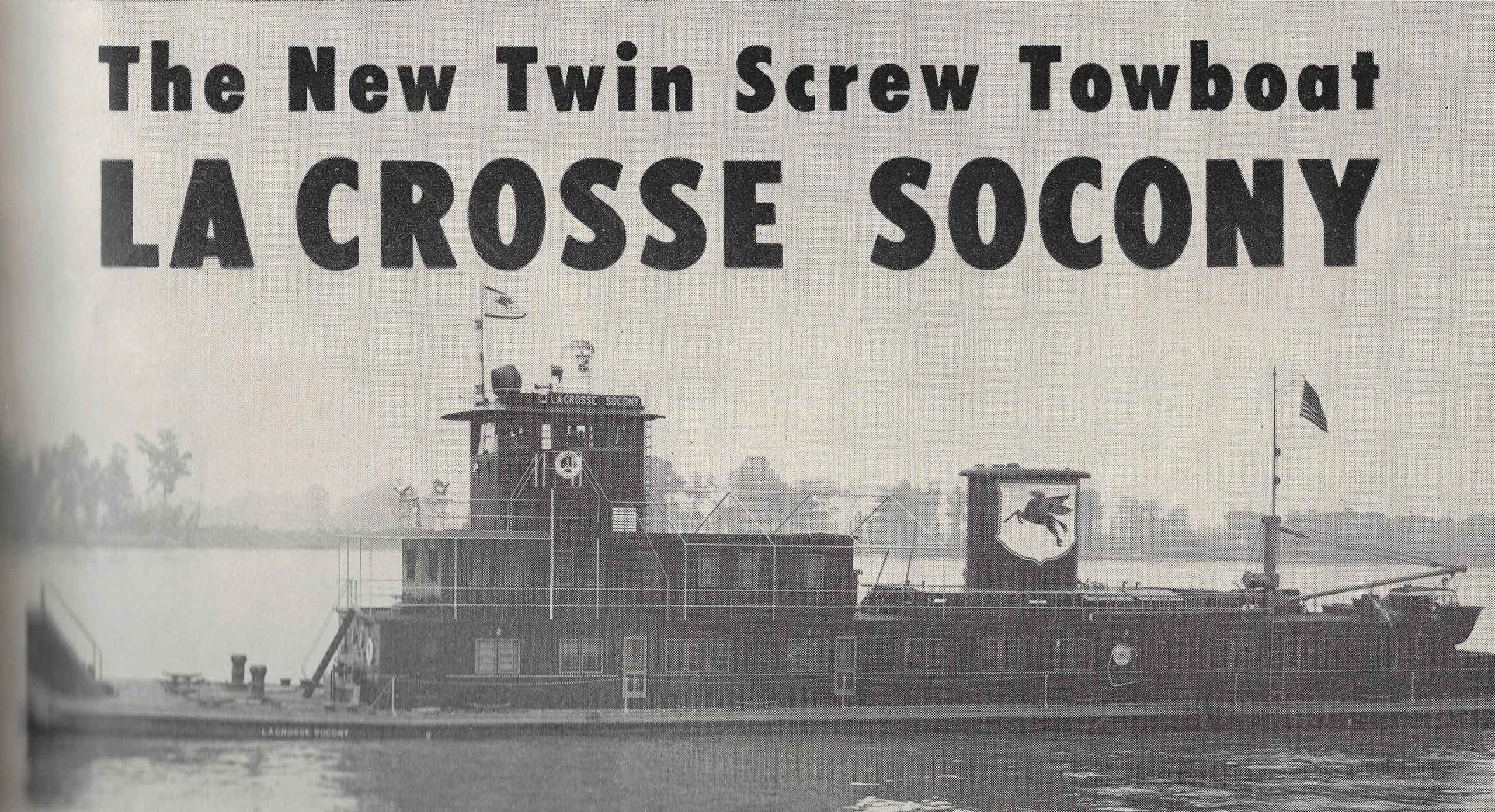
In 1951, Socony took delivery of what would be the largest and last boat to carry the Socony name. St. Louis Shipbuilding & Steel Company built the vessel, which had a hull that measured 156 feet by 35 feet and was twin screw. The June 23, 1951, issue of The Waterways Journal had a photo of the new vessel on the front cover incorporated into a St. Louis Ship ad. A feature story appeared on page nine.
The story said that the boat was christened the La Crosse Socony in a ceremony at St. Louis on June 6, 1951, with Mrs. H.T. Ashton, wife of Socony’s central region marketing manager, serving as the vessel sponsor. The boat, described as “one of the most powerful and modern towboats on the rivers today,” boasted 3,200 hp., provided by a pair of GM (Cleveland) 16-278A engines coupled to Falk gears. The four-bladed propellers measured 102 inches in diameter and turned within kort nozzles, and the rudders were of the patented St. Louis Ship “Contraguide” design.
The La Crosse Socony was built according to “St. Louis Ship standard rugged construction with heavy hull plating,” the article stated, and the bow was “of the modified scow type.” The bow or work deck of the boat was longer than normal, followed by a full lower cabin. There was a smaller upper cabin and a raised pilothouse on top of that.
A large single stack was located behind the upper cabin, atypical of the usual practice of St. Louis Ship-designed boats having twin stacks. It has been said that a single stack was placed to afford pilots a better view astern while transiting narrow bridges. The boat was dressed in the standard Socony red color, and the Pegasus, while still present, appeared on a shield adorning each side of the black stack.
The new boat had accommodations for two cooks as well as 17 other crew members, plus a guest room. The vessel was formally delivered to Socony at Cairo, Ill., on June 18. It went to work with Capt. Louis B. Nyhammer, who had been with Socony since at least 1938, as master. The original Socony boat, the Kansas City Socony, was sold soon thereafter.
In 1955, the company name changed to Socony Mobil Oil Company. The boat was renamed Mobil La Crosse in 1961, and the company became Mobil Oil Corporation in 1966. The bulkhead color changed over the years from red to light blue, but the Pegasus logo remained.
In 1985, the boat was sold to G&C Towing Inc., Point Pleasant, W.Va., and renamed Capt. Charles H. Stone. Capt. Charles Henry Stone was a well-known Kanawha and upper Ohio riverman, a noted historian and a driving force behind the Point Pleasant River Museum. In 1990, the vessel was sold to Kanawha River Towing Inc., also of Point Pleasant.
The Inland River Record notes the vessel was repowered in 1991 with GM 16-645E2 engines totaling 3,950 hp. This repower was done over time, with first one engine replaced and then the other. The boat had a distinctive sound with one 278A and one 645. The 645 engine was sourced from the recently dismantled Warren.
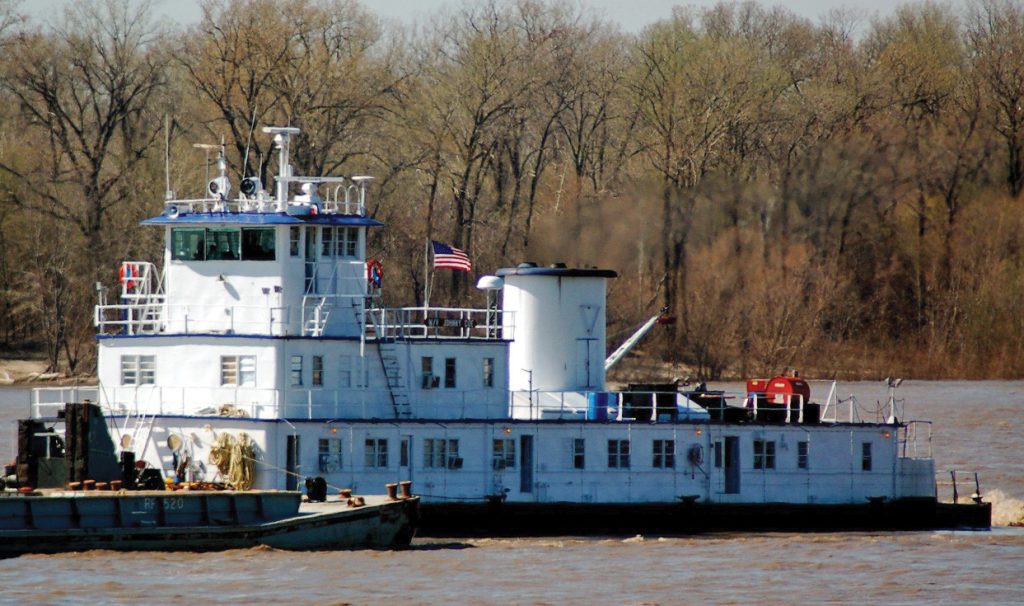
In 2002, it was transferred to Campbell Transportation Company, Charleroi, Pa. It was sold in February 2006 to First Marine Corporation, Benton, Ky., and then in May 2006 to Ozark Transportation Company. Under that ownership, it was renamed Capt. Johnny Coe. Western Rivers Boat Management, Paducah, Ky., operates it now.
The boat is still at work today, and its appearance belies the 74 years it has been in operation. The WJ article from June 1951 described the boat as a “very good looker” that “should prove to be a very good worker.” The continued operation of the mv. Capt. Johnny Coe begs the question: Is any vessel truly an “old boat” if it is faithfully maintained over the years?
————
Featured photo caption: The new LaCrosse Socony in a St. Louis Ship advertisement that appeared in the July 7, 1951, issue of The Waterways Journal. (From the author’s collection)