
Early Freeze Puts Strain On River Ops
Winter has arrived early in parts of the Upper Mississippi, Illinois and Ohio river valleys, bringing snow and ice along with more low-water issues downriver.
“There’s a lot of sheet ice forming, and it’s forming fast,” said Terry Bass, captain committee chair of the Illinois River Carriers’ Association (IRCA).
Locks from Dresden Island south on the Illinois Waterway have been requiring ice couplings, he said. So far there have not been tow width restrictions due to ice buildup on lock walls.
.Bass is hoping a slight warming trend in the forecast becomes reality over the next few days and causes some snow and ice upriver to melt.
“We all know it’s Illinois,” he said. “It’s going to be cold from here to March, but that warmup would be nice. Just a few days. That may help give us a little bit of water from Dresden south.”
It is more typical for prolonged freezes to come in late December and January, Bass said. The early winter weather this year has meant the upper Mississippi is beginning to freeze, and snow and ice are forming in some parts of the upper Ohio Valley. Those conditions have coincided with the end of navigation flow support on the Missouri River and continued low-water levels on the Lower Mississippi.
“The no. 1 battle we’re fighting now, similar to last year, is the low river stages,” Bass said. “The water’s not moving, so the river freezes faster and freezes thicker, and there’s nothing to flush the ice out once it starts breaking.”
That could create the possibility for ice gorges, he said.
Bass emphasized that effective communication among the Corps of Engineers, the Coast Guard and industry stakeholders is essential. Because the system is interconnected, changes in one region can have significant impacts elsewhere, making cross-regional dialogue critical, he said.
An example Bass gave was that in mid-November, when the Mel Price Lock and Dam pool was dropped to help compensate for low water near the Mississippi’s confluence with the Ohio River in Cairo, Ill., it inadvertently caused multiple groundings in the lower reaches of the Illinois River, just upriver from the lock.
“Guys with 15-barge tows and 9 feet of draft were running aground,” he said before adding, “It seems to be better now.”
With so much precipitation locked up in snow and ice upriver, though, he said it will take time for pools upriver to refill.
Additionally, Bass said, at an IRCA meeting in November, forecasters said climate data suggests the possibility of an especially cold winter, which could exacerbate the problem.
The cold and ice also add stress to lock and dam infrastructure, much of which is already antiquated, he said. He noted that Marseilles Lock and Dam had an issue with a tow hauler briefly, while Starved Rock Lock and Dam had to repair a bubbler at the same time the first extended period of snow and ice hit. Both issues have now been resolved, but “It can become a headache pretty quick,” he said.
The Coast Guard reported some problem areas remained, including at Upper Mississippi Mile 14.9, where potential shoaling was reported. The navigation channel had been reduced to approximately 400 feet, according to a notice issued December 9.
“Mariners are advised to transit this area with extreme caution,” the Coast Guard said in the notice.
Lower Mississippi River Committee Chairman Donnie Williams said the ice upriver is contributing to an expected drop to 7 feet on the Ohio River at Cairo over the next several days. The low-water threshold on the Cairo gauge is 10.3 feet.
The Coast Guard, with the concurrence of LOMARC, has restricted drafts and tow sizes through Sector Ohio Valley and Sector Lower Mississippi as far south as Rosedale, Miss. (Mile 585.)
As of December 9, southbound traffic was restricted to a draft of 11 feet, 6 inches and no more than seven barges wide as far south as Rosedale. Williams said it was likely to be cut within the next few days to 11 feet of draft and no more than six barges wide.
South of Rosedale, it was expected to be decreased from 12 feet down to 11 feet, 6 inches and no more than six barges wide.
The draft for northbound traffic above Rosedale was a maximum of 10 feet, 6 inches, but Williams said that was expected to lower to 10 feet from Mile 303 (Old River) to Cairo. The four wide maximum width for loaded barges and a maximum of six barges wide for empties was expected to be maintained for that area.
Williams said that with a forecast calling for single-digit lows overnight in the Chicagoland area, “We’re experiencing wintertime a little sooner.”
Snow covered the ground there. “If it had been rain, we would be out of low water,” he said.
Winter Weather Precautions
Bass offered reminders for coping with wintry weather, adding that it was especially important for supervisors to make sure that those new to the industry understood the clothing, gear and best practices necessary to prevent frostbite.
“These guys from Texas have never seen below zero temps before, and now they’re going to work on it,” he said as an example.
He suggested a thermal base layer with warm clothing on top of it, including a winter hat, gloves, insulated overalls, thick or doubled socks and a thick, heavy jacket with a hood. A ski mask is especially helpful for protecting the face, he added.
“Don’t just go up there with a hoodie and think you’re going to be fine,” he said. “I’ve seen that happen.”
Additionally, he said that black ice can form on boats and barges just as it can on roads during the river, and that can cause a major risk for slips and falls. Crews should use a buddy system when out on barges and also bring a handheld radio, he said.
Finally, he said crews should come inside and warm up at regular intervals, as necessary.
The American Waterways Operators added additional cold weather operations recommendations it had received from member companies, including Magnolia Marine, American Commercial Barge Line, Northern Marine and McAllister Towing, along with organizations such as the National Oceanic and Atmospheric Association (NOAA) and National Safety Council. They broke them down into cautions for slips, trips and falls on frozen decks, barges and piers; falls overboard in cold conditions; hypothermia, frostbite and cold stress; cold effects on equipment creating secondary injury risk; driving to and from the vessel in winter; long-haul vessel travel into colder environments; and snow blindness.
Cautions and points of concern included the following:
• Freezing rain, sleet, snow, frost and condensation on steel create extreme slip hazards, with frost accumulating most heavily before sunrise and after dark on handrails, ladders, fittings, tow knees and barge gunnels.
• Crews must slow down, test footing before committing weight and clear walking surfaces as conditions allow. Pro-actively clearing snow and applying non-corrosive deck salt before work begins is recommended.
• Crews should maintain three points of contact when climbing, stepping across equipment or transitioning between vessels and tow. Ice spikes should be worn when conditions warrant to provide critical traction on frozen steel in towing operations. Ladders must be inspected for frost and ice before every use. Wet or frozen gloves compromise grip strength.
• Snow and icy conditions significantly increase the probability that a simple slip becomes a fall overboard. Such falls are immediately life-threatening due to cold water shock and rapid loss of muscle control. Winter water temperatures routinely fall into the mid-30s, leaving only minutes of functional survival time.
• Hypothermia symptoms include uncontrollable shivering, slurred speech, confusion, clumsiness, collapse and unconsciousness. Frostbite symptoms include numbness, prickling sensation, skin discoloration and loss of sensation in extremities. Risk factors include wind chill, low humidity, heavy labor, wet clothing and lack of recent cold exposure. Wet clothing and boots dramatically increase the risk of hypothermia and frostbite. Wind chill dramatically accelerates heat loss even at moderate ambient temperatures. Dehydration is also a winter hazard because cold suppresses thirst while fluid loss continues.
• Mooring lines become stiffer and heavier in cold weather, increasing handling strain and snap-back severity. Non-skid deck coatings lose effectiveness when ice forms. Frozen lines, radar ice and frozen deck equipment increase exposure time and fatigue.
• Travel should be delayed during winter storms, whenever possible. Vehicles must be winter-ready before crew changes, including tires, brakes, battery, antifreeze and washer fluid. Emergency vehicle kits should include traction aids, blankets, water, food, shovel, jumper cables and flashlight. Fatigue following long vessel watches significantly increases night-time winter driving risk. Cold temperatures degrade batteries, thicken oil, gel fuel and significantly extend startup and maintenance timeliness.
• Although ultraviolet light reflections from water can cause sunburn to the eyes, snow and ice can also reflect UV light, causing the same issues. Use sunglasses and a ballcap as needed to help guard the eyes from UV light reflection off different surfaces.
• Early and frequent communication regarding winter readiness, crew exposure limits and support resources is essential.
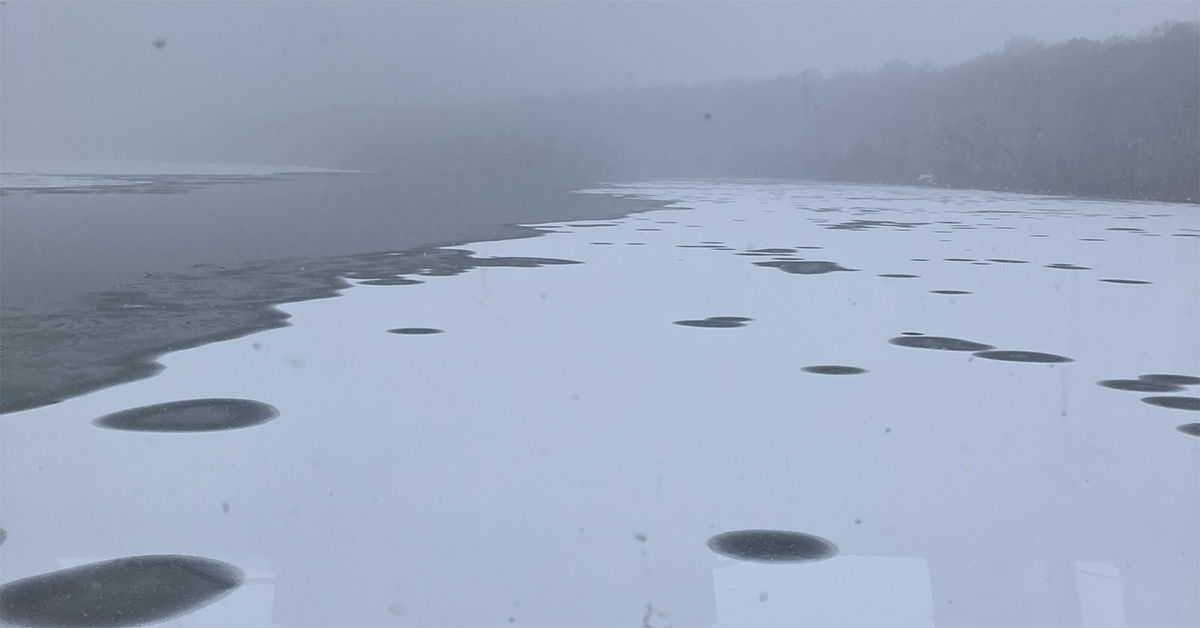
Featured image caption: Ice forms on the Illinois River on December 1 just above Dresden Island Lock, near the mouth of the Kankakee River. (Photo courtesy of the Illinois River Carriers’ Association)