Wing Marine Developing Modular Dredge Concept
A new modular dredging concept under development by Wing Marine could offer inland waterway operators and the U.S. Army Corps of Engineers a more flexible and less disruptive way to maintain navigation channels, ports, harbors and reservoirs.

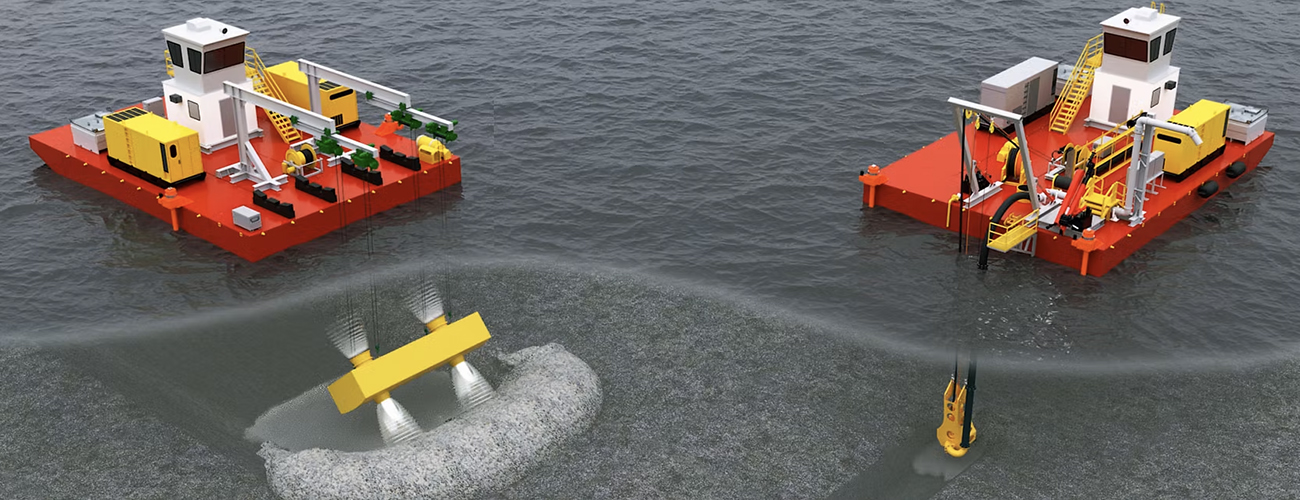
Led by Mel Friedman, CEO, and Peter Crossland, president, Wing Marine has spent years refining a system that combines a patented wing sediment-mobilization device with high-capacity pumping, all packaged into a modular dredge that can be shipped by truck, rail, barge or container ship and assembled quickly at the job site.
“Our focus has always been maintenance dredging rather than large-scale excavation of virgin material,” Friedman said. “The inland waterways are constantly filling with soft sediment that returns every few years. That’s where this system is most effective, and that’s where it can have the biggest impact.”
From Offshore Roots To Inland Focus
Both Friedman and Crossland bring decades of marine and offshore experience to the venture. Crossland’s career began with major dock expansion projects in the United Kingdom, followed by bridge and causeway design in Europe and the Middle East and power plants, refineries and offshore oil and gas work across multiple regions. Friedman, trained as an aeronautical engineer, moved into the energy sector in the 1970s and spent much of his career with Exxon on early North Sea developments. He later consulted on pipeline and platform projects in West Africa.
That background shaped Wing Marine’s approach. The original technology was developed to move sediment off pipelines and subsea structures without aggressive cutting or grinding. When the U.S. Army Corps of Engineers evaluated the concept more than two decades ago, the feedback was immediate: the system moved large volumes of sediment efficiently, but it needed an integrated way to remove and manage that material.
“That question really defined what came next,” Crossland said. “Moving sediment is only half the equation. What you do with it after extraction matters just as much.”
Modular Dredge, Built For Mobility

The result is a modular dredge system designed for flexibility and as a lower-cost alternative to traditional dredging. Major components can be transported on flatbed trucks, rail or barges, allowing the equipment to be deployed quickly to remote river reaches, shallow harbors or emergency sites. Once on location, the system can be assembled and operational in a matter of days.
At the heart of the concept is the wing device, which uses water energy to create a controlled rolling wave of sediment along the bottom. Instead of injecting sediment into the full water column, the material stays low and consolidated and is deposited at an extraction location, allowing a pump to remove it efficiently without creating turbidity issues.
“We’re often compared to water injection dredges, but the physics are different,” Friedman said. “We’re using water to create a sediment wave with momentum, not to disperse it. That distinction is critical, especially in rivers and reservoirs.”
Testing by the Corps has shown minimal entrainment into the upper water column, an important consideration for potable water reservoirs and environmentally sensitive areas. According to Crossland, this opens the door to applications well beyond traditional navigation channels and into reservoirs sometimes deemed too expensive to dredge.
Keeping Traffic Moving
One of the most significant advantages for inland waterways is the system’s ability to operate without shutting down traffic. With an operational footprint of roughly 40 feet in width, the dredge can work along channel edges or problem shoals while tow traffic continues to pass.
“On rivers like the Mississippi, downtime is incredibly costly,” Crossland said. “If you can maintain depth without closing the channel, you save time, fuel and money for everyone involved.”
The concept could be particularly relevant during low-water events, when the Corps is forced to deploy dredges almost continuously to maintain navigation. By positioning modular units at chronic trouble spots, maintenance dredging could become more proactive and less reactive.
Sediment As A Resource
Wing Marine has also built beneficial use into the system’s design philosophy. Rather than treating dredged material as waste, the company has explored options ranging from lightweight aggregate and brick manufacturing to shoreline nourishment and structural fill.
“Sediment management is becoming a systemwide issue,” Friedman said. “Sediment that doesn’t move downstream affects the stability of bridges and other riverside structures and starves deltas. Our system allows you to remove it where it’s a problem and reuse it where it’s needed.”
That approach aligns with evolving Corps priorities and could make the system attractive for projects with limited or costly disposal options.
Looking Ahead
Wing Marine is currently seeking funding to build its first operational units, with an estimated timeline of about 10 months from financing to deployment. The company intends to operate the systems directly rather than sell them as standalone products, though international partnerships and regional opportunities remain under consideration.
“We see ourselves as operators with a unique tool,” Crossland said. “Once the first units are in the water and proven at scale, we expect interest to follow.”
For inland waterways facing aging infrastructure, recurring shoaling and increasing pressure to minimize environmental impacts, the concept represents a potential shift in how maintenance dredging is approached.
“This isn’t about replacing the big cutterheads,” Friedman said. “It’s about giving the waterways a practical mobile solution to stay ahead of sediment before it becomes a crisis.”