
The Henry S. Sturgis Became A Notable Boat On Two Rivers
The recent ice on the Illinois River, as well as the annual Missouri River Navigators Meeting at Jefferson City, Mo., last week, brought the Henry S. Sturgis to mind. The history of the Ohio River Company has been detailed in this column several times over the past few years. The company has origins dating back to 1915, when A.C. Ingersoll Sr. delivered coal by horse and wagon in the Cincinnati area. This operation grew into the Philadelphia and Cleveland Coal Company, which chartered towboats and barges, then purchased its own towboat in 1923. After gaining new investors, the Ohio River Company (ORCO) was incorporated in West Virginia as a wholly owned subsidiary of West Virginia Coal and Coke Company on April 17, 1925. In 1937, ORCO secured some large contracts with Commonwealth Edison to supply coal to Chicago area power plants.
In 1938, ORCO purchased the 1,000 hp. diesel-powered, twin-screw towboat North Star (see The Waterways Journal, June 5, 2023) and converted it to Illinois River service by installing a retractable pilothouse to allow it to transit under low bridges. The North Star was the first diesel vessel to be owned by ORCO and the company’s first to have a retractable pilothouse. In 1941, ORCO took delivery of the new retractable W.W. Marting from St. Louis Ship (see WJ, September 12, 2025). The construction of this boat was the beginning of a long association between St. Louis Ship and ORCO.
The next vessel St. Louis Ship built for ORCO was delivered in 1943. It can only be assumed that since most shipyards had converted to building craft for the war effort that the coal deliveries to the Illinois River power plants were important enough to warrant allowing the new towboat to be constructed. This towboat was conventional, rather than a retractable as the W.W. Marting of 1941 had been. However, the superstructure was of a radical streamlined design much like the Sohioan (see WJ, June 30, 2025) built for Sohio Petroleum also in 1943.
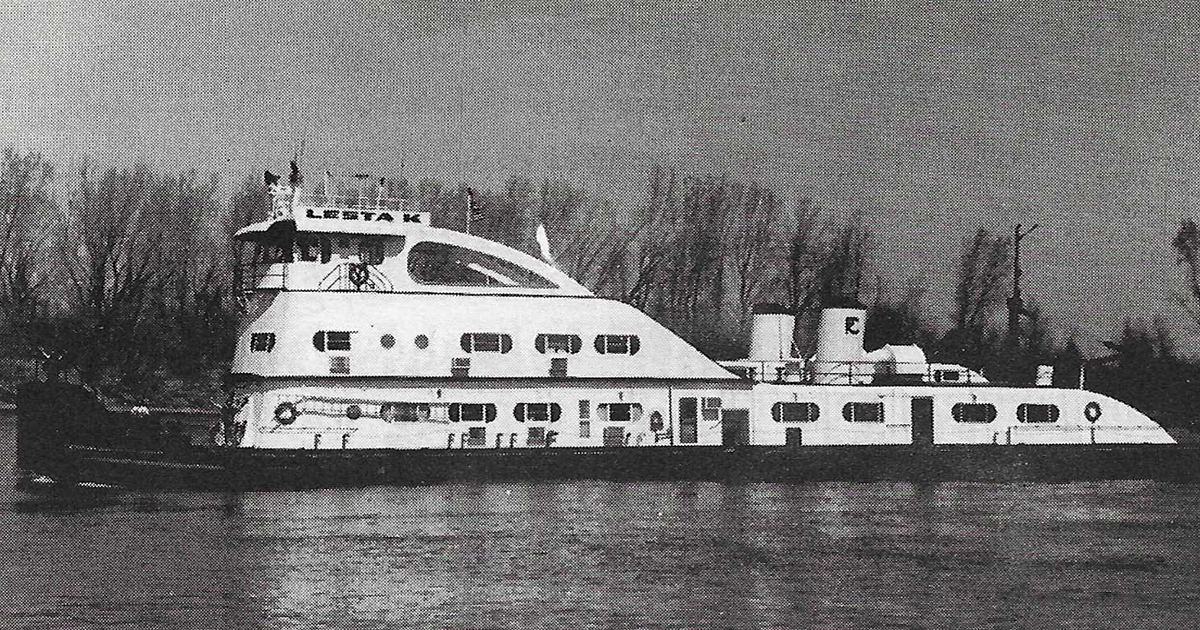
Unlike the triple screw Sohioan (which at 2,415 hp. was the most powerful on the rivers at the time), the new ORCO boat was twin screw. It had a hull that was 154 feet by 36 feet and was powered by two direct-drive Fairbanks-Morse engines that delivered 1,610 hp. at 275 rpm. The cabins on all three levels were rounded at the front, and the two stacks on the roof were slightly raked back. As with the Sohioan, the engines were located well aft to reduce the amount of shafting and reduce vibration.
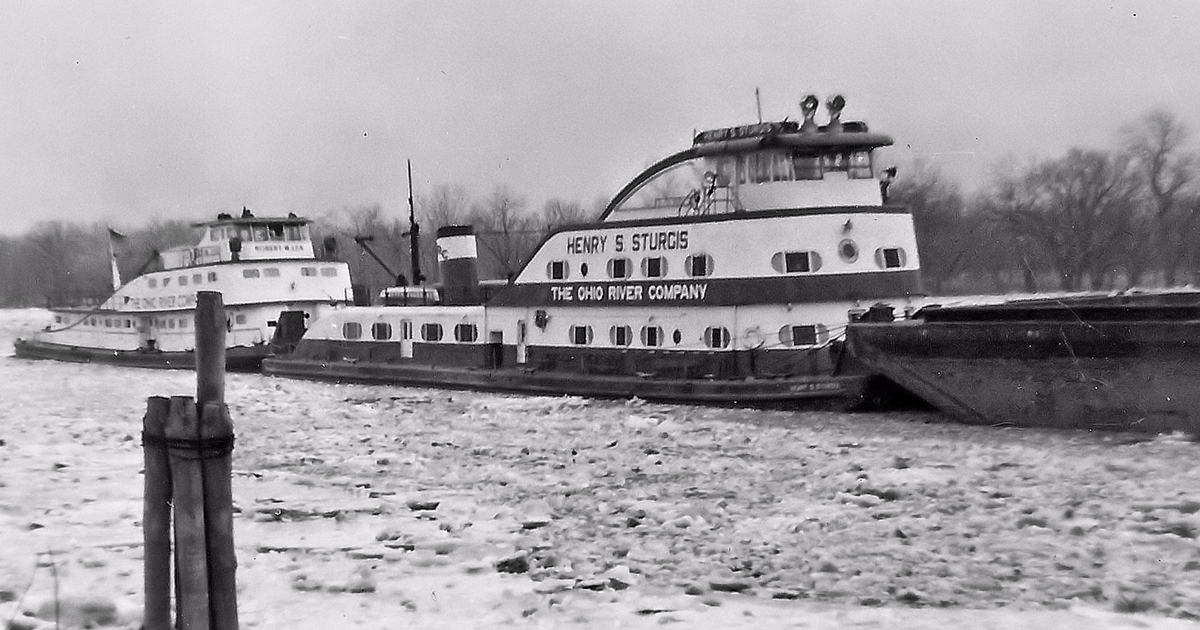
The boat was christened the Henry S. Sturgis and was painted in white with broad dark green stripes on the main and second cabin. The upper works were trimmed in the same green. The Henry S. Sturgis initially went into Illinois River service. The first photo with this column shows it engaged in working in the ice. The boat faced up to the stern is the Robert W. Lea (see WJ, November 10, 2025). This photo was probably taken soon after ORCO acquired the Lea in 1947. This is surmised by the fact that neither of the boats have a radar scanner evident, and radar became prevalent soon after 1947.
The Sturgis became a mainstay on the Illinois with occasional forays to the Ohio River. In 1959, it returned to St. Louis Ship, where kort nozzles were installed. In February 1966, it was sold to Econo-Flo Flour Service, Salina, Kan., and renamed Lesta K. In 1968, it again was sold, this time to Port City Towing Company, Greenville, Miss., and repowered with a pair of GM 16-567 engines and Falk 2.5:1 gears that produced 3,200 hp.
Port City ran the Lesta K on the Missouri River during the annual navigation season and then elsewhere in the off season. Due to the shallow, swift channels of the Missouri, the kort nozzles were removed. With the call letters WG 2922, this boat served as the proving ground for a young Dave Dewey, who rose from deckhand to pilot to master aboard the Lesta K.
The late Dan Owen, editor of the Inland River Record (IRR) for more than 40 years, wrote in the forward to the 1993 edition about making a trip on the Missouri aboard the boat with Capt. Dewey in the early 1980s. Owen, who himself had been a mate aboard boats “on the usually docile Ohio River,” had been much in awe at how things were done on the rapidly running Missouri River. He spoke of how easily the youthful Dewey, who “looked like he should still be in high school,” handled the boat and maneuvered the tow through treacherous areas, where he would at times “miss the end of a dike by 10 feet while making 12 mph” downstream.
The Lesta K was leased to White River Fleeting Inc., Greenville, Miss., in 1983, and in 1984 to Triangle Marine Inc., also of Greenville. In 1986, it was sold to Mississippi-Alabama Boat Leasing Inc., Vicksburg, Miss., and in 1988, it was sold for a final time to American Boat Company, Cahokia, Ill. It was listed in the Off The Record section of the 2004 edition of IRR as having had the machinery removed. It was seen after this at Grand Rivers, Ky., for a long time. It was spotted in McKellar Lake at Memphis sometime around 2010, being cut up.
Featured image caption: The Henry S Sturgis working in ice on the Illinois River with the Robert W Lea astern. (From the Dan Owen Boat Photo collection)