

LIT Highway Advances With Federal Funds
The first phase of the St. Bernard Transportation Corridor, a planned elevated roadway that would connect the Port of New Orleans’ forthcoming container terminal in Violet, La., to the interstate system to the north, is moving forward thanks to $10 million in federal funding. The Louisiana Department of Transportation and Development (LaDOTD) made the announcement March 4 after Congress passed the 2026 Transportation, Housing and Urban Development, and Related Agencies (THUD) Appropriations Act about a month prior.
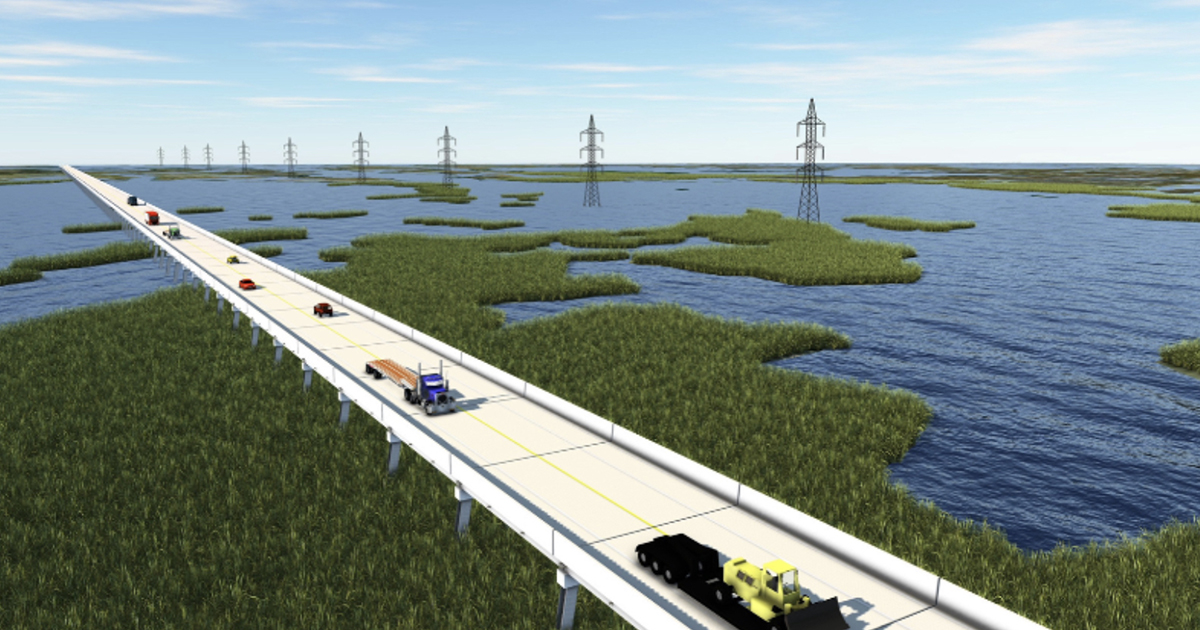
The project is moving forward through a cooperative partnership between LaDOTD, the Port of New Orleans and St. Bernard Parish. The corridor will enhance freight mobility, improve local traffic flow, reduce congestion and serve as an additional hurricane evacuation route out of the parish by way of an elevated roadway running through the marsh between the community of Violet and the I-510 spur that meets I-10 in New Orleans.
Phase 1 of the project will include environmental review, corridor planning and route selection. As part of the process, LaDOTD will receive public comments from the community.
The roadway will begin at the planned Louisiana International Terminal (LIT), a $2 billion container terminal the Port of New Orleans plans to build in Violet. Access to Port NOLA’s current container terminal, located in Uptown New Orleans, is limited to smaller ships due to air draft restrictions at the Crescent City Connect bridge.
“The Louisiana International Terminal will be transformational for Louisiana, strengthening our position in global trade, creating jobs and driving economic growth across our state,” said Gov. Jeff Landry. “The St. Bernard Transportation Corridor is a strategic investment that makes that transformation possible. I appreciate the strong partnership between DOTD, Port NOLA, St. Bernard Parish and our federal delegation, especially Sen. [John] Kennedy’s leadership, in securing critical funding to move this project forward. This corridor will enhance freight mobility, improve public safety, support hurricane evacuation and ensure Louisiana remains competitive and resilient for generations to come.”
Two years ago, Kennedy played a key role in securing $15 million in congressional-directed spending for the corridor in a prior THUD bill.
“Louisiana’s already a great state in which to live and do business — but we can improve both our economy and quality of life by building more roadways that look like they were designed on purpose,” Kennedy said. “The St. Bernard Transportation Corridor will improve safety and hurricane preparedness in the local community while helping create good Louisiana jobs. I’m proud of the funding I’ve delivered for this important project through my role on the Senate Appropriations Committee to make this corridor a reality.”
Louisiana Economic Development Secretary Susan Bourgeois, in praising the corridor funding, emphasized the importance of the LIT project, which is awaiting a permitting decision from the U.S. Army Corps of Engineers.
“The Louisiana International Terminal represents one of the most significant economic development opportunities our state has ever seen,” Bourgeois said. “LIT will generate thousands of family-supporting jobs from construction throughout long-term port operations and related industries while driving millions of dollars in new state and local tax revenue. The St. Bernard Transportation Corridor is a critical component of that success. By improving connectivity, freight efficiency and access to the terminal, this investment ensures Louisiana can fully capture the economic benefits of expanded global trade and deliver lasting prosperity for our communities.”
LIT has drawn often outspoken opposition from the St. Bernard community and its elected officials. St. Bernard Parish President Louis Pomes offered cautious support for the roadway project.
“I remain focused on protecting the people and quality of life in St. Bernard Parish,” Pomes said. “While I continue to have concerns about the Louisiana International Terminal, we have a responsibility to ensure that, if this project proceeds, our residents are protected, and therefore we have worked closely with DOTD to ensure that continuing to move this roadway forward is a top priority.
“The transportation corridor is critical to reducing truck traffic on local roads, improving safety and strengthening our hurricane evacuation capabilities,” Pomes continued. “By working with DOTD and our federal partners during this planning phase, we can help shape the project, protect wetlands and make sure St. Bernard families are not left to bear the impacts without solutions.”
Featured image caption: An artist’s rendering of the St. Bernard Transportation Corridor, a planned elevated roadway that would connect the Louisiana International Terminal to Interstate 10. (Artist’s rendering courtesy of Port NOLA)