

Carver Marine Steel Works Expands Repair Capabilities
As the inland and coastal barge fleet across the United States continues to age, the demand for efficient repair, retrofit and drydock services has increased. Located at the Port of Coeymans on the Hudson River, Carver Marine Steel Works provides operators serving New York Harbor and the Northeast with access to shipyard capacity outside of the congestion and scheduling constraints often found in larger port facilities. The purpose-built shipyard, designed around an 820-metric-ton Marine Travelift, allows the company to handle those projects with speed, flexibility and protection from the elements.
The facility, launched in 2020 as part of the broader Carver Companies portfolio, was created to support the company’s vertically integrated operations while also serving external customers across the maritime sector.
Phillip Gallo, general manager of Carver Marine Steel Works, said the company’s roots trace back to construction.
“Carver Companies started primarily as a construction company,” Gallo said. “Over time, the company needed more aggregates to support those construction businesses, so quarries and ports were added. Eventually that led to the development of the marine division to move those materials by water.”
As that marine presence expanded, leadership saw an opportunity to bring shipyard services in-house rather than relying on outside facilities.
“About five to seven years after the marine division was created, the decision was made that we didn’t want to rely solely on outside shipyards anymore,” Gallo said. “Steel Works itself started as a shipyard in 2020, and we’ve been growing steadily since then.”
Maritime Background
Gallo joined the company in 2020 after more than a decade in the maritime industry. A 2008 graduate of SUNY Maritime College, he began his career working aboard towing vessels.
“I started on tugs and barges in the wheelhouse,” Gallo said. “Then, later, I moved into the marine construction side of things.”
From there, his work expanded into shipyard services, marine surveying and salvage operations.
“I spent time supporting shipyards and independent contractors, marine underwriters and towing vessel owners,” he said. “I also traveled quite a bit doing salvage work and conducting damage surveys.”
Those experiences eventually led him back to the shipyard side of the industry.
“I really enjoyed the shipyard aspect of everything,” Gallo said. “That’s what brought me here — to help run this facility and continue building it.”
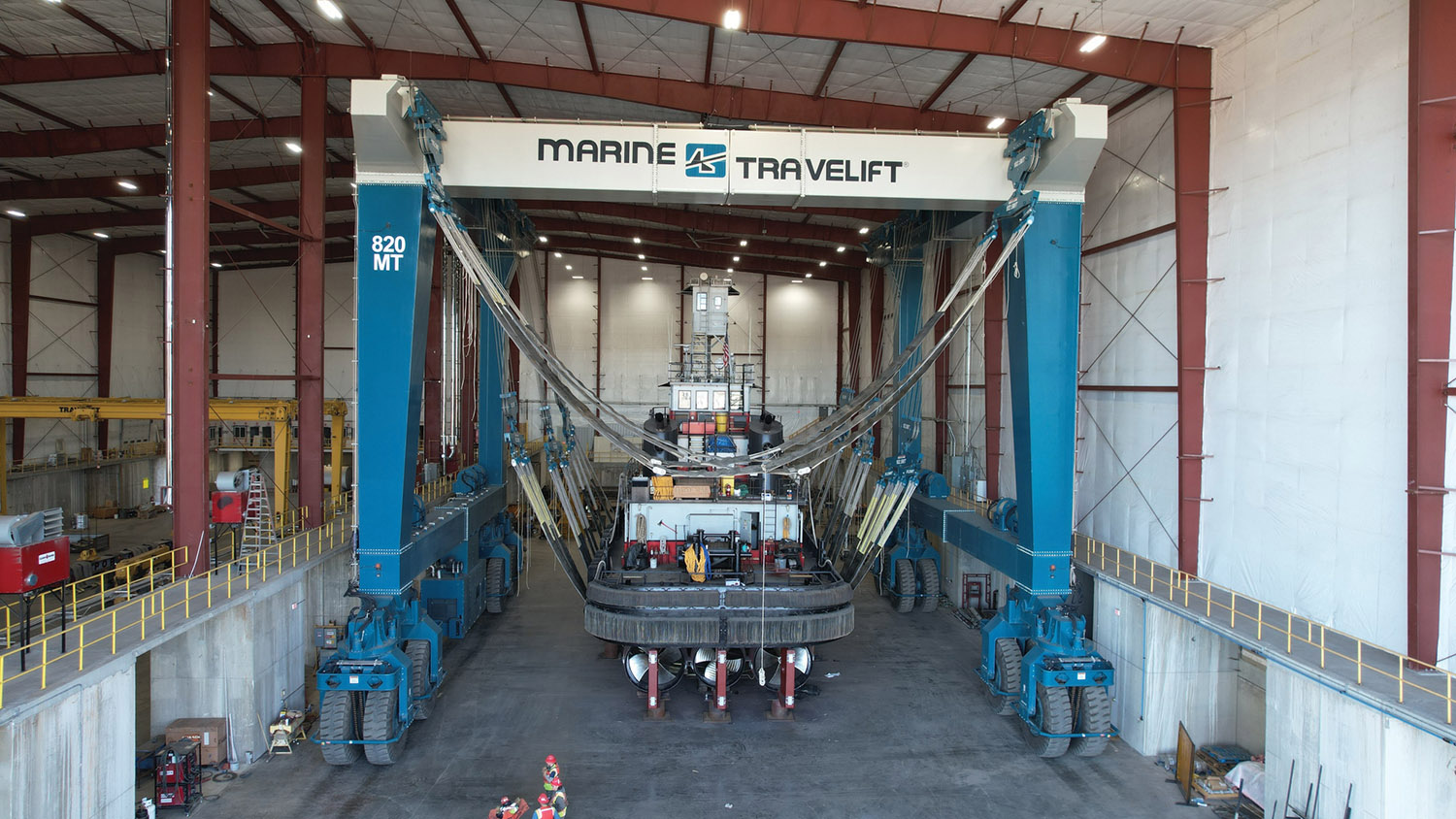
One of the defining features of the Carver Marine Steel Works yard is its 820-metric-ton Marine Travelift, which allows the yard to haul vessels and barges and move them directly into an indoor service bay.
“We designed the building so the Travelift can actually walk vessels right into the building,” Gallo said. “That allows us to perform retrofit services and any work needed during a drydock period without being hindered by weather.”
The Travelift can be configured with four heavy-lift frames rated for 210 short tons (ST) each that span roughly 60 feet in width, allowing the Travelift to maintain its full rated capacity when precise lifting-point adjustments or narrower lifting configurations are required. When utilizing a conventional strap configuration is not practical, the wide-span frame arrangement provides flexibility for handling a variety of vessel or project cargo geometries without sacrificing lifting efficiency.
When used for below-the-hook lifting, each frame rated for 210ST enables it to lift in a similar manner as a rubber-wheeled gantry system capable of positioning loads throughout the facility. In other configurations, vessels or heavy components can be supported directly on top of the frames in a cradle-style setup, allowing the frames themselves to carry the load. Slings can also be incorporated to control tipping moments and increase overall lifting capacity. In practice, the system can operate similarly to a marine railway or a self-propelled modular transporter-type platform, giving the yard significant flexibility when handling vessels, barges or large structural components.
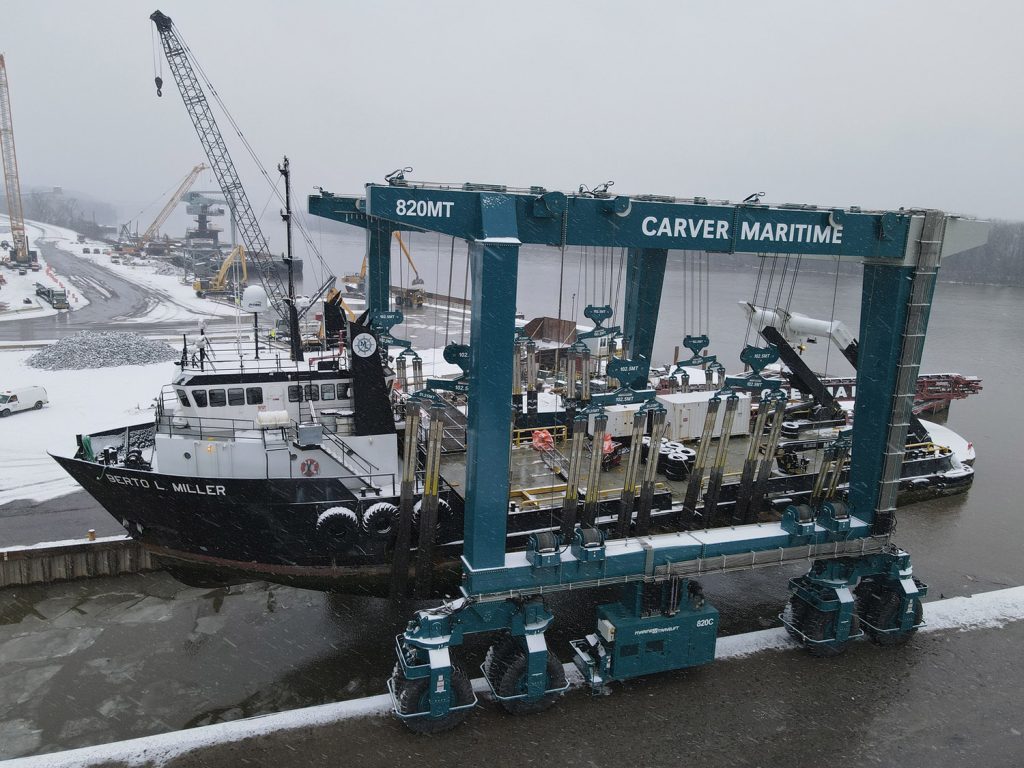
The Travelift can accommodate vessels with beams up to 60 feet. Once lifted, the machine functions like a large rubber-tired gantry crane, transporting vessels from the water to outdoor dry-dock positions or into the enclosed shop.
The indoor capability has proven to be a major advantage in the region’s challenging climate.
“Working indoors eliminates a lot of the weather-related delays you see in traditional yards,” Gallo said. “You don’t have to worry about snow, freezing temperatures or rain impacting your schedule. That makes a huge difference when it comes to turnaround times.”
The yard also maintains several acres of outdoor drydock space, allowing multiple vessels to be serviced simultaneously.
“We can accommodate anywhere from five to seven vessels at a time, depending on their size,” Gallo said. “And we provide the same range of services you would expect from a larger shipyard — including blasting and painting, mechanical and electrical work and full structural steel repairs.”
The Travelift system also significantly reduces the time required to haul vessels compared to traditional graving docks.
“From the time a barge arrives at our inlet to the time it’s hauled and blocked is usually two to four hours,” Gallo said. “In a traditional graving dock, that process could take 12 hours or more.”
The yard handles a wide range of barge and vessel types.
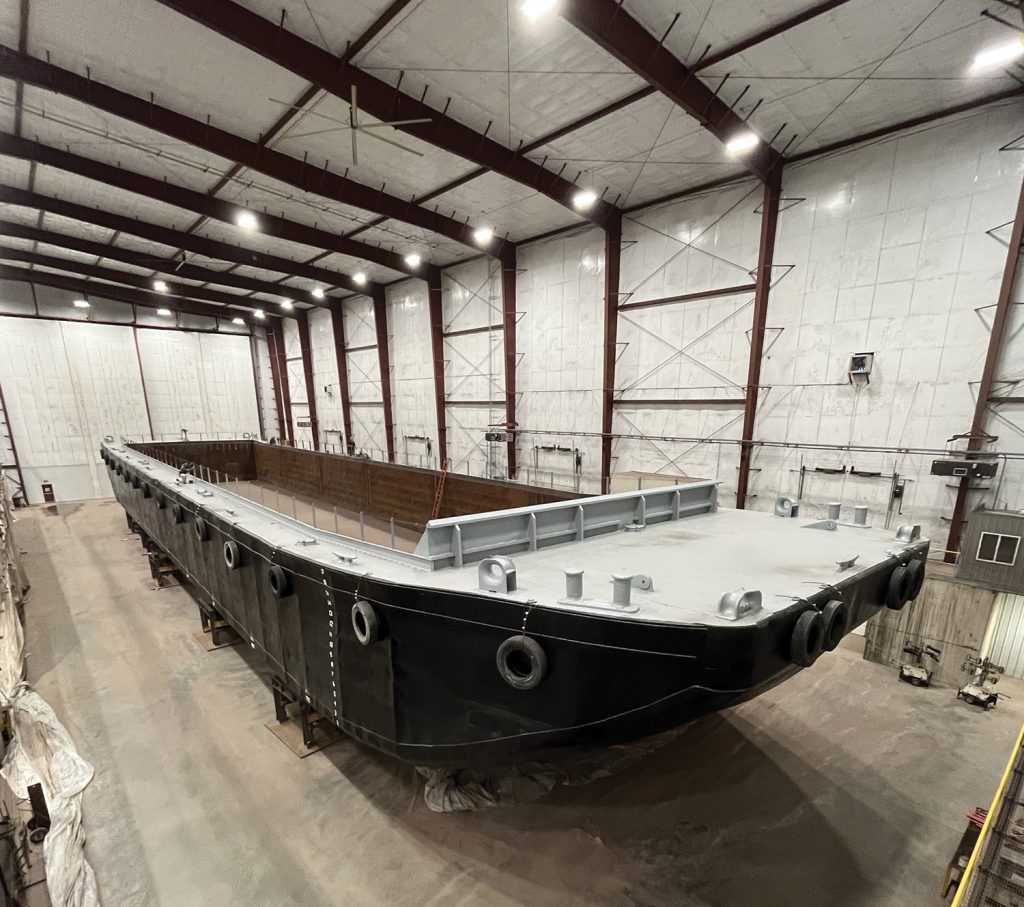
“We service hopper barges, deck barges, crane/spud barges and tugs,” he said. “A lot of the work involves structural repairs such as renewing bottom plating and framing or performing the standard two-and-a-half and five-year drydock maintenance periods.”
In addition to routine repairs, the yard has also completed specialized retrofit projects, including the installation of heavy cranes.
“One pedestal-mounted crane we hauled on land while another rail-mounted crane install project was completed topside while the vessel was afloat,” Gallo said. “In general, performing that kind of work on land makes things much simpler.”
Having vessels out of the water allows crews easier access for welding, fabrication and heavy equipment use.
“You’re not relying as heavily on floating cranes or working around vessel movement,” he said. “Access to equipment and materials is much easier.”
Aging Fleet Drives Demand
Across the inland waterways and coastal fleets, aging barges are creating additional demand for shipyard services.
“With steel prices and new construction costs where they are today, many of the operators we deal with are focusing more on retrofitting or repairing existing equipment rather than building new vessels,” Gallo said. “We’ve definitely seen an increase in maintenance and repair work as a result.”
Steel supply — which was heavily disrupted during the pandemic — has largely stabilized.
“Material availability has returned to normal,” Gallo said. “Depending on the project size, we might bring in multiple truckloads of plate steel directly from the mill or smaller shipments for routine work, but we’re not seeing the delays we had during COVID.”
Looking Ahead
While the yard currently focuses primarily on repairs and retrofits, Carver Marine Steel Works is exploring opportunities to expand into new construction.
“We’re starting to explore new-build possibilities,” Gallo said. “The indoor facility would be a big advantage for that type of work.”
One potential project already under development is a truckable tug design.
“That’s something we’re currently in the design phase for,” he said. “Within the next year, you may see some new equipment coming out of our yard, including smaller deck barges as well.”
Like many shipyards across the country, Carver Marine Steel Works is also paying close attention to workforce development.
“I’m fortunate that we have a strong labor force here and can scale as needed, depending on project demand,” Gallo said. “But across the industry there’s definitely a shortage of skilled shipfitters and tradespeople.”
Gallo said strengthening maritime training programs will be critical to the industry’s future.
“There’s been a shift away from trade careers over the past decade,” he said. “Programs at maritime schools and technical institutions are incredibly important because they help bring new people into the industry.”
Despite the challenges, Gallo remains optimistic about the shipyard’s future.
“Once people get into maritime, they tend to stay,” he said. “It’s a unique industry — and there’s a lot of opportunity ahead.”
Featured photo caption: A vessel is lifted inside Carver Marine Steel Works’ enclosed facility by the company’s 820-metric-ton Marine Travelift, allowing crews to complete repair and retrofit work in a controlled indoor environment. (Photos courtesy of Carver Marine Steel Works)