

American Ship & Dry-Dock Designs Modular System
American Ship & Dry-Dock Company has developed what it calls a Rapid Deployment and Modular Dry-Dock System, an approach that rethinks how floating drydocks are designed, transported and installed. According to Brian Read, chief executive with the company, the concept grew from the same problem many operators across the inland and coastal maritime industry face — the simple difficulty of getting vessels out of the water for maintenance and repair. Traditional floating drydocks can also be extremely costly to move from one site to another by water, making the transport task itself a major factor of drydock ownership.
“We were doing machining, fabricating and manufacturing large equipment for decades,” Read said. “During that time, we were always working on ships, but we never had a practical way to take them out of the water. That was frustrating. We finally decided, if we were going to solve the problem, we were going to build our own drydock.”
The system that eventually emerged was the result of years of conceptual development. Read said the design process stretched well beyond the typical engineering cycle.
“In reality, we designed a drydock many times over,” he said. “On paper we built one again and again for probably more than a decade. It kept evolving until we finally arrived at what we think is the best solution for its size.”
The result is a modular floating drydock constructed primarily of A36 structural steel and engineered with redundancy and safety as core design principles. The system is designed to operate in protected waters such as rivers or sheltered ports where draft limitations and available space often restrict traditional dock designs.
“Our situation required something that could operate in relatively shallow water and in confined areas,” Read said. “So we designed a dock where the draft, length, width and lifting capacity can all be adjusted depending on the customer’s requirements.”
The company’s current dock configuration provides approximately 1,200 tons of lifting capacity, capable of accommodating vessels approaching 200 feet in length. Because the system is modular, however, expansion and customization are built into the design.
“The easiest way to increase capacity is simply by adding modules,” Read said. “You can attach additional sections onto either end to extend the length. Width, height and lift capacity can also be engineered to suit the customer’s needs.”
Modular Design At Every Level
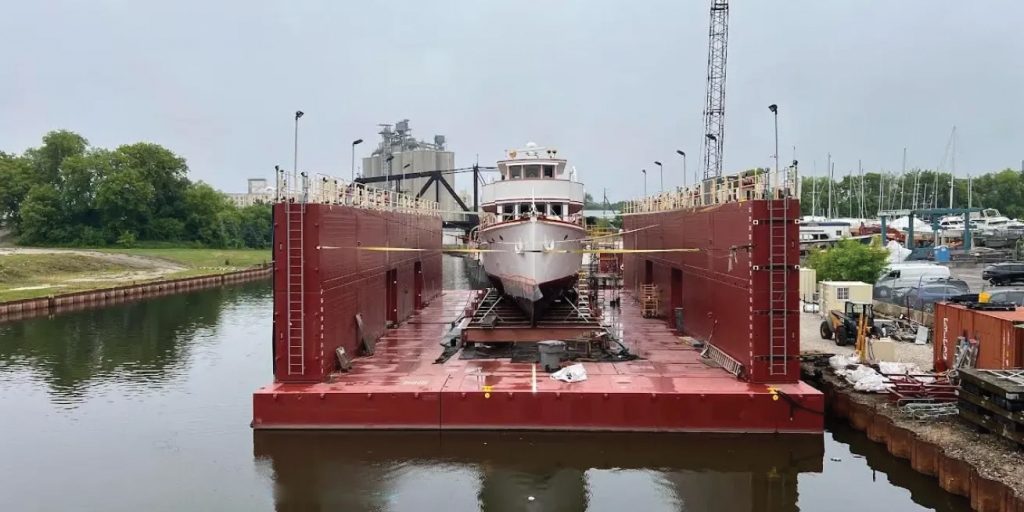
The defining feature of the Rapid Deployment system is its fully modular architecture. Nearly every component of the dock — structural sections, operational systems and auxiliary equipment — is designed to function as an independent module that can be added, removed or replaced as needed.
“The main structure is modular, but everything that works with it is modular as well,” Read said. “The generators are modular. The control systems are modular. The spuds and winches that make up the anchoring system are modular. Even the railings and ladders are modular.”
This approach allows operators to configure the dock to match their specific operational needs while maintaining flexibility for future changes.
“We designed it so essentially every part of the dock can be attached or detached,” Read said. “That means customers can start with a configuration that meets their current requirements and expand or modify it later as their operations grow.”
Spuds provide vertical anchoring and can be installed or removed depending on the operating environment. Additional warping winches can also be added to help guide vessels into position and secure them during lifting operations.
“The winches have locking capability, so they hold the load securely,” Read said. “It’s all designed so the components integrate seamlessly with the structure.”
Because the dock’s systems connect through standardized mechanical and electrical interfaces, installation is also significantly faster than with conventional designs.
“In a few days you can actually assemble one of these docks,” Read said. “And if necessary, you can take it apart just as quickly.”
Another key advantage of the modular approach is the ability to maintain an inventory of standardized components. By fabricating modules in advance, the company can significantly shorten delivery timelines once an order is placed.
“The goal is to keep the component pieces in inventory,” Read said. “When those modules are already built and available, the turnaround time becomes extremely quick.”
Instead of designing and fabricating an entirely new structure from scratch, the company can assemble the required dock configuration using existing modules and supplement them with additional components if necessary.
“For example, we recently quoted a dock roughly 80 feet wide by 140 feet long,” Read said. “Right now, we estimate about three to four months to build that system. As we continue building inventory of the modular components, we expect to shorten that delivery time even further.”
This inventory-driven approach allows the company to respond quickly to shipyards and operators that need dry-docking capability on shorter timelines than traditional dock construction typically allows.
Simplified Transportation And Installation
The modular system also simplifies transportation and deployment. Instead of moving a large, fully assembled drydock long distances, the structure can be disassembled and transported as individual components.
“Moving a conventional drydock can be extremely complicated,” Read said. “With this system, the pieces can be transported separately and then assembled at the destination.”
Because each module is designed for independent handling, transportation can occur through a variety of methods, including trucking, barge or sealift transport, depending on the project location.
Once the components arrive on site, the dock can be assembled relatively quickly.
“That’s part of what we mean by rapid deployment,” Read said. “The dock can go from delivery to operational in a very short period of time.”
The company also assists customers with installation and commissioning to ensure the system operates as designed.
Operational Efficiency And Reduced Downtime
Modular construction also offers significant advantages for maintenance and long-term operation.
“In any repair operation, downtime is the most expensive thing,” Read said. “If a drydock isn’t available when you need it, you lose revenue.”
Because individual modules can be removed and replaced independently, damage to a single section does not necessarily disable the entire dock.
“If a part gets damaged, you can remove that module, repair it and install a replacement in the meantime,” Read said. “That keeps the dock working.”
The modular structure also simplifies routine maintenance tasks.
“If you keep a dry-dock painted and maintained, it can last a very long time,” Read said. “Working with modules makes maintenance easier because you can isolate sections and address them individually.”
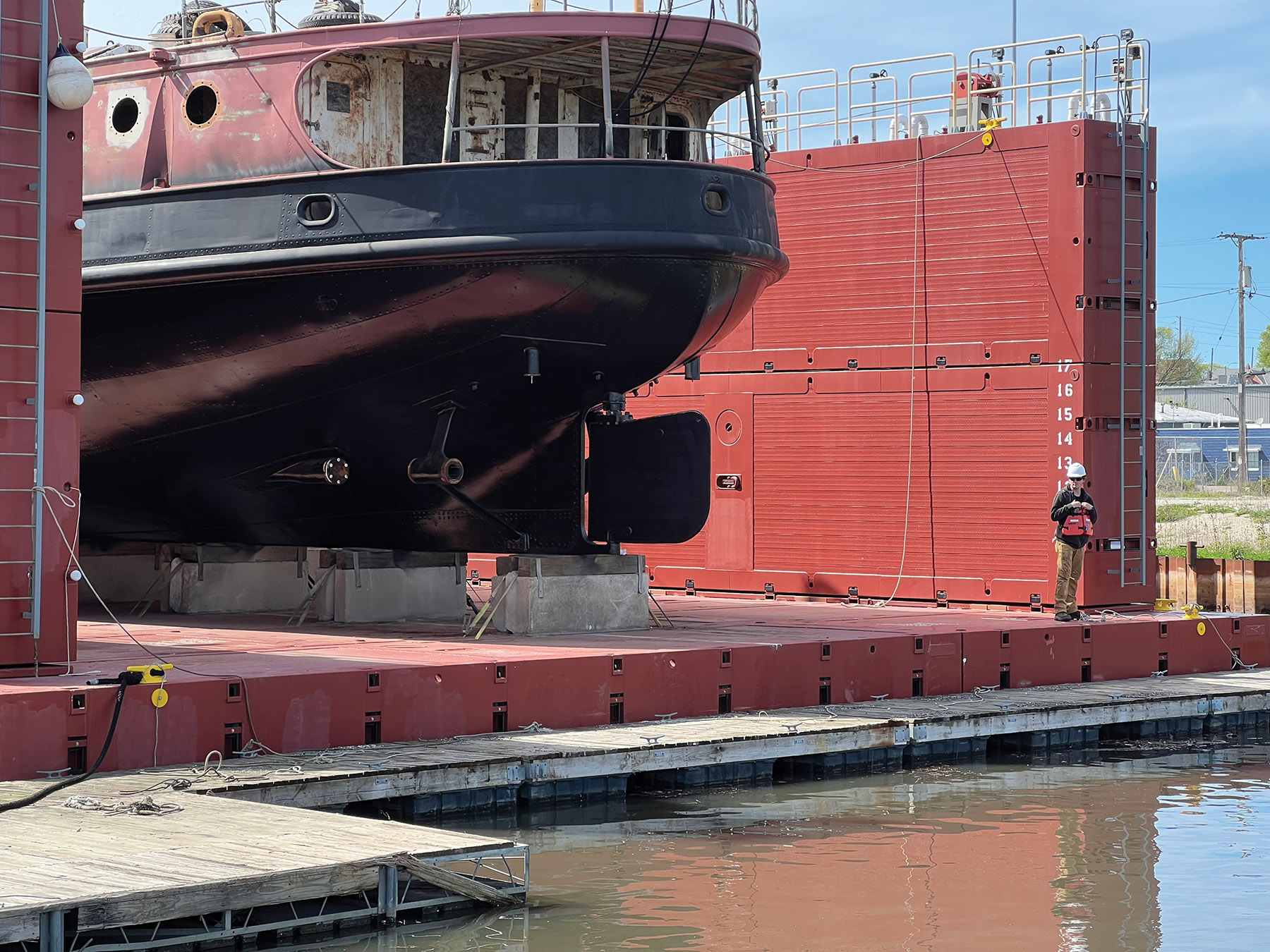
The company’s prototype dock is currently operating at its Milwaukee shipyard, where it has helped reintroduce dry-docking capability to a region that historically supported multiple shipyards.
“Milwaukee used to have several shipyards, but over time they disappeared,” Read said. “As far as we know, true drydocking here largely ended around the early 1900s.”
Read believes the company’s modular system could help address a broader shortage of modern drydocks across both domestic and international markets.
“When we first started looking for a dock, we tried to buy one,” he said. “Everything we saw was either extremely expensive or in very poor condition. There just weren’t many good options available.”
That experience helped shape the company’s mission.
“We believe there’s a need in the United States for new dry-docks and replacement dry-docks,” Read said. “And we think that need exists worldwide as well.”
As awareness of the modular system grows, Read expects interest from shipyards, ports and repair facilities to follow.
“Our goal is to provide a solution that can be delivered quickly and adapted to different operational needs,” he said. “With the modular design and the ability to keep components in inventory, we think we can offer something that hasn’t really existed in the market before.”
American Ship & Dry-Dock’s Rapid Deployment System is currently patent pending.
Featured photo caption: American Ship & Dry-Dock Company’s modular drydock is shown in operation at the company’s shipyard in Milwaukee. Designed for rapid deployment, transportability and expansion, the dry dock features modular components that can be assembled, removed or reconfigured to meet different vessel repair and maintenance needs. (Photo courtesy of Read Development Company Inc.)