
The Last Boat Built By A Famed Yard
The previous Old Boat Column detailed the final steam sternwheel towboat in regular service on the Mississippi River system, the steamer Lone Star. That wooden vessel was built by the Kahlke yard at Rock Island, Ill., in 1922. The shipyard dated back to at least 1868, and the Lone Star may have had roots back that far, as well, to a packet built at Lyons, Iowa, that year.
The Howard Ship Yards and Dock Company had its beginnings in 1834, when 19-year-old James Howard built a steamboat hull for a Capt. Leonard of Apalachicola, Fla. The young Howard was born in England and emigrated to the United States in 1819 with his family. His father, John Howard, who was a weaver by trade, had the family first in Brooklyn, N.Y., before moving on to Cincinnati, where he established a wool finishing mill. James Howard first worked in the mill with his father and brothers. He later worked for the area’s boatbuilders, apprenticing finally with William Hartshorn until 1833. He then was a steamboat clerk for several months.
According to the Charles Preston Fishbaugh history of the Howard yards, “From Paddlewheels to Propellers,” Howard rented a river-front lot at the foot of Mechanic Street in Port Fulton, Ind., now part of Jeffersonville. Howard built only the hull of the vessel for Capt. Leonard, with the hull built of wood and measuring 107 feet by 18 feet, with an 8-foot depth. The sidewheel vessel was named Hyperion and was completed by others in the area. The Hyperion departed for Florida in September 1834.
Howard first partnered with David Barmore in 1834, but the partnership was dissolved in 1835 for some unknown reason. Howard married Barmore’s sister, Rebecca, in 1836. He then moved to Madison, Ind., where he formed a partnership with P. Emerson, operating the firm as Emerson and Howard. The business had mixed success, and, by 1846, Howard relocated to Shippingport (Louisville), Ky., and built several steamboats or hulls on his own. After issues with flooding, Howard relocated to Jeffersonville and became quite successful.
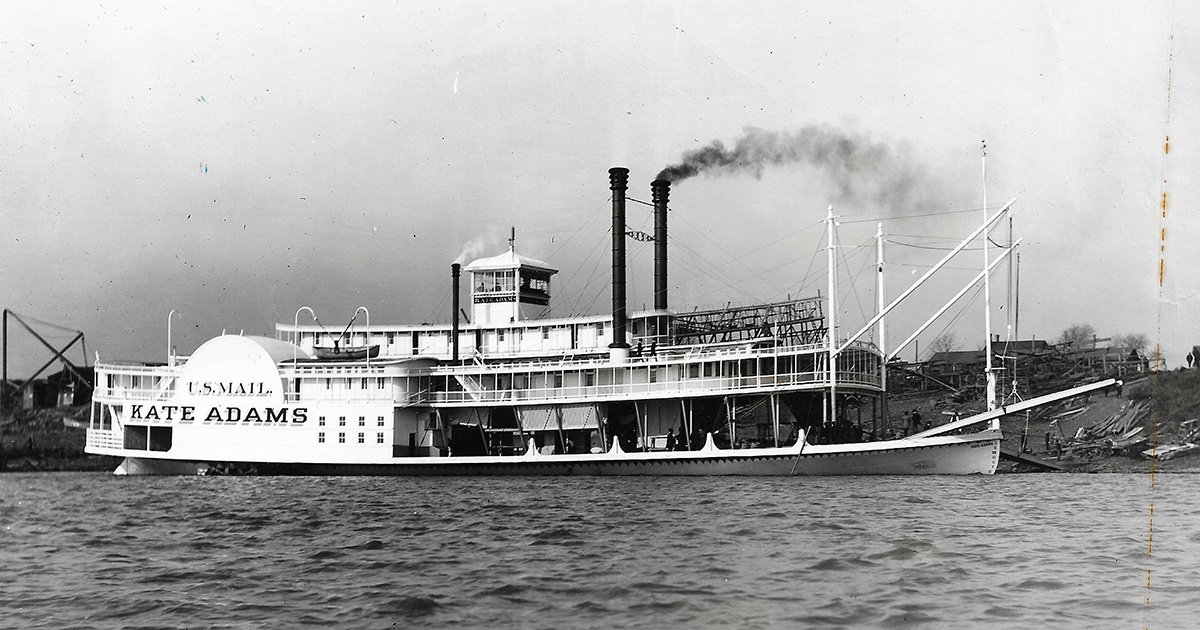
The Howard yards were renowned for the beauty and craftsmanship of their vessels, turning out such fabled craft as the sidewheel packet J.M. White in 1878, the City of Louisville in 1894 and the City of Cincinnati in 1899. The last Kate Adams, a majestic steel-hulled sidewheel packet, was built there in 1898.
Howard, tragically, died in an accident in 1876 when his horse was spooked and backed the carriage off the end of a ferry at Louisville. His son, Edmonds J. Howard, was then in charge of the firm until his death in 1919. After that, his son, James E., and wife Loretta Howard led the company.
The Howard firm, much like the Kahlke yard detailed in the last column, was proficient in wood construction. While the Howards did eventually embrace steel construction, they were late in doing so, and the yards were already in financial difficulty when Edmonds J. Howard died in 1919. The company built its last packet, the Cape Girardeau (later the very popular tourist steamer Gordon C. Greene) in 1923, and its last steam towboat, the Mark Twain, in 1931. Smaller boats and barges were turned out after that, but in a sporadic fashion.
In 1939, the yard turned out a small towboat and two small ferry boats, as well as four motorboats for the Corps of Engineers. In 1940, Costanzo Transportation Company, a division of Costanzo Coal Company, Warwood, W.Va., contracted with the Howard firm for the construction of a new steel towboat. This vessel was named Frank Costanzo and had a hull that measured 75 feet by 20 feet. It was single screw, powered by a Kahlenberg diesel engine of 360 hp. It had a full main cabin with a large, raised pilothouse above that. One stack rose from the roof behind the pilothouse.
This boat was quite small and plain compared to the palatial packets and even the large steam towboats built at Howards in days gone by. Despite this, the Frank Costanzo exhibited some of the “style” indicative of a Howard-built craft. The pilothouse, large for a boat of its size, was set back on the cabin and had a modified dome on the roof, while its single tall stack was raked at the top. These distinctive details gave the boat the appearance of being somewhat larger than it was.
As it turned out, the Frank Costanzo was the last vessel built by the Howard yard, closing out more than a century of boat building. The Fishbaugh book states that James E. Howard was still seeking capital to continue the business as late as August 1941, hoping to bid on Navy contracts. However, in February 1942, the Navy assumed control of the yards through the process of “eminent domain,” and the Howard era was officially over.
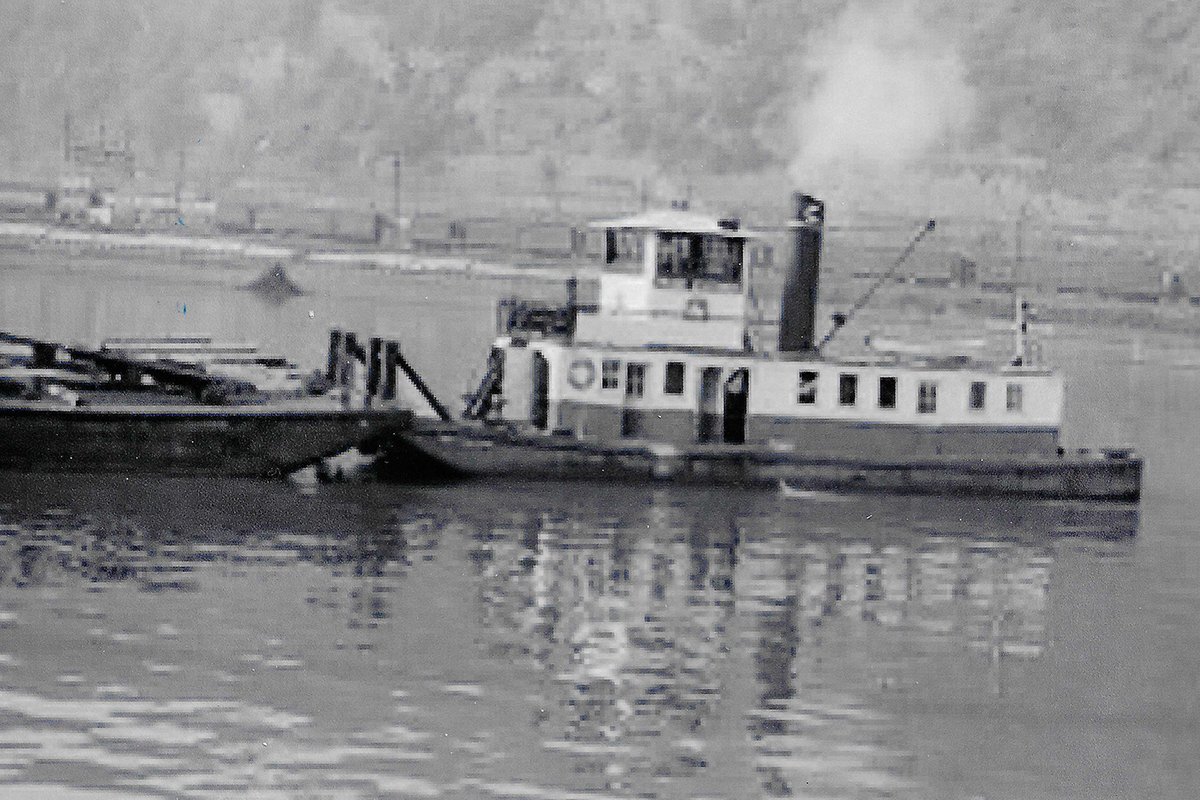
The Frank Costanzo was repowered in 1948 with a GM 12-278 engine of 520 hp. In June 1957, it was sold to Monongahela Iron & Metal Company, New Eagle, Pa., and in 1960, it was sold to Crain Bros. Inc., Glenfield, Pa., and renamed Steel City. In February 1983, it was sold to Commercial Diving, Chesapeake, W.Va., and in 1993 it was sold to River Salvage Company of Pittsburgh. In October 1994, it was sold to Industry (Pa.) Marine Service, which then sold it in 1995 to Bartley Marine Inc., Wellsburg, W.Va.
Originally identified in the 1945 Inland River Record (IRR) as single screw, by 1948 it was shown as twin screw. Whether it was built as single or twin, at some point the one stack was split down the middle and separated to make two. No other appreciable changes were made to the outward appearance of the boat throughout its history.
While the IRR continued to list it with the GM 12-278 engine, this author was aboard it only once, during the Bartley ownership, and it had a pair of tandem GM 6-110 engines in place. It was last listed in the 2005 edition of the IRR. The boat was included in the 2006 “Off The Record” section as having been scrapped.
Featured image caption: The recently completed steamer Kate Adams at Howards in 1898. (From the collection of Capt. Bill Judd)