Devall Diesel Launches Barge-Mounted Power Pack
Devall Diesel Services is bringing a new mechanical solution to the inland marine market with the introduction of its barge-mounted power pack, a purpose-built system designed to improve safety, simplify maintenance and reduce lifecycle costs for operators working in regulated cargo environments.
The Louisiana and Texas-based company has spent the past year developing the system around a specific operational need: providing reliable pump power on 10,000-barrel barges operating within intrinsically safe zones where electrical components are restricted.
“We started looking at this in January of 2025,” said David Devall, general manager of Devall Diesel Services. “The opportunity came when we became a dealer for the FPT series engines, and we realized there was a way to build something that fit the industry better — not just drop an engine in place, but create a complete, safer, more serviceable package.”
Designed For Intrinsically Safe Operations
At the heart of the system is a 173-horsepower FPT mechanical engine — notably configured without electronics. That design is critical for compliance in hazardous cargo environments, where sparks from electrical components could ignite vapors.
On many inland tank barges, a designated zone near the pump system restricts the use of any equipment capable of producing electrical discharge. Devall said the company’s power pack is specifically engineered to operate within that zone without requiring costly barge modifications.
“In simple terms, if you introduce anything electrical into that space, you’re looking at reengineering the entire barge,” Devall said. “This engine allows operators to stay within the safe zone requirements without that added expense.”
The absence of electronics also shifts the system toward mechanical reliability. Starting functions rely on accumulator tanks rather than batteries or ignition systems, eliminating a major source of spark risk while maintaining operational readiness.
From Engine To Integrated Package
While the engine itself is supplied by the manufacturer, Devall Diesel’s innovation lies in the surrounding structure — a custom-designed housing and support system built specifically for marine service conditions.
“We didn’t reinvent the engine,” Devall said. “What we did was take our fabrication team and our technicians and put them together to design something that works in the real world — in saltwater, in bad weather, in environments where maintenance access matters.”
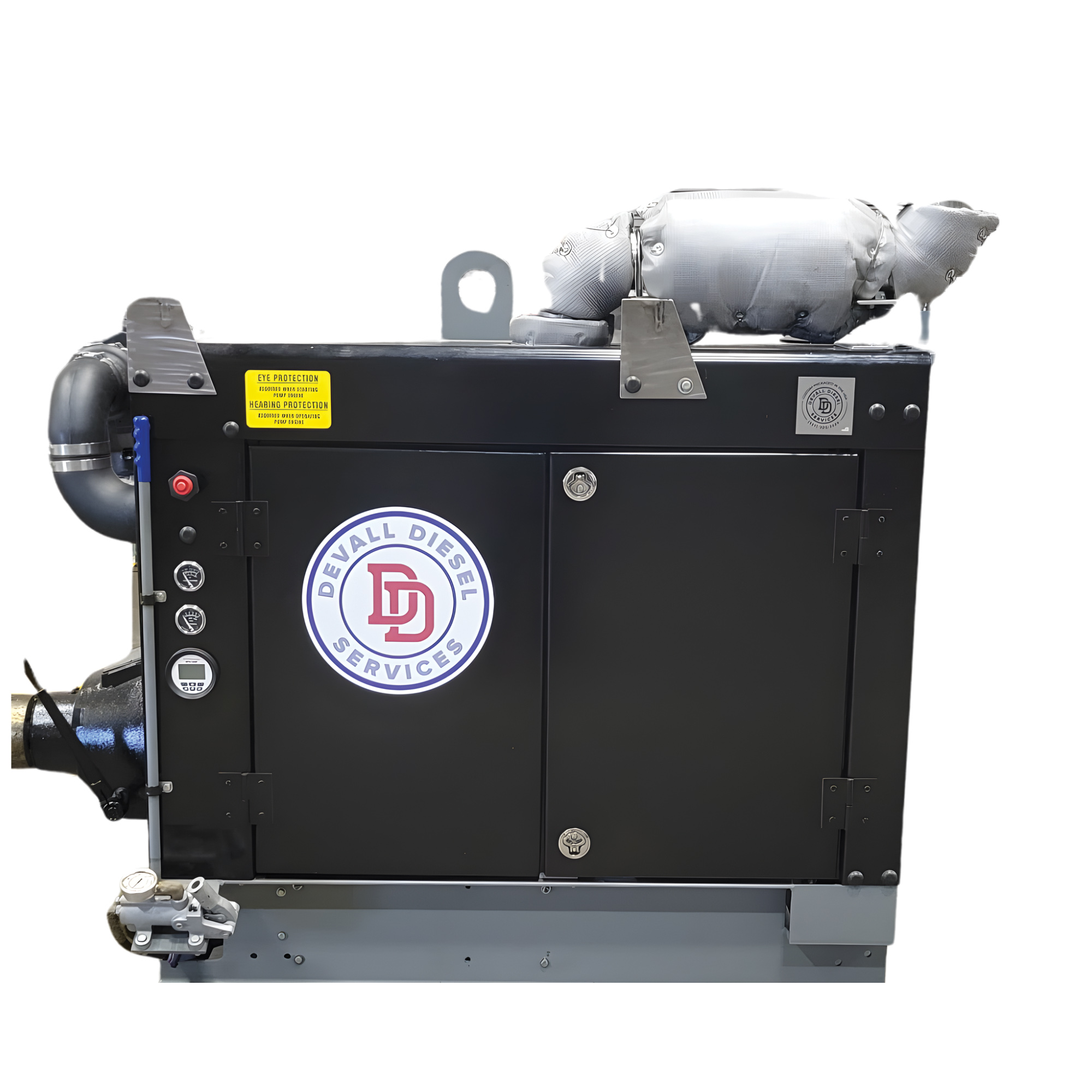
The result is a fully enclosed unit engineered to withstand corrosion, limit exposure to the elements and reduce common failure points seen in traditional installations.
Among the key design features is a three-point fueling system that allows access from multiple orientations. This flexibility ensures that fueling operations can be performed regardless of how the unit is positioned within the barge.
The system also incorporates both small and large accumulator tank options. The smaller tank can be mounted internally, reducing tripping hazards and improving deck safety. Larger tanks, which reduce the need for manual pumping during startup, are mounted externally due to their size.
Reducing Failure Points
A major focus of the design process was minimizing potential leak paths and maintenance issues. Devall said the team intentionally reduced the number of hoses and connections, replacing multi-fitting assemblies with more direct, single-connection solutions.
“Every fitting is a potential leak,” he said. “Every hose is something that can corrode or fail, so we eliminated as many of those as we could and simplified the system.”
The hydraulic tank, constructed of stainless steel, is positioned inside the housing to protect it from environmental exposure and reduce the risk of corrosion-related failures or spills.
The radiator assembly also received significant attention. Traditional designs often rely on bracket-mounted housings that can weaken over time, potentially collapsing into the fan and causing damage. Devall Diesel reinforced this structure and redesigned access points to simplify maintenance.
“Before, you had to remove the entire housing to get to certain components,” Devall said. “We changed that. Now it’s a single access panel, so technicians can get in, do their work and get out.”
Maintenance-Driven Design
Ease of maintenance was a central theme throughout development. Full-size access doors allow technicians to perform inspections and routine service tasks without obstruction, improving both efficiency and thoroughness.
Devall emphasized that user-friendly design can have a direct impact on operational outcomes.
“If it’s difficult to inspect, the reality is inspections may not be as thorough as they should be,” he said. “We wanted to eliminate that barrier and make everything accessible, so maintenance gets done the right way.”
The system also includes a serviceable diesel particulate filter (DPF), a feature aimed at reducing long-term costs and improving safety. Unlike sealed units that must be replaced entirely, the DPF can be removed, inspected, cleaned or replaced as needed.
“It’s similar to a dryer vent,” Devall said. “If you don’t clean it, buildup can create a hazard. We made ours serviceable so operators can maintain it instead of replacing a very expensive component.”
Internal Use And Market Rollout
Devall Diesel has already begun deploying the power pack on its own equipment, using in-house installations as a proving ground before broader market expansion.
“We’re an end user as well,” Devall said. “We have a few units out now, and as we replace older systems, we’ll continue installing our own.”
The company expects adoption to grow steadily as the product gains visibility. Devall estimated that by the end of 2027, the system could be installed on more than 30 externally owned barges, in addition to internal deployments.
“This is brand new for us,” he said. “We wanted to get units out in the field and make sure everything performed the way we intended before pushing it to market.”
Supporting Service Infrastructure
A key advantage for customers is Devall Diesel’s service network. The company operates both as an internal service provider and as a third-party dealer, supporting a wide range of diesel equipment across the Gulf Coast and inland waterways.
“We don’t just sell equipment,” Devall said. “We support it. We have more than 20 field and in-house technicians, and that’s a big part of the value we bring.”
That service capability is particularly important for a product designed with maintenance accessibility in mind. By combining simplified design with dedicated service support, Devall Diesel aims to reduce downtime and improve reliability for operators.
A Shift Toward Practical Innovation
The barge power pack reflects a broader trend in the inland marine industry toward practical, field-driven innovation. In this case, the focus is on balancing safety, compliance and operational efficiency in a demanding environment.
“It’s not just about making something new,” Devall said. “It’s about making something better for the people who are actually using it every day.”
As operators continue to navigate stricter safety requirements and cost pressures, systems like Devall Diesel’s power pack may offer a pathway to meeting both demands without compromise.
With early deployments underway and a broader rollout planned, the company is positioning the product as a long-term solution for barge operators seeking a safer, more maintainable approach to onboard power.
Featured photo caption: A custom-housed barge power pack from Devall Diesel Services features a fully enclosed unit designed for durability, noise reduction and ease of maintenance, with integrated controls and exhaust components. (Photo courtesy of Devall Diesel)