
Past Propeller Club President Keynotes Paducah Lunch
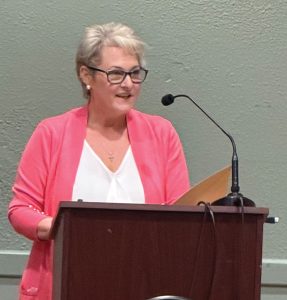
Past International Propeller Club President Maria Conatser headlined a lunch the Paducah Propeller Club hosted April 9 in conjunction with the U.S. Army Corps of Engineers’ Industry Day and the Inland Rivers Ports & Terminals’ (IRPT) Ohio River Basin meeting.
Elected in 2023 as the first female president in the International Propeller Club’s near 100-year history and serving until 2025, Conatser described the role of the club as to advocate for maritime business and national strength, and to “advance maritime excellence.” She noted the importance of Paducah to the inland waterways network, as it sits at the confluence of the Ohio and Tennessee rivers. Conatser said the health and reliability of locks and dams and consistent dredging and channel maintenance is critical, as modern infrastructure and efficient maintenance increase waterways traffic, reduce transit times and ensure long-term capital investment. This offers “resilience over reaction” for the nation’s waterways transportation system.
Conatser highlighted several current legislative initiatives the club has been supporting, including the SHIPS for America Act, the National Maritime Strategy that defines maritime policy and supports economic security and military strategy and the 2025 Executive Order “Restoring America’s Maritime Dominance” aimed at enhancing U.S. shipbuilding capability.
The United States builds less than 1 percent of the world’s commercial shipbuilding tonnage. Conatser said the ship-building initiative is not just about building U.S. ships but is for national security and global stability. Issues related to cybersecurity, national security, decarbonization, digitalization and artificial intelligence, workforce and system resilience are also key areas of focus now for the International Propeller Club, she added.
The International Propeller Club continued to grow in 2025 with ports in Cyprus, Oslo and Iberia chartering.
“Maritime maps are being redrawn, and global trade routes are shifting, and geopolitical headwinds impact the maritime industry, from the Suez Canal to the Strait of Hormuz to the South China Sea to the Panama Canal,” Conatser said.
The club also continues to assess challenges in the environmental, geopolitical and technology realms. Propeller Clubs “provide a platform where conversation becomes action,” she said. Referring to the maritime industry as “a public good,” Conatser said that the maritime industry “is not just relevant but essential.”
As the International Propeller Club prepares to celebrate its centennial in 2027, Conatser said the Club will reflect on the past while defining the future, underscoring the value of the club in a changing world. “We will work to shape a future that is strong, secure and sustainable,” she said.