

The Admiral Was A St. Louis Destination For 40 Years
A piece by David Murray in the March 26 issue of The Waterways Journal told of a large-scale model of the excursion boat Admiral on exhibit at the National Transportation Museum in St. Louis. The history of the model and how it came about is very interesting, as is the background of the vessel that inspired it. The Admiral was based in St. Louis and beloved by locals for more than four decades.
According to “Moonlight At 8:30,” a definitive book on excursion boats by the late Capts. lan L. Bates and Clarke C. “Doc” Hawley, the act of carrying excursionists dates back to the very first steamboat on the Western Rivers. While the New Orleans was at Louisville, Ky., on the inaugural trip downstream from Pittsburgh, it hosted a group of leading citizens on board. On October 2, 1811, it departed with these people and journeyed upstream to prove to skeptics that the boat could, in fact, stem the current.
Bates and Hawley point out that, “Excursion boats arrived with the packets and watched them disappear, saw the rise of barge towing, and have battled automobiles, movies, radio, and even television successfully.” Streckfus Steamers was founded by John Streckfus, Sr. and was initially in the packet business until transitioning to exclusively excursion boats just after 1900. The firm became a premier excursion operator and had large boats stationed at St. Louis and New Orleans while others would tramp between towns on the Ohio and other rivers during the warm weather seasons.
Just prior to World War II, the excursion business, especially the tramping aspect, had fallen somewhat out of favor. In 1933, the Streckfus company purchased the large sidewheel steam packet Cincinnati, built in 1924 for the Louisville & Cincinnati Packet Company One of the last packets built, it had a steel hull and wooden superstructure. Streckfus tore it down to the steel hull at St. Louis and built a new steel cabin structure. The new boat was named President and came out on July 4, 1934. It was an immediate success.
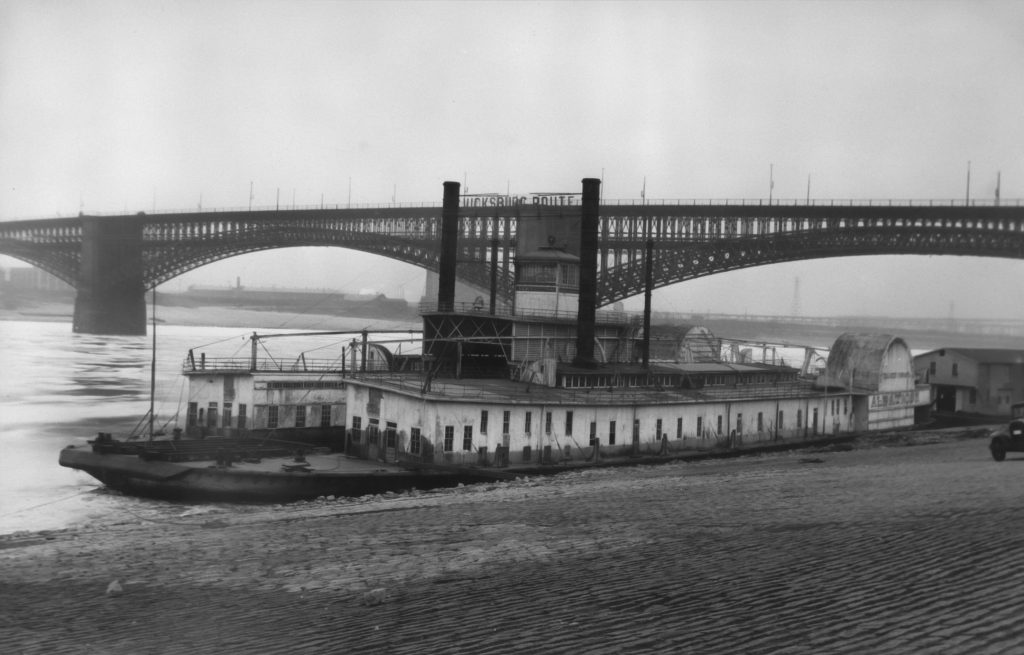
With the positive reaction by the public to the President, Streckfus decided to look toward an even bigger boat. In 1935, according to Annie Blum, who worked many years for the Streckfus firm, the company purchased the railroad transfer steamer Albatross. The Albatross was built at Dubuque, Iowa, in 1907 for the Louisiana & Mississippi Valley Transfer Company. It originally had a steel hull that was 308 by 53 feet, and the sidewheels were propelled by high pressure engines with cylinders 26 inches in diameter with 10-foot stroke rated 750 hp.
The Albatross was lengthened to 361 feet long in 1921. After the sale to Streckfus, the big boat was brought from Vicksburg to St. Louis under its own power and laid up. In 1936, plans were formulated to convert the boat into the foremost excursion boat on inland waters. Blum relates in her writings that there was a family story that the exterior design of the new boat came about when Capt. John Streckfus (son of the founder) saw the streamlined Kalakala ferry at Seattle, Wash.
Blum writes that the interior art deco design of the new craft was designed by St. Louis industrial designer Mazie Krebs, who had also designed the interior of the President. Krebs reportedly also had a hand in the exterior design of the new boat. What resulted was described in the initial 1945 edition of the Inland River Record as a boat allowed 4,100 passengers with “great stress on streamlining and application of modern metal design.” The description continued, saying, “No outside guards, almost invisible stacks, wheelhouses (paddlewheel boxes) entirely unaccented, boilers in the hold, no gangplank.”
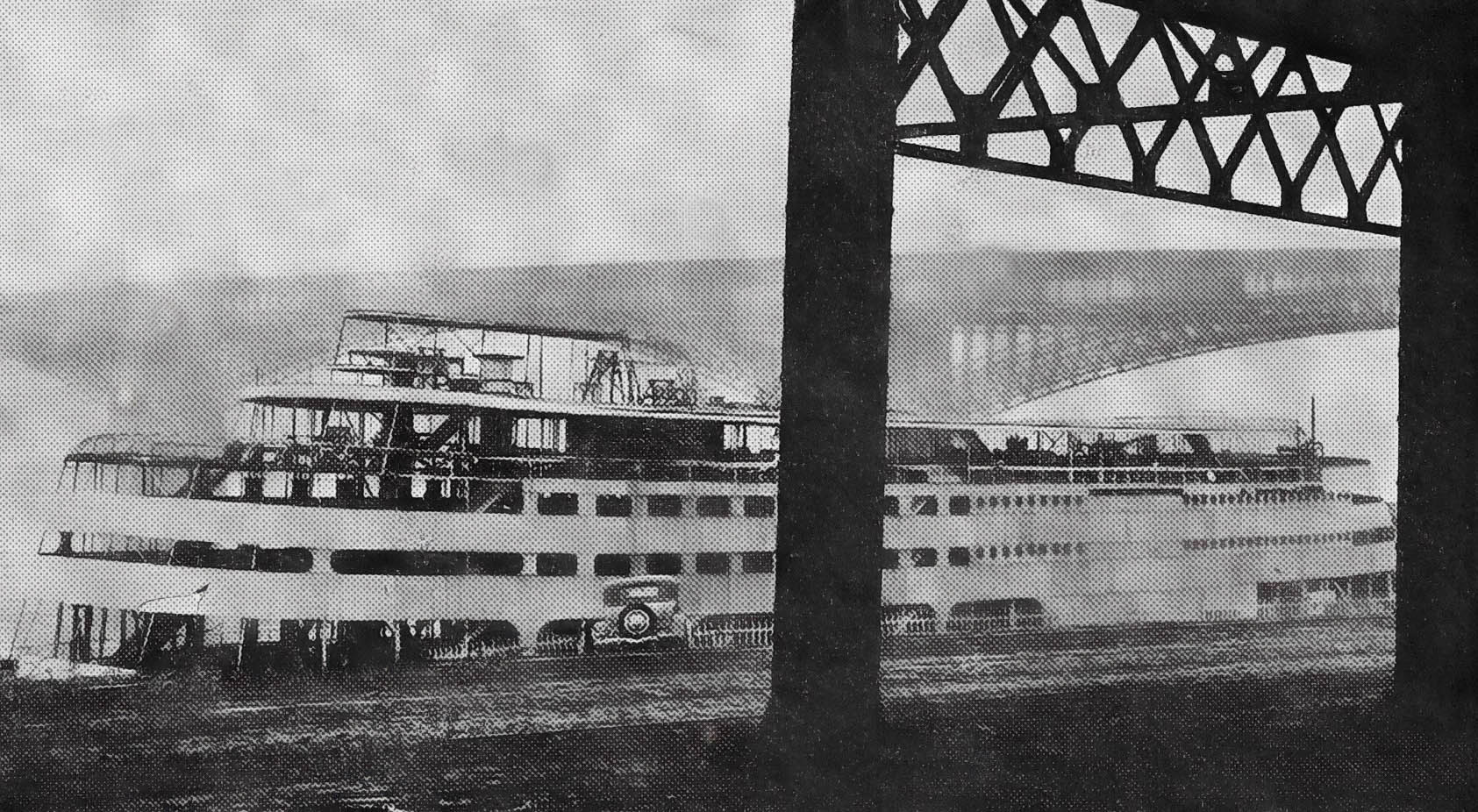
The January 8, 1938, issue of the WJ carried a photo of the new boat under construction, noting that it “would probably be completed in the first half of 1938” and that it had not yet been decided “to what use it will be devoted or by what name it will be known.” While it is widely reported that conversion/construction of the craft was done between 1938 and 1940, the photo shown as taken in January 1938 shows the cabin well underway, so actual work had to have begun in 1937 or even before.
The St. Louis news column in the June 8, 1940, WJ said that a dedication ceremony and inaugural trip of the new Streckfus Steamers streamlined excursion steamer Admiral would take place on June 12, 1940. The construction process must have taken longer than anticipated, but the boat was popular and successful from the start. Beyond the appearance, another drawing card for ridership was that the interior was air conditioned. Blum notes, “The new design plus air conditioning joined with the old pleasures of good music for dancing, efficient service and sailing on the Mississippi River. It all came together for a perfect combination.”
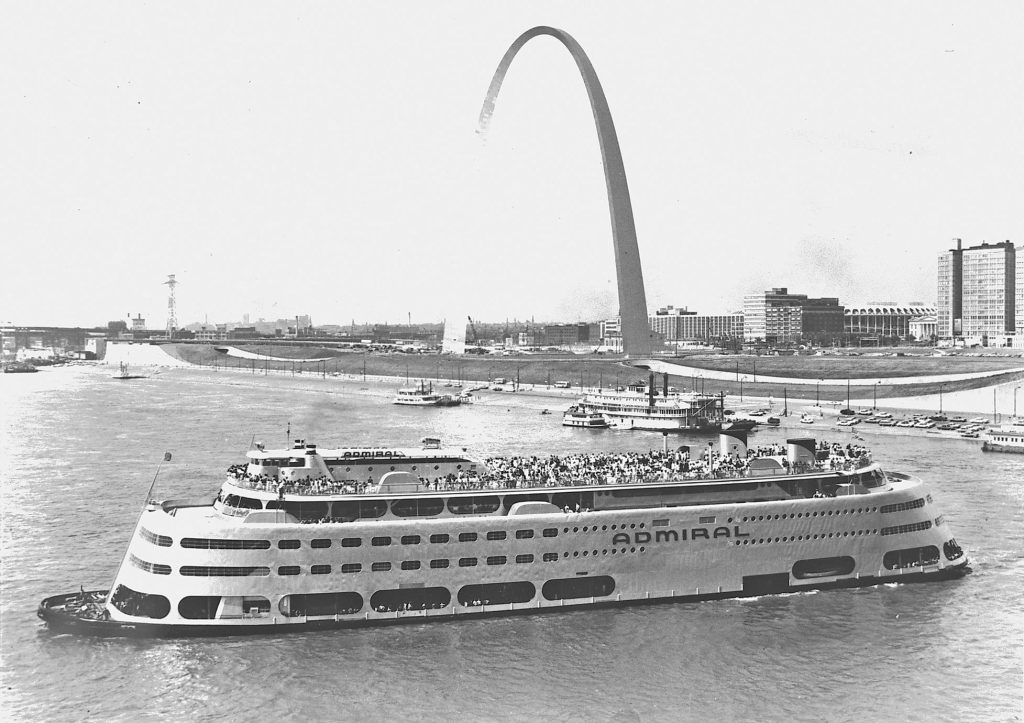
Due to costs with operating boats on steam, both the Admiral and President were converted to diesel power in 1974 and 1978, respectively. With waning ridership as well as hull issues, the Admiral was retired in 1979.
It was sold to several different owners, becoming an entertainment venue at St. Louis in 1987 and then a floating casino there in the 1990s. It was struck by break-away barges in 1998 and ceased operating as a casino in 2010. It was scrapped the following year. By this time, some parts of the hull were 104 years old. It was a sad end to a once prominent vessel of St. Louis where, for many years, if people said they were “going to the boat,” they meant the Admiral.
Featured photo caption: Under construction as pictured in the January 8, 1938 The Waterways Journal. (Photo from the author’s collection)