
The Little Towboat That Could
A book titled “The Little Engine That Could” came out in 1930 “as retold by Watty Piper,” a pen name for Arnold Munk. This beloved tale for children tells of a tiny locomotive bravely trying to help a broken-down train with a load of toys make it over a mountain. The struggling little engine gradually succeeds in getting over the crest by chanting “I think I can. I think I can.”
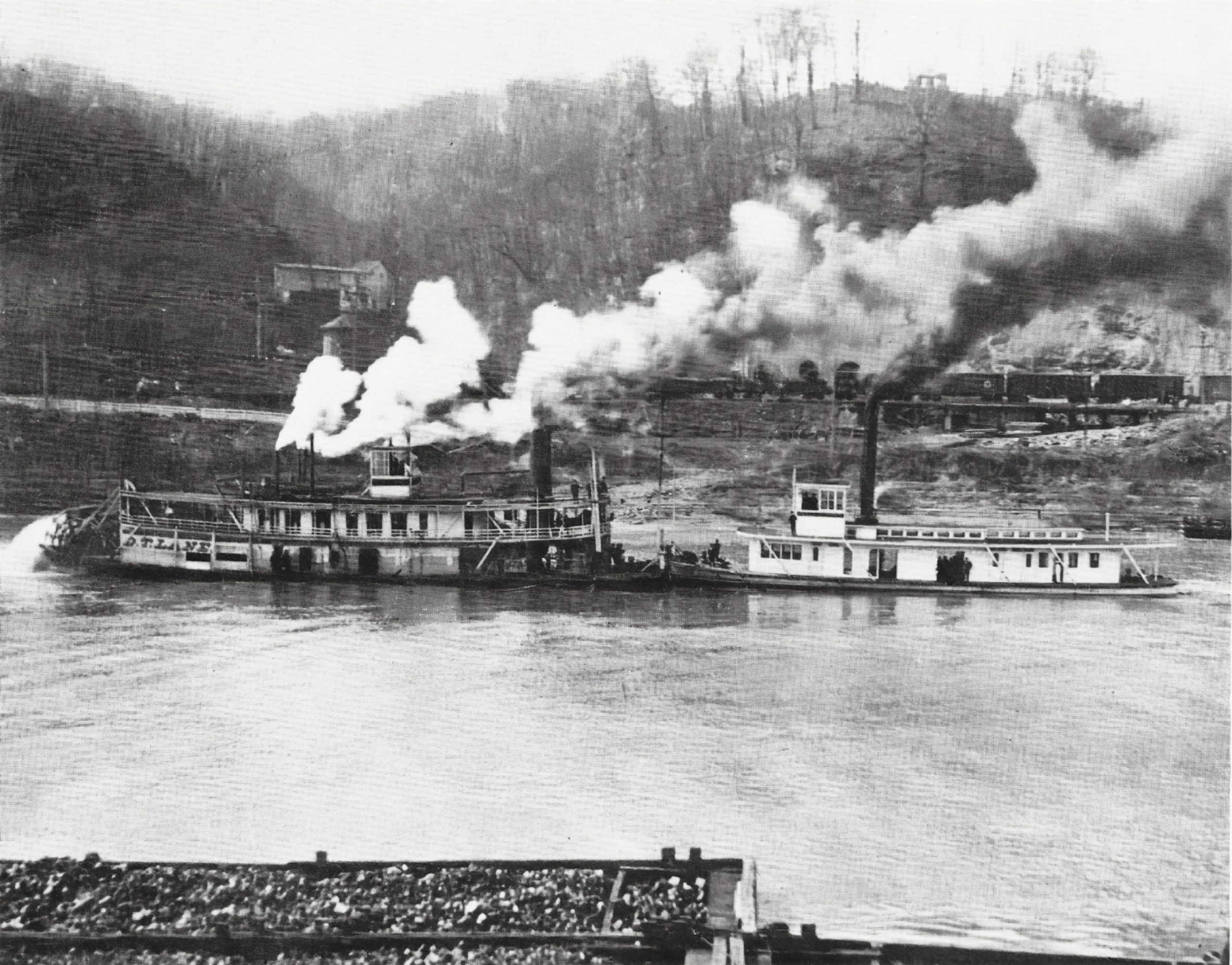
This story of determination and belief in self could be applied to a vessel, or more aptly the builder that participated in a staged event on the Kanawha River at Charleston, W.Va., March 7, 1903. It has been mentioned many times in the pages of The Waterways Journal over the years and is significant in that it proved the dominance of the prop-driven James Rumsey over the sternwheel D.T. Lane.
While the Lane was larger in tonnage at 350 to the Rumsey at 120, they were nearly equal in rated horsepower, with the Lane having 450 and the Rumsey 425. The contest between the two was close, but as recorded in the Charleston Daily Gazette the next day, “More than 5,000 Charleston people witnessed an exhibition Saturday of the triumph of modern and scientific steamboat building in the contest of the relative power possessed by the towboat D.T. Lane, one of the best known of the Kanawha River craft, and the James Rumsey, the United States government’s newly completed twin-screw steamer.”
The D.T. Lane had been a Kanawha River institution since 1875. Built at Pittsburgh in 1871, it had a wood hull 129 feet by 24 feet and engines that were 16 inches in diameter with a 5.5-foot stroke. These engines had originally been on the Civil War gunboat General Thomas, which was later rebuilt into the sidewheel packet Ingomar. Part of the cabin from the Ingomar was said to have been used on the new D.T. Lane. The Lane was rebuilt about 1880 and became a part of the Campbells Creek Coal Company (CCCCo.).
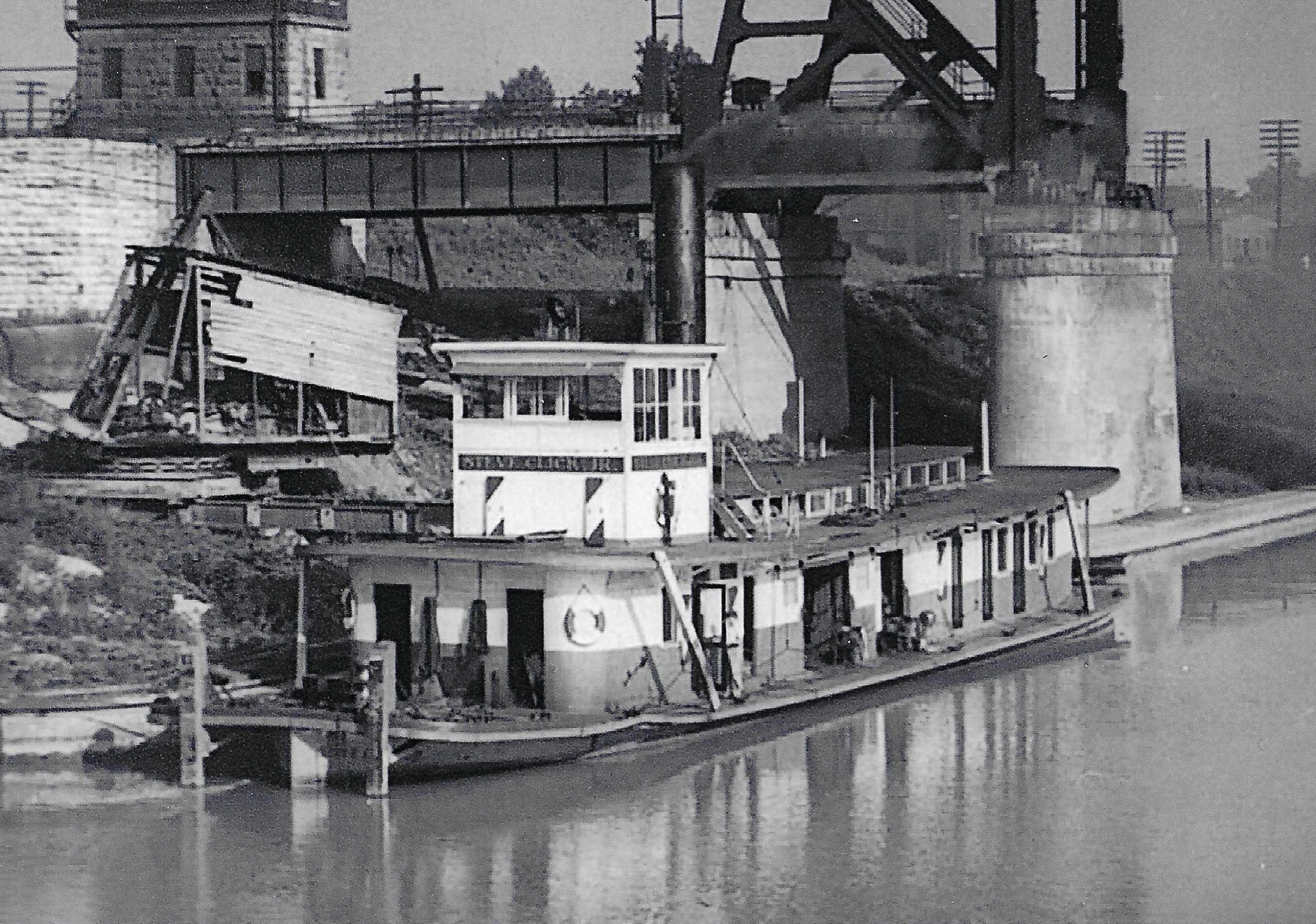
The James Rumsey was built by the Charles Ward Engineering Company, Charleston, W.Va., for the U.S. Engineer Department (USED) in 1903. It had a steel hull that was 119.6 feet by 22 feet, and the twin engines were quadruple expansion, condensing, 7’s, 10’s, 14’s, 20’s with 12-inch stroke. The propellers were 54 inches in diameter with 67 inches of pitch. The USED had stringent requirements for the craft to meet regarding speed and maneuverability before it would accept it.
After the Rumsey had met all the requirements during trials, Charles Ward, Sr. of the firm that had constructed the tunnel stern boat felt so confident in it that he approached the CCCCo. and challenged the D.T. Lane to a shoving and backing contest. The challenge was accepted, but as the Charleston newspaper article later stated, few other than Charles Ward felt that the smaller Rumsey would be the victor.
In a piece about the contest in the March 1967 S&D Reflector, Capt. Fred Way said, “It never dawned on the Lane crew, nor her management, that she could lose such a contest, but young David slew Goliath.” The Rumsey slowly shoved the Lane up against the current, and, when the boats were turned, was able to back it upriver as both vessels operated astern. The results were controversial among rivermen for years afterward. This was before the use of flanking rudders on propeller craft and sternwheel proponents claimed that the contest was inconsequential since the Rumsey would not be able to handle a southbound tow and perform necessary flanking around bends as the Lane could.
In the March 1967 Reflector piece, Way said that, for years afterward, mention of the event around Capt. E.A. Burnside, legendary CCCCo. transportation manager, would bring “thunder and lightning.” Burnside even wrote a paper once proclaiming that propeller boats would never supplant the sternwheel towboat. “Nobody save Charles E. Ward,” Way continued in the Reflector, “seemed to grasp the profound, glaring truth; the sternwheel towboat was on the skids. … The Rumsey-Lane affair was the cause célèbres leading to the transformation.”
The James Rumsey went on to perform admirably for the Engineer Department for more than 30 years. In 1933, it was the first boat to lock through the new Marmet Lock on the Kanawha River. In late 1934, it was sold to Louisville Sand & Gravel Company and renamed Steve Click, Jr. It was a familiar sight around Louisville, Ky., then and, in May 1935, made a trip up the Cumberland River to Carthage, Tenn. In 1946, it was sold to Jesse L. Cooper, and, on July 3, 1947, it sank at Helena, Ark., becoming a total loss.
Charles Ward. Sr. provided the “determination and belief in self” to make the Rumsey the “Little Engine That Could.” The Ward firm went on to produce many of the pioneering tunnel stern propeller and diesel towboats that led to the present-day craft on the Mississippi River system. The firm closed in 1932 due to financial and ownership succession issues.
Featured photo caption: The celebrated David vs. Goliath contest between the D.T. Lane (left) and the James Rumsey at Charleston, W.Va., March 7, 1903. (Photo from the author’s collection)