
Coast Guard Commander Outlines Paducah Priorities
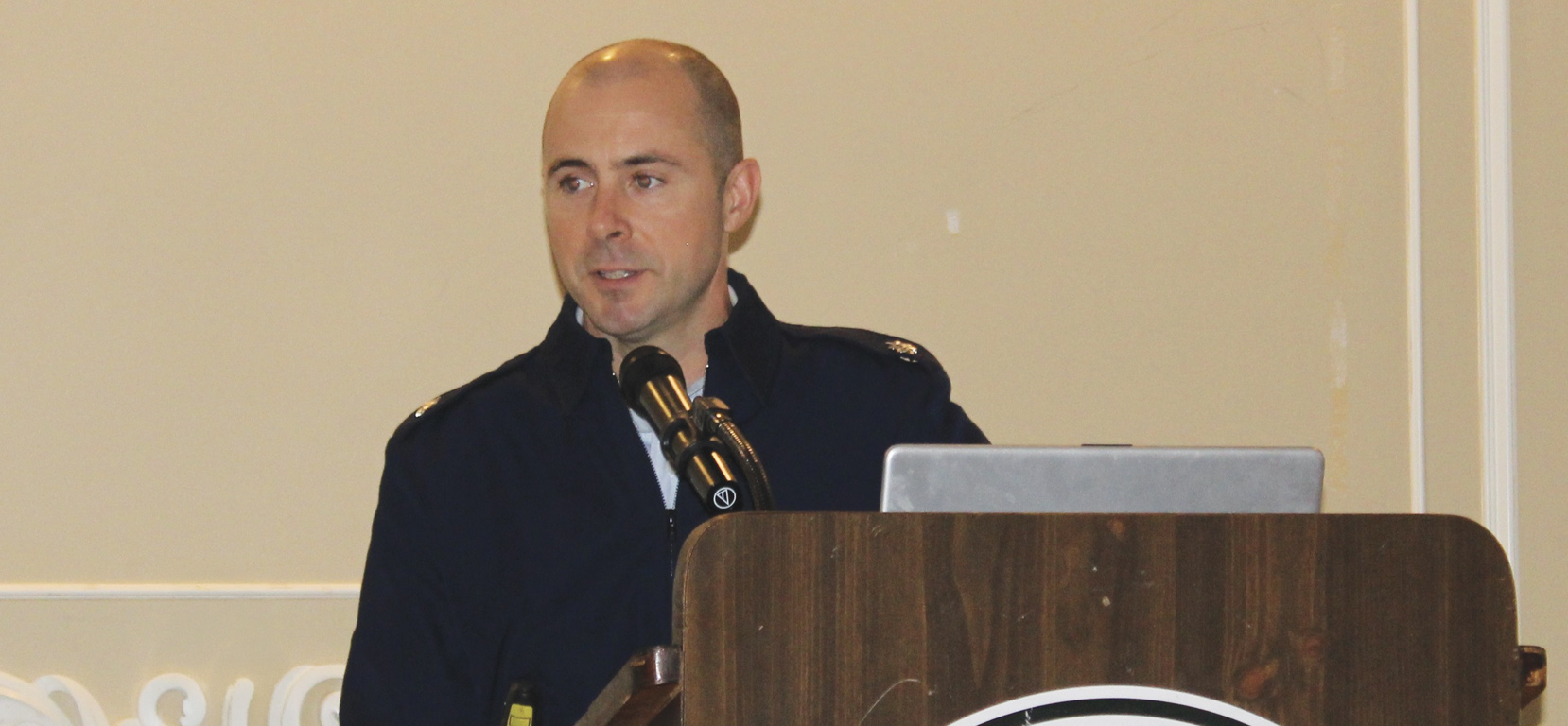
U.S. Coast Guard Cmdr. Daniel Wilkinson outlined some of the major responsibilities of Marine Safety Unit (MSU) Paducah and his own background as the featured speaker during the October 14 meeting of the Paducah Propeller Club.
Wilkinson assumed command of the unit in June, relieving Cmdr. Shehu Bello.
Wilkinson grew up in Pensacola, Fla., and received his Bachelor of Science degree in mechanical engineering at the University of South Florida in 2010 before attending Officer Candidate School (OCS) in 2011. He completed the Coast Guard’s marine engineering postgraduate program, earning a Master of Science degree in ocean engineering from the Florida Institute of Technology.
Wilkinson’s past assignments included serving aboard the U.S. Coast Guard Cutter Oak as a deck watch officer, at MSU Houma in Louisiana as an apprentice marine inspector and at Marine Safety Detachment Peoria in Illinois as supervisor before becoming the commanding officer of the Outer Continental Shelf National Center of Expertise. There, he led the staff in providing technical assistance, support and training to Coast Guard Headquarters, field units, other government agencies and industry partners on offshore drilling and production facilities, offshore supply vessels and crewboats.
While MSU Paducah’s geographic area of responsibility (AOR) is smaller than some others, it is unique in that it includes four states, five major inland rivers and 470 miles of waterway. The unit also works closely with four different districts of the U.S. Army Corps of Engineers. An estimated 300 million tons of cargo pass through MSU Paducah’s AOR per year, Wilkinson said.
The unit is responsible for ports and waterway security, marine safety, defense readiness, including national security and military preparedness, maritime environmental protection and law enforcement. It does this with 17 active-duty members, three civilians and three flotillas of auxiliary members, of whom there are 74 in total.
“As a 20-person unit, Paducah is a very productive place and very active,” Wilkinson said.
He pointed to data from 2025, showing that Paducah’s unit performed 446 vessel inspections, compared to 1,176 in other sectors and sub-units in total around the nation.
Paducah also performed 84 incident investigations in 2025, compared to 135 elsewhere around the nation, responded to 24 pollution incidents compared to 22 elsewhere and conducted 105 facility inspections, compared to 618 in other sectors and subunits.
Looking toward the future, Wilkinson pointed out several important initiatives. One of those involves new cybersecurity regulations that were enacted in 2025 but are being implemented over a three-year period. Another involves the Coast Guard’s Drug and Alcohol Program audits, official inspections and evaluations of marine employers’ chemical testing programs to verify compliance with federal safety regulations.
He said companies should expect an increase in audits of their drug and alcohol enforcement programs but added, “From what I have seen, the towing industry is extremely on top of it.”
On a national level, Wilkinson also mentioned Operation River Wall, a program the Coast Guard is putting into place that uses drone deployments to help with border security.
“Like anything new, there are going to be some growing pains and lessons learned,” Wilkinson said.
More locally, the Coast Guard will continue to assist as needed with major ongoing projects. That includes the Corps of Engineers’ Kentucky Lock Addition Project as well as a study being performed on the Hickman Hard Point, an area of bedrock and rock pinnacles near Hickman, Ky., that poses a particular hazard to navigation traffic during periods of low water. The study is helping to determine whether blasting rock in that area would cause issues in other nearby river reaches.
Featured photo caption: Marine Safety Unit Paducah (Ky.) Commander Daniel Wilkinson was the featured speaker at the October 14 meeting of the Paducah Propeller Club. Wilkinson detailed his own background as well as that of the unit while speaking about ongoing and future initiatives. (Photo by Shelley Byrne)