
Crew Details Rescues In ‘Mississippi Miracle’
What New Orleans Mayor Helena Moreno and national media have dubbed the “Miracle on the Mississippi” became more miraculous as further details emerged of rescue efforts following the allision of the tanker vessel Atlantic Asphalt with the moored passenger vessel American Heritage, according to Moreno, who has spoken at multiple news conferences.
All passengers and crew were accounted for, and there were no fatalities, although 32 people were hospitalized initially. Eight people were described as seriously injured.
The allision happened Friday, November 13 and quickly became a national story, with video and news accounts going viral on social media and YouTube. The tanker struck the moored vessel at almost a right angle, and the vessel turned onto its side and sank in about 22 minutes, according to investigators from the National Transportation Safety Board (NTSB), who arrived on scene to investigate.
The American Heritage was already in the process of being evacuated when it rolled onto its side and sank at its moorings, sending two responders as well as 98 passengers and crewmembers into the water. They were rescued by passing commercial towboats as well as vessels belonging to the city of New Orleans police and fire departments and Coast Guard.
Elly Lane’s Story
Canal Barge’s mv. Elly Lane was one of the many industry boats that responded to the Atlantic Asphalt’s radio call asking for aid. Built in 1974 by Halter Marine Services, the twin-screw vessel was repowered in 2011 with 2,800 hp. engines. Canal Barge acquired the boat in 1998, and it was christened on January 23, 1999, at the New Orleans Hilton Riverside Dock. The Elly Lane is named for the wife of Canal Barge President and CEO H. Merritt Lane III. Its former names include the Precursor, Force Leader, Capt. Bud Watson and Precursor (again). The Elly sank in 2005 while tying off at a dock near Calvert City, Ky., was raised, completely rebuilt and returned to service in June 2006.
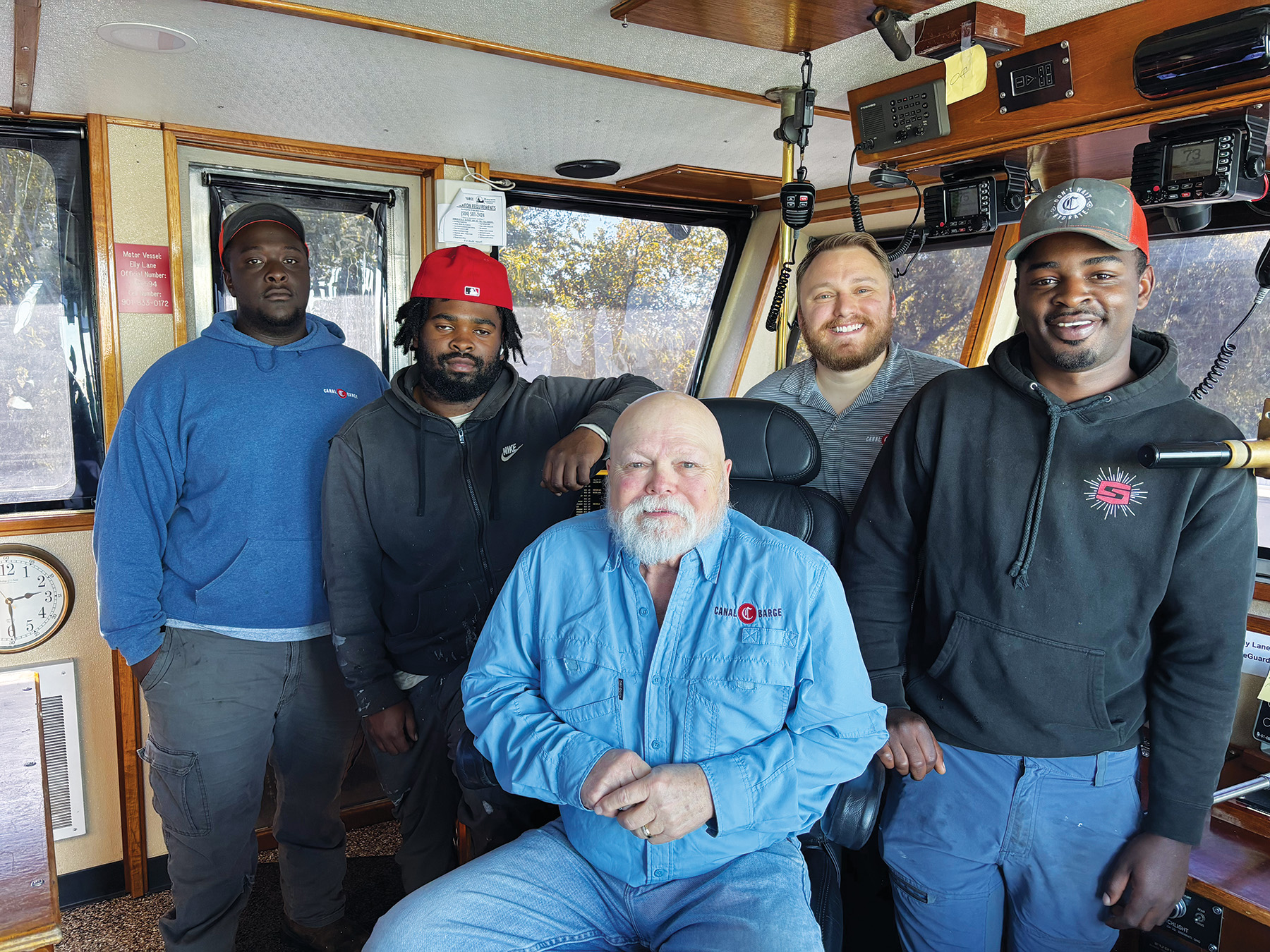
When Pilot Miles Smith heard the Atlantic Asphalt asking for help due to a “potential loss of steering,” he called Capt. Clyde “C.A.” Bowen to the bridge while the crew of three got ready to assist. It took about 15 minutes to travel from the Kinder Morgan terminal at Harvey downriver to where vessels were already responding. “The response from fireboats and private industry was very robust,” Smith said. “It was a broad mix of vessels. We saw people in the water right away.”
“We train regularly for scenarios like this,” he continued. “Man overboard is a very serious concern, and it’s a part of every conversation and pre-watch huddle. We are very grateful for the robust safety-training program here at Canal Barge.”
All the boats on scene coordinated with each other. The Elly Lane’s crew pulled some of the 14 people they rescued from the water, and they helped others transfer from small line-handling pontoon vessels that had already picked some up.
“Our greatest concern was hypothermia,” Smith said. “Even though the weather was warm, the water was about 66 degrees. We gave them blankets and got them into the warm galley as quickly as we could. Most of the people were in shock; some said they were not sure how they ended up in the water.” One woman had a suspected arm and leg injury. “The Coast Guard medical response was overwhelming,” Smith said.
Both Bowen and Smith said they are sure that the crash will be studied for lessons learned for years to come and will be part of all towing vessels’ training materials in the future. “It’s very humbling to be part of such a fantastic group effort,” Smith said. Bowen added, “I couldn’t ask for a better crew or better training.”
Rescuers Praised
All public officials, from the mayor to NTSB investigators, praised the rescuers who responded “in minutes, not hours,” NTSB board member John DeLeeuw said. At the November 13 news conference, Louisiana Gov. Jeff Landry also repeatedly praised the rescuers, saying about the response, “These things don’t happen by accident.” In addition to vessels of the Coast Guard and the New Orleans police and fire departments, commercial towboats sprang into action.
There was no shortage of heroes and good Samaritans, each coordinating their efforts. The crew of the mv. Stephanie Stone were the first to arrive on scene and helped prop up the listing cruise ship to bear its weight. Other Stone Oil towboats assisted, including the Presager and Stone Power.
Several other John W. Stone boats took part in rescue operations. Capt. William Brunner of the mv. Madison Stone positioned his vessel against the American Heritage to hold it steady while his crew executed rescues. Capt. Ryan Williams managed operations on the Madison Stone’s lower decks to organize rescue plans and pull people to safety. Capt. Brian Clesi of the paddlewheeler Creole Queen, who appeared on several TV newscasts, and his crew pulled nine people from the water.
Other responding vessels included Moran Towing’s Becky S; Crescent Towing’s Mardi Gras and G. Shelby Friedrichs; E.N. Bisso’s Marauder; and Canal Barge’s Elly Lane.
American Cruise Lines released its own statement, saying, “We are proud of our captain and crew for their professional response, and we are grateful to the first responders in New Orleans who stepped in quickly to assist. All passengers and crew are safe and accounted for. We would like to recognize Capt. Leonard Stewart, whose immediate and decisive actions with the crew allowed for the rapid evacuation of the vessel. Capt. Stewart remained on the bridge as the vessel capsized, calling for aid and keeping the ship alongside the dock for as long as possible.” Stewart reportedly refused to leave the bridge or accept assistance for his injuries until the ship was evacuated.
NTSB Investigation
NTSB investigators, delayed by a flight grounding blamed on “a telecommunications and data overload issue stemming from an infrastructure upgrade,” held news conferences November 14 and 15. A preliminary report is due in 30 days and a final report in 18 to 24 months.
DeLeeuw said 16 investigators were interviewing crews from both vessels. They recovered the Atlantic Asphalt’s voyage data recorder, which NTSB investigator Bart Barnum likened to a cockpit flight recorder, capturing course, speed, rudder angle and bridge audio.
DeLeeuw described a “steering casualty” in which the tanker’s rudder stuck to starboard but said many things could cause it, deferring further comment until all facts are gathered. He asked the public to send video to witness@ntsb.gov.
Salvage Efforts
DeLeeuw said that investigation efforts involving the American Heritage depend on the vessel’s ongoing salvage, which may take weeks and is under the direction of the Coast Guard and contracted salvage companies.
According to the Coast Guard, a Unified Command consisting of the Coast Guard and American Cruise Lines is overseeing and coordinating all lightering and salvage operations for the American Heritage. Priorities remain the safety of response personnel and the public, protection of the marine environment and the safe and efficient recovery of the vessel. Diving operations began on November 15 to assess hull damage below the waterline and inform subsequent salvage operations.
Additional surveys and assessments are ongoing, and lightering and salvage plans are being developed and reviewed by technical experts. A containment boom remains deployed around the American Heritage as a precautionary measure.
Tanker Seized
The Atlantic Asphalt was seized by the U.S. Marshals Service due to two lawsuits against the vessel. The first was filed by the board of commissioners of the Port of New Orleans November 13, the day of the allision, in the U.S. District Court for the Eastern District of Louisiana (Case No. 2:26-cv-02611), seeking more than $1 million in damages, cleanup costs and repairs to the Thalia Street Terminal. A federal judge authorized the seizure.
The second lawsuit was filed by four crewmembers of the American Heritage in the Eastern District of Louisiana against the tanker’s owner and management company, seeking compensation for significant injuries, medical expenses and punitive damages. Under maritime law, vessels with monetary claims against them may be seized after a judge’s order to satisfy the claims.
The tanker’s owner is Nave Shipping SA, a Monrovia, Liberia-registered company that is a subsidiary of the China State Shipbuilding Corporation, according to the International Maritime Organization (IMO) and court records from the board of commissioners of the Port of New Orleans lawsuit.
According to MagicPort, a ship-tracking and logistics website founded in Singapore, funded by a group of venture capital funds and supported by the Maritime and Port Authority of Singapore, Nave Shipping SA’s fleet is active across 48 ports and regions worldwide and is currently not sanctioned.
Tanker Had Prior Warnings
The Times-Picayune/Advocate’s James Finn broke the news that the Atlantic Asphalt has been repeatedly cited for malfunctioning navigational systems and not being able to properly deploy lifeboats in an emergency by the U.S. Coast Guard, Canadian and European officials, Nola.com reported. NTSB investigators responded to questions about possible causes by saying they were still gathering facts.
Featured photo caption: Left to right: Tankerman Keelan Slaughter, leadman Derrick Carter, Capt. Clyde “C.A.” Bowen, pilot Miles Smith and tankerman Zebbdee Harris of Canal Barge’s mv. Elly Lane. (Courtesy of Canal Barge Company)