

A Year of Service, Resilience and Deepening Commitment
By the Rev. Mark Nestlehutt, President and Executive Director, The Seamen’s Church Institute
December always invites pause—a chance to reflect on all that has unfolded across our industry and the role the Seamen’s Church Institute (SCI) has played in supporting the men and women who keep our waterways moving.
Since our founding in 1834, SCI’s sole purpose has remained unchanged: to care for the material, physical, emotional and spiritual wellbeing of mariners. For nearly two centuries, this mission has often meant stepping into moments of profound crisis, whether comforting surviving crew members after the sinking of the RMS Titanic, standing alongside the families of deceased seafarers in the wake of the SS El Faro tragedy or standing with the crew following the mv. Dali’s catastrophic allision with the Francis Scott Key Bridge in Baltimore, Md.
This year brought its own unexpected call to serve. In January, a U.S. Army Black Hawk helicopter collided midair with an American Airlines regional jet, sending both aircraft into the Potomac River. At first, SCI’s role in such an aviation tragedy wasn’t immediately clear, but the maritime community saw one and reached out. At the company’s request, the Rev. Geoffrey Davis, a Ministry on the River (MOR) chaplain, deployed from New Orleans to Washington, D.C. to provide pastoral care to the mariners working first on the search-and-rescue vessel and then on the recovery vessel as the mission shifted.
Not every trauma makes national news. This year, our MOR chaplains responded quietly and steadily to overboardings, drownings, collisions, completed suicides and other tragedies—including a helicopter crash into a barge—that the public rarely hears about. Each of our full-time chaplains and chaplain associates is trained in Critical Incident Stress Management (CISM) and Applied Suicide Intervention Skills Training (ASIST), building on their pastoral and theological foundations to bring mariners comfort in their most difficult hours.
Yet crisis response is only part of what SCI’s chaplains do. Day after day, they move where mariners move: attending port captain meetings, visiting vessels, conducting ride-alongs, offering Christmas at Sea on the River packages, participating in crew changeovers, speaking at conferences and celebrating new vessel christenings. They provide continuing care long after a tragedy and even perform baptisms and weddings for mariners who may have no faith community of their own. Standing alongside mariners—body, mind and spirit—is our calling.
Education is another cornerstone of our work. SCI began training mariners in the late 19th century, focusing first on deep-sea sailors. Our inland maritime chapter began in 1997 with the opening of our training facility in Paducah, Ky., followed by a second one in Houston in 2001. Today, SCI’s Center for Maritime Education (CME) delivers 80 weeks of Advanced Pilothouse Management each year, serving nearly 2,000 captains, pilots and steersmen from more than 30 inland and coastwise companies. Our advanced simulators allow mariners to rehearse complex scenarios, such as vessel constraints, near misses, collisions and challenging weather conditions, so they can learn safely from both experience and error. And when mariners can’t train in our simulators, our e-Learning courses step in, giving more than 10,000 mariners each year the flexibility to train anytime, anywhere, on whatever mobile device they have in hand.
SCI’s third mission area—advocacy—has evolved from addressing traditional seafarer rights (such as piracy, abandonment and shore leave) to confronting the inland industry’s pressing challenges around physical and mental health. While still providing legal assistance to mariners, our Center for Mariner Advocacy (CMA) also partners with our chaplains, providing ASIST and safeTALK training to port captains, shoreside personnel and active mariners, equipping them to recognize and respond to suicidal ideation and mental health crises.
On a broader level, CMA collaborates with institutions like Yale Medical School to deepen understanding of the unique pressures maritime workers face. Earlier this year, CMA Director Phil Schifflin, Esq., a retired U.S. Coast Guard captain, presented research and insights on mariner health at both the GICA Seminar and the AWO safety meetings. Phil also convenes a monthly Mariner Wellness Committee, bringing industry leaders together to address shared concerns and build practical solutions.
In 1997, when SCI expanded into the inland and coastwise industry, the Rev. Canon Peter Larem, then president of SCI, insisted that training mariners must be paired with ministering to their unique needs. From that conviction, Ministry on the River was born. Today, MOR includes three full-time chaplains (based in Paducah, New Orleans and Houston) with plans to add a fourth chaplain in 2026. They are supported by more than 20 trained chaplain associates across 14 states, ensuring SCI can respond quickly when crisis strikes, wherever it strikes.
For 28 years, the inland and coastwise community has supported SCI through annual campaign gifts, corporate sponsorships, training partnerships and participation in our Maritime Bell and River Bell luncheons and our Mountain Challenge. We could not do this work without your generous commitment and support.
As this year draws to a close, I remain deeply proud of SCI’s mission and feel honored to serve alongside the dedicated chaplains, instructors, simulator operators, attorneys and staff who carry out our mission every day. Please reach out to any of us at SCI if you want to learn more about how we can support you, or if you have ideas about how we can better serve this extraordinary industry. Thank you for the many ways you have allowed SCI to serve you, and for the many ways you continue to support us in return.
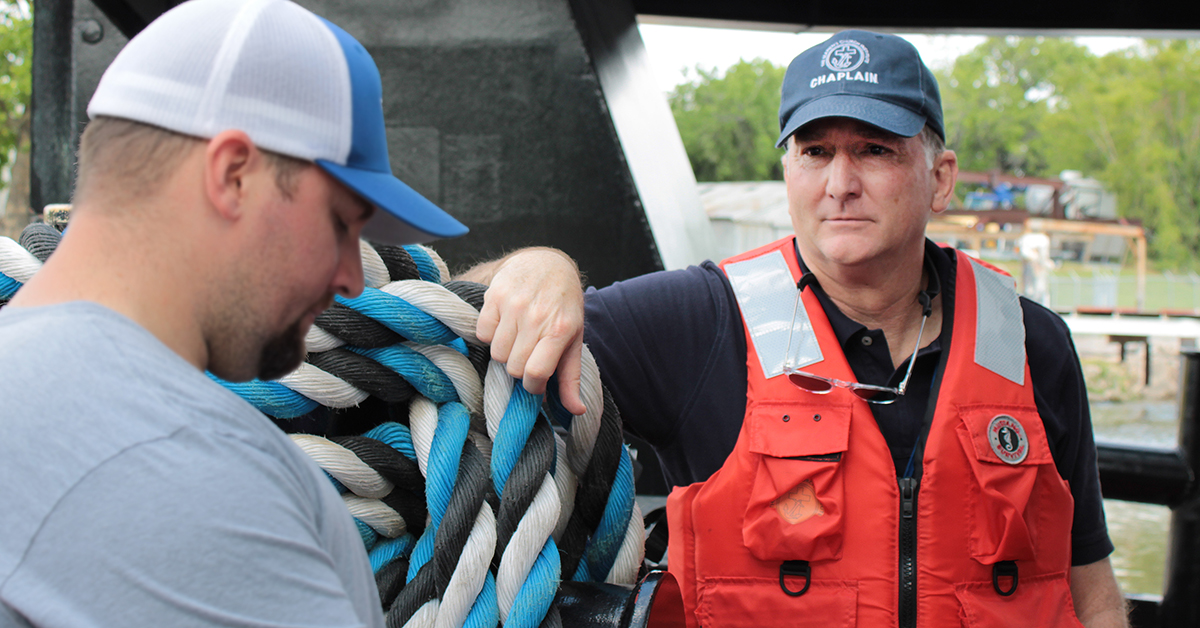
Featured image caption: SCI President and Executive Director Mark Nestlehutt visits with a mariner aboard a towing vessel. (Photo courtesy of the Seamen’s Church Institute)