

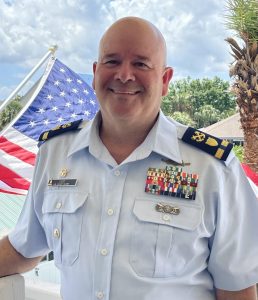
Chief Warrant Officer Paul Zado, Captain, Coast Guard Cutter Pamlico
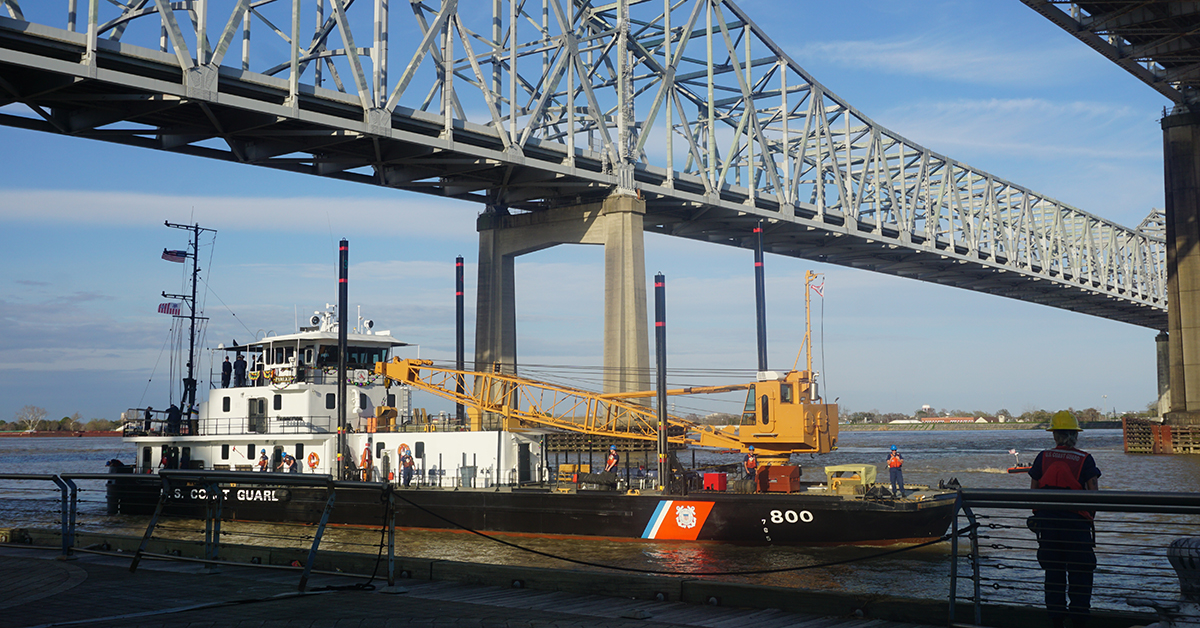
Coast Guard Cutter Pamlico has seen a lot of crew members come and go over the years. The 160-foot-long inland construction tender assigned to Sector New Orleans was commissioned on August 11, 1976, and in the 50 years since then, the Pamlico has been home, at any given time, to as many as 16 crew members, each serving up to three years before moving on to another assignment.
All except Chief Warrant Officer Paul Zado, now in his eighth year as captain aboard the Pamlico.
“I’ve been here on Pamlico since 2018,” Zado said. “I’m an anomaly, a major anomaly.”
Longest-serving captain of the Pamlico isn’t the only superlative Zado can claim. Among the Coast Guard’s more than 40,000 active-duty members, Zado stands alone in terms of sea time.
“I don’t brag about this because it’s just the way it is,” Zado said, “but I happen to have more time consecutively on ships than anyone else in the Coast Guard. I’ve been on 13 ships in a row.”
Of all active-duty Coast Guard members, only about 6,000 have more than five years of ship time, Zado said. Ten years? That number shrinks to 1,000. Fifteen years? About 100. According to Zado, only nine current Coast Guard members have reached the distinction of “master cutterman” with 20 years or more on ships.
“I have nearly 32 years on ships,” he said. “I don’t say that to impress people or any of that. I’ve enjoyed doing it. I like doing what I’m doing.”
Zado comes from a long line of public servants. His great grandfather was fire chief for the city of Detroit. His grandfather was chief of police for Detroit. Zado’s father served in the U.S. Navy during Vietnam, as did an uncle. Zado’s brother spent 25 years in the Coast Guard.
“I’m at 35 years now of being in the Coast Guard, which, again, is an anomaly,” he said. “I was supposed to retire mandatorily at 30.”
Zado graduated from high school in 1991, and as he was deciding what to do next, his father encouraged him to consider the Coast Guard. He joined in January 1992 and was first assigned to a search and rescue station in New London, Conn. While working on smaller utility boats at that station, Zado interacted with some colleagues who had worked on ships, so after about 10 months there, he put his name in for specialty school to be a quartermaster.
“Then I got orders to go to my very first ship up in Ketchikan, Alaska,” Zado said, “which was a 180-foot buoy tender.”
He was hooked. Because of the remoteness of Alaska, Zado’s ship often would service lighthouses, in addition to shore-based aids to navigation. He was there from 1993 through 1995, when GPS in that part of the world wasn’t 100 percent functional, so crew members would use sextants to position buoys.
“I navigated all over southeast Alaska, in and around all these waterways with rocks, using traditional, old-school radar ranges and bearings and good old seamen’s eye and aids to navigation that we would service to make sure mariners could get where they needed to go,” Zado said.
While there, Zado also met his wife, Jessica, whose father was the boatswain on his ship.
“I got invited to Thanksgiving dinner,” Zado said. “Evidently, I was doing something right because I was his subordinate and got invited.”
Zado said his wife’s family also has a legacy of service. Besides her father, her grandfather was also in the Coast Guard, as was an uncle, who died aboard the Coast Guard Cutter Blackthorn, which sank in Tampa Bay following a collision with the tanker Capricorn in 1980.
From his ship in Alaska, Zado next served on an 82-foot patrol boat in Newport, R.I. Then, he served on a 210-foot medium endurance cutter out of Astoria, Ore. After a year there, Zado went back to the East Coast, this time on a 110-foot patrol boat stationed at Fort Macon, N.C.
From there, he became first mate on an 87-foot patrol boat in Panama City Beach, Fla. He then served on a 210-foot medium endurance cutter based in Cape May, N.J.
“That was a three-year job for me, but I was gone 235 days a year on that ship because of everything that we were doing with 9/11, all the boardings and protecting infrastructure in the Northeast,” Zado said.
While on that ship, Zado was promoted to senior chief, and after two years, he was given his first command aboard a vessel based in South Padre Island, Texas. His second command was in Carabelle, Fla. Both of those vessels were primarily tasked with law enforcement. After a stint on a buoy tender, Zado was sent to be the boatswain of a 378-foot high-endurance cutter based in Alameda, Calif. That vessel, he said, deployed anywhere from Central America to the Bering Sea. He then spent four years on a buoy tender in Galveston, Texas, followed by another three-year stint in North Carolina.
Zado said from there he hoped for one more command in Texas, after which he planned to retire there. Instead, the Coast Guard assigned him to the Pamlico in New Orleans.
“We’ve always been very optimistic about everywhere we go,” Zado said. “We’ve always made a bucket list right when we get to a place. You make the best of wherever you’re at because, if you don’t, shame on you. If you’re just disgruntled and unhappy, it’s your own fault.
“So we got here, and this is the best job I’ve ever had in my entire career,” he added. “It’s an unbelievable job.”
Zado said he loves the complexity of maneuvering the Pamlico, building aids to navigation, the whole bit.
“It’s just downright fun,” he said. “It’s hard work, but it’s good work.”
The Pamlico’s area of responsibility stretches from Biloxi, Miss., west to Grand Isle, La., then from the mouth of the Mississippi River up to Baton Rouge, La.
“We have almost 800 aids to navigation that we’re responsible for rebuilding if something happens to them,” Zado said.
Zado said, as busy as the region is with commercial navigation and as dynamic as the environment is, the Pamlico stays busy repairing and replacing physical aids. He emphasized the importance of industry reporting damaged or displaced aids. Doing so ensures efficient repair schedules for the Pamlico.
So how has Zado made it to eight years on the Pamlico, well beyond the typical three?
It’s a combination of Zado’s unmatched expertise and the difficulty of the Pamlico’s mission.
“This is a unique job, and the area has its own challenges that some people don’t want to accept, but we’ve loved it here,” he said.
Besides the work of building and repairing aids to navigation, Zado said he enjoys the training and team building he gets to do as captain aboard a construction tender. Effectively leading a crew, he said, has changed a bit over the years.
“One of the biggest things I’ve learned is you have to morph with the people,” he said. “I can’t be a one-trick pony, ‘this is how I lead people.’ I have to learn how to motivate people.”
A big part of that is being willing to explain why something is done a certain way, rather than just giving an order.
“We have inquisitive, very informed young people today,” he said.
Zado said one way he enjoys building a sense of team and camaraderie among the crew is by hosting crew members in his home for holidays and special occasions and by taking the crew out when off duty.
“Those things are huge morale boosters,” he said.
With his retirement coming up this summer, Zado said he’s soaking up his last Carnival season as captain aboard the Pamlico, while also composing some “cliff notes” for his successor. And while Zado has no doubt the next captain of the Pamlico will do a great job, his record of eight years aboard the buoy tender is likely safe. Sector New Orleans is third in line for a new Waterways Commerce Cutter to replace Pamlico, Zado said.
Retirement may not last forever, Zado said, but post-Coast Guard, he’s looking forward to seeing his two children through college and traveling in his family’s Airstream.
Featured image caption: U.S. Coast Guard Cutter Pamlico, a construction tender homeported in New Orleans, beneath the greater New Orleans Bridge in New Orleans on March 3, 2025. (Photo by PO3 Cheyenne Basurto)