
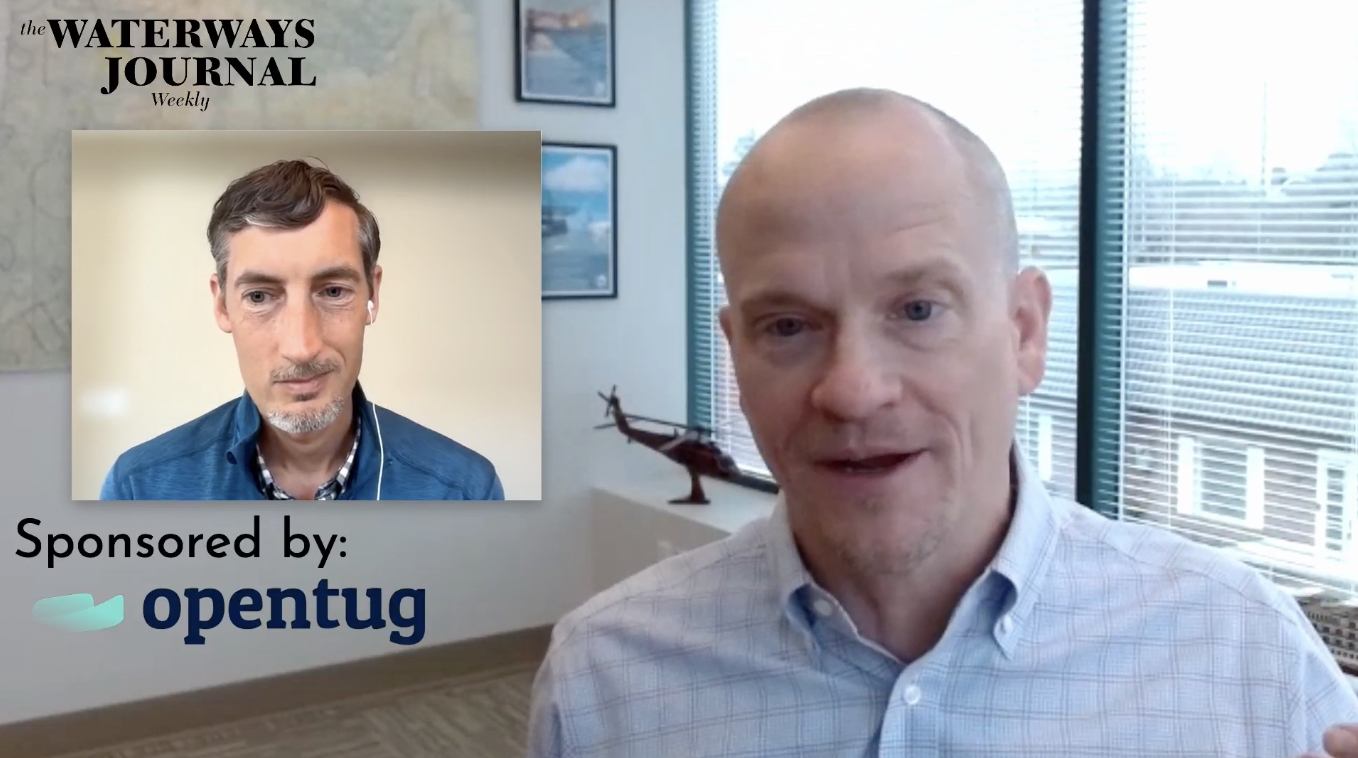
WJ Talk: Neil Maunu Discusses Cargo Diversity, Strategic Role Of PNW Waterways
Neil Maunu has been executive director of the Pacific Northwest Waterways Association (PNWA) for the better part of three years. Maunu was the guest on the most recent WJ Talk podcast where he discussed the diversity of his organization’s members, cargo and operational trends on the waterways in his region, goals for PNWA and challenges facing the Columbia-Snake River System. The full interview is available at www.waterwaysjournal.net/wj-talk. What follows is a condensed Q&A version of the conversation.
The Waterways Journal: First off, take a moment to introduce readers to the Pacific Northwest Waterways Association, your members and the areas in which your members work. What are some of the industries they’re involved in and what commodities do they move?
Neil Maunu: We have over 150 members. We’re a non-profit, non-partisan industry trade association that does federal advocacy. We do the vast majority of our work with our members and with our partners back in Washington D.C. We’re regionally based, regionally focused, so that means Oregon, Washington and Idaho.
One of the great things about our membership is the diversity. Examples of PNWA members include: public ports, tug and barge operators, terminal operators, union labor, agriculture producers, steamship operators, electrical utilities, irrigation districts, other businesses, public agencies and individual. We even have some consulting groups. So we’re this great conglomeration of maritime industry folks that gather, support each other, network and work on the issues that are important to our river system, our coastal ports and our members.
WJ: Our readers will be familiar with the phrase ‘Western rivers,’ meaning the Mississippi River and its tributaries. But your river system is truly ‘western.’ Talk a bit about what’s distinctive about the waterways in your area and the vessels that work upon them.
NM: We have small coastal ports that are primarily involved in commercial fishing. We also have large container ports along the Columbia River. Then, we have river system operations. Some of the commodities we’re moving on the river system include grains (wheat, primarily, for which we are the number one exporter in the country), renewable fuels and conventional fuels, wood chips and wood products.
We work pretty closely with some other regional industry groups and associations, including the Upper Mississippi Waterways Association, with whom we’ve begun a partnership over the last couple of years. We’re able to cross-talk similarities and differences and share ideas.
Our federal navigation channel is a high-lift system that goes all the way up to the seaport in Lewiston, Idaho. The deep-draft channel is 43 feet deep and goes from Portland, Ore., 110 miles down the Columbia River to the Pacific Ocean. Our shallow-draft section is 14 feet deep and goes 465 miles inland, with four locks and dams on the Columbia River and four on the Snake River all the way up to Lewiston. Our locks provide a lift of between 100 feet and 110 feet.
WJ: The barges that move grains on the Columbia-Snake River System are different from the ones on the Mississippi River and tributaries, correct?
NM: Yes. Our locks are 86 feet wide by 675 feet long — all eight projects are the same — so our grain barges are designed specifically to fit in four-barge tows. They average 3,500 tons per barge, so we can move almost 14,000 tons in a tow. Our barges are made specifically for this system. We have six export elevators on the lower Columbia River between Portland and Longview, Wash., that unload the barges. It’s a closed system, and it’s a unique system, so our tug and barge operators are built specifically for this system.
WJ: Dredging on the Columbia River and lawsuits opposing the locks and dams on the system have been in the news lately. What updates can you provide on those two issues?
NM: The lower Columbia River was deepened to 43 feet in 2010. Four ports on the lower Columbia River were cost-share partners with the Portland District on that project. The Corps is now working on its 20-year dredge maintenance plan for dredging the lower Columbia River. One of the challenges is that we’ve run out of places to put the material, so the Corps is proposing to build confined aquatic structures in the river and placing dredged material there. That would be great for salmon and steelhead habitat. It’s a great solution. The challenge, though, is the cost, $85 million, which would be cost shared by those same four ports, because the Corps considers it to be a new construction project.
One of the things PNWA has been advocating for in this year’s Water Resources Development Act (WRDA) is to have that project to be fully federally funded. Even folks in the Midwest and the other river systems rely on our system here for exports. We’re the number one export gateway in the United States for wheat. We export 30 million tons of grain through the Columbia River every year, so we think this is a national priority that should be fully federally funded.
Regarding the dams on the Snake River, environmental groups, some tribes and even the states of Oregon and Washington have sued the federal government over the past 25 years saying that those dams should be removed for salmon and steelhead populations. The most recent litigation was filed in 2020. At issue is a term in the Endangered Species Act on whether these dams cause “jeopardy” to the fish species. After four years and $54 million, all the government agencies involved said no, they do not cause jeopardy. That led to a federal mediation process that resulted in a stay in litigation and a path that our stakeholders and river users viewed as leading toward dam breaching. Within the last year, the Trump administration has taken a position saying, “No, we are not acceptable of moving forward with this sustained litigation.”
About a month ago, the issue was heard by a judge in Oregon District Court. The plaintiff asked for lower pool levels and more spill in the system, which from a navigation standpoint compromises the safety of what we do in this river system and the reliability. It sets us on a path toward a federal judge telling industry, river experts and the Corps how to operate this system. Fortunately, we’ve got a great partnership with the Corps of Engineers, and they’re able to fulfill their congressional mandate to ensure we have a safe system, but again, it sets poor precedent.
What I tell people is, endangered species issues are everywhere throughout the country. For these environmental groups, this is a litmus test for the rest of the country. On the Columbia-Snake River System, this affects navigation, renewable power generation, irrigation for tens of thousands of acres of crops and recreation. It’s important that folks understand why it’s important and learn about the issue, because it’s far from over.
WJ: Talk about how global issues like tariffs, fuel prices, war, etc., affects your stakeholders.
NM: Our industry and our farmers are trying to compete globally with places like Ukraine and Australia on that soft white wheat market. We’re moving it the most efficient way, barge to vessel, with some moving in by train and a little by truck. When those input costs go up, those margins go away. Inputs like diesel fuel and fertilizers have a big impact on our agriculture community and our maritime industry, so they’re really feeling the negative effects now.
WJ: What are some ways readers can get involved with PNWA and advocate for the system?
NM: We’re going back to D.C. for our annual Mission to Washington on April 20. We’ll have a full day at the Capitol, like a lot of our industry groups do. We’ll sit in one room with our members, bringing together about 80 stakeholders and members of Congress. We’ll visit both the House side and the Senate side, and it’s a really good opportunity for our members to hear from PNWA’s members and to hear the real-time impacts we’re seeing because of what’s going on globally right now, both good and bad.
At the PNWA website (www.pnwa.net), anyone can sign up for our newsletter. On the website, we also offer general fact sheets about the system, along with a WRDA-specific fact sheet. Are priorities as an organization are outlines at www.pnwa.net/our-priorities.