
Columbia-Snake River System: The Breadbasket To Asia
From the crest of the Rocky Mountains along the Continental Divide and the eastern slopes of the Cascade Range flows one of North America’s great river systems: the Columbia River and its largest tributary, the Snake. Their combined drainage basin covers approximately 258,000 square miles, an area roughly the size of Myanmar in Asia, spanning seven U.S. states and a portion of British Columbia, Canada.
Within this vast watershed lie the fertile fields of the Palouse and other productive agricultural regions. Farmers here harvest bountiful crops, chief among them wheat destined, not only for domestic milling, but also for export to Asia, where it becomes bread, pastries and noodles for millions.
The Columbia-Snake River System forms a critical 465-mile federal inland navigation waterway from the Pacific Ocean near Astoria, Oregon, upstream to Lewiston, Idaho, making Lewiston one of America’s most inland seaports. This includes about 326 miles on the Columbia River and 139 miles on the lower Snake River. The system serves key ports, including Portland; Vancouver, Wash.; the Washington Tri-Cities of Pasco, Kennewick and Richland; and Lewiston.
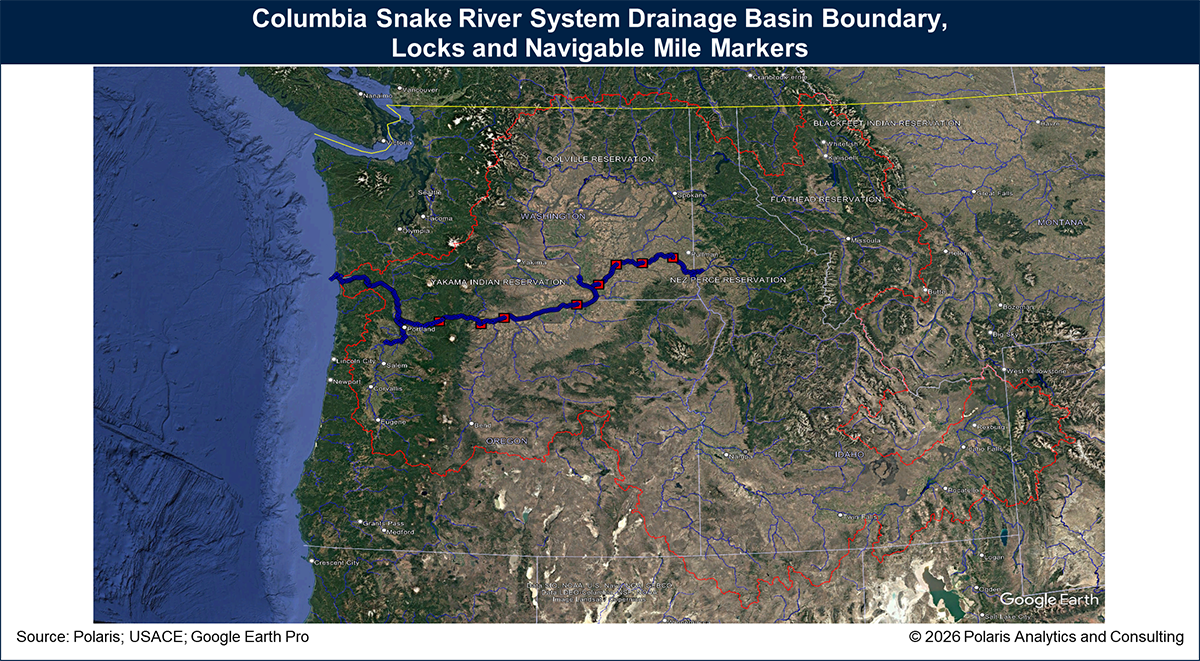
Eight federal locks and dams make this navigation possible: four on the Columbia (Bonneville, The Dalles, John Day and McNary) and four on the Snake (Ice Harbor, Lower Monumental, Little Goose and Lower Granite). These structures create a series of slack-water pools, allowing barge tows and passenger river cruises to operate with a minimum 14-foot channel depth in the upper reaches. The lower Columbia River, meanwhile, accommodates ocean-going vessels with drafts up to 43 feet.
Waterborne Commerce On The Columbia River
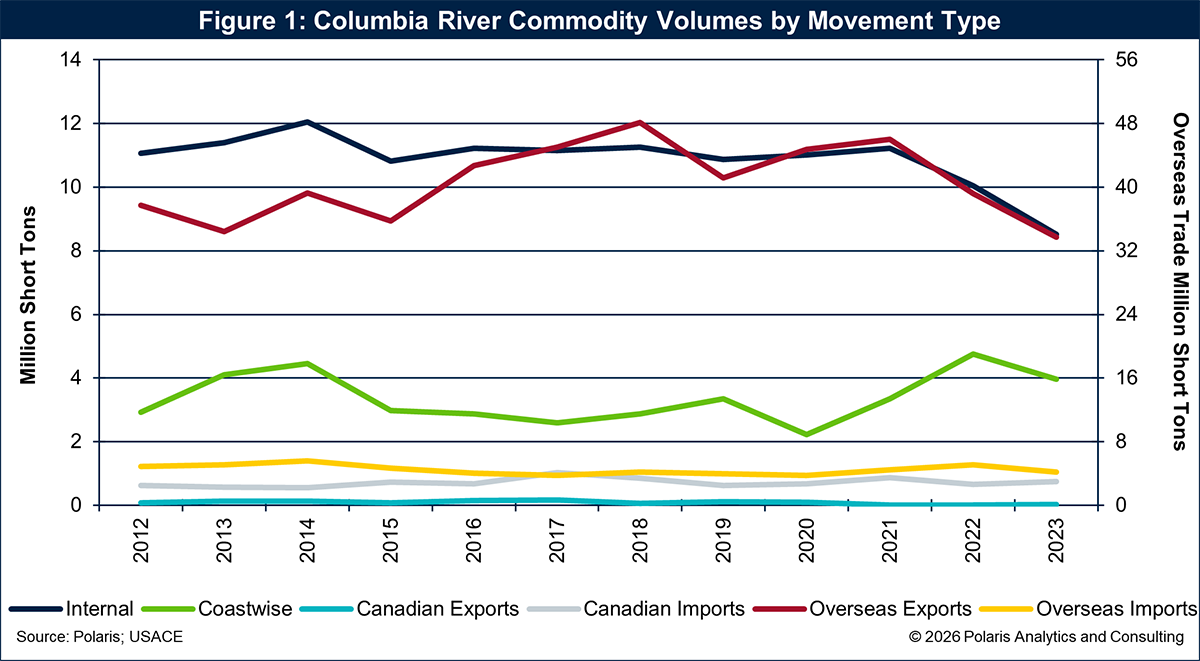
The Columbia River serves as a vital lifeline for both international trade and domestic markets. According to Corps of Engineers data, foreign export volumes through the Columbia River system have averaged roughly 40 million to 45 million short tons in recent years, fluctuating from a low of about 33.6 million tons in 2023 to a high of 48.1 million in 2018. Imports average around 4 million to 5 million short tons annually.
Inland barge traffic (internal movements) averages approximately 10 million to 12 million short tons per year, while coastwise traffic (serving other Pacific Coast ports) contributes several million more. The most recent data available on waterborne commerce is through 2023 and is shown by movement type in Figure 1.
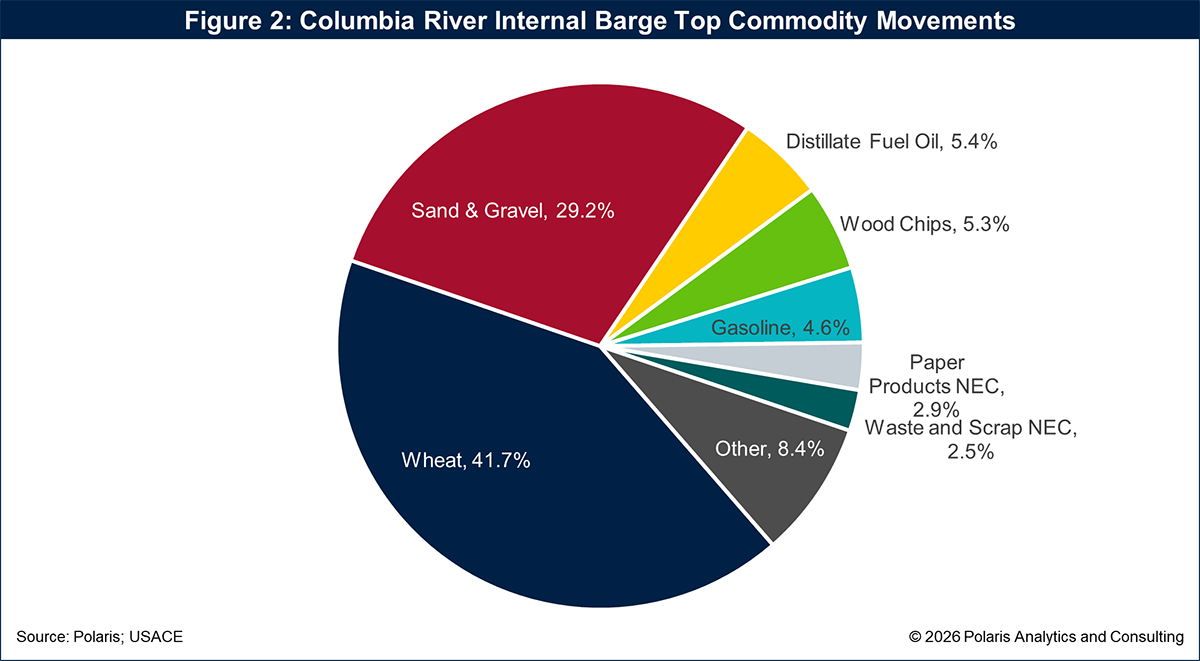
Since 2012, the Columbia-Snake River System has moved at least 34 different commodities. However, traffic is dominated by wheat and sand/gravel, which together account for more than 70 percent of barge volumes in many years. Other key commodities include distillate fuel, wood chips, gasoline, paper products and waste/scrap materials. These goods feed and fuel the Pacific Northwest while underpinning the regional economy and global supply chains. The top commodities moved by barge on the Columbia-Snake River System are shown in Figure 2.
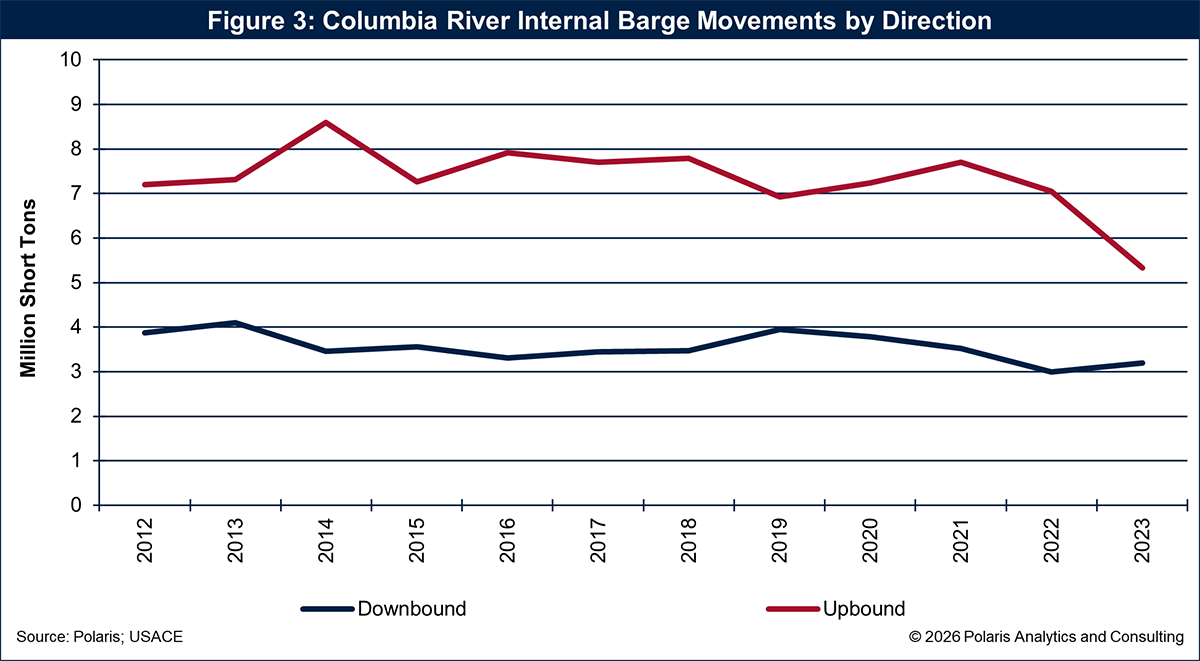
Directionally, roughly two-thirds of barge commodity volume moves upriver (bringing fuel, fertilizer and construction materials), while one-third moves downriver (primarily grain and forest products to export terminals). Seasonal patterns are pronounced, with barge movements peaking during the grain harvest and export season. Wheat, particularly soft white varieties ideal for Asian noodles and pastries, remains the standout commodity. The Snake River alone accounts for a significant share of U.S. wheat exports moving by barge. The direction that commodity volumes are moved by barges is shown in Figure 3.
Resilient River, Improving Export Prospects
The Columbia-Snake River System has proven remarkably resilient despite challenges such as fluctuating water levels, maintenance outages and shifting trade dynamics. Annual lock maintenance temporarily pauses navigation (typically for two weeks in early spring), but operators coordinate closely to minimize disruption.
Looking ahead, U.S. wheat exports are forecast to reach 900 million bushels for the 2025-26 marketing year, an increase of about 9 percent from recent lows and a positive signal for the river system. Strong global demand for high-quality Pacific Northwest wheat, combined with efficient barge transport, positions the Columbia-Snake corridor as a competitive gateway to Asia.
Barging remains one of the most fuel-efficient modes of freight transportation, with barges capable of moving one ton of cargo approximately 675 miles on a single gallon of fuel, far surpassing rail or truck efficiency. On the Columbia-Snake, this efficiency is achieved with larger barges (typically 3,500 tons each) assembled into compact four-barge tows that fit the system’s locks, compared to the Mississippi River’s smaller barges (1,750 tons) and much larger 15-barge tows.
Beyond economics, the system delivers multiple benefits: hydropower generation, flood risk management, irrigation support and recreation (including growing river cruise traffic). Yet it also faces ongoing environmental considerations, particularly around salmon and steelhead passage, which require careful balancing with navigation and power needs.
From the snow-capped peaks of the Rockies to the Pacific, the Columbia River and its Snake River partner continue to serve as a dynamic “breadbasket to Asia.” As global trade evolves and export prospects brighten, this resilient waterway will remain essential to Pacific Northwest agriculture, regional prosperity and international commerce.