

TRVA Conference Stresses Importance Of Lock Projects
A Corps of Engineer initiative launched in February is helping to prioritize each district’s and region’s major projects, and that includes both the Kentucky Lock Addition Project and the Chickamauga Lock Replacement Project.
Lt. Col. Guillermo Guandique, commander of the Nashville Engineer District, made the announcement in an update to the Tennessee River Valley Association (TRVA) on March 23. He added that Assistant Secretary of the Army for Civil Works Adam Telle will be in charge of communicating specifics, including timelines and funding needs for each project to Congress, so he could not speak on those topics.
However, he said, the “Building Infrastructure Not Paperwork” initiative is designed to prioritize fewer projects and deliver those faster, with special emphasis on projects of national significance.
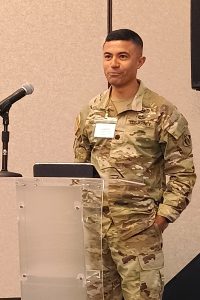
“The good news for you is at the top of that is navigation,” Guandique said.
Each district has been asked to prioritize its top five projects, with regions then asked to prioritize their top 20 projects. Chickamauga and Kentucky both were included in those rankings, Guandique said, saying of Telle, “He’s going to hold us accountable for that.”
Because of limitations on its resources, the Corps of Engineers will rely more on industry and state partners to make sure that needs other than those on its priority list are met, he said.
“What we can commit to you is that we understand the challenges, and we also understand our mission,” he said.
Guandique was the first of several invited speakers at the 59th annual TRVA meeting, held in conjunction with the Tennessee-Cumberland Waterways Council meeting in Franklin, Tenn.
“Our objective is to make sure our system is in top shape,” TRVA Executive Director Cline Jones said in his welcome to participants. He emphasized the connectedness of the river system, noting that projects even far away, such as a planned new 1,200-foot lock chamber at Upper Mississippi Lock 25 or the completion of the Lower Monongahela River Project near Pittsburgh all affect what moves downriver.
Projects moving on the Tennessee River and Tennessee-Tombigbee Waterway also have national significance, he said. As an example, he pointed out that United Launch Alliance’s new Vulcan rocket, built in Decatur, Ala., is the backbone of NASA’s Space Launch System, including the Artemis program designed to return humans to the moon. Those rocket components are tested in Huntsville, and the only way to get them from the factory to the test site is by barge, he said.
According to the ULA website, the specialized boats R/S RocketShip and R/S SpaceShip transport Atlas V and Vulcan boosters, second stages and payload fairings 2,652 river miles and 10,506 ocean miles from Decatur, Ala., to Cape Canaveral Space Force Station in Florida and to Vandenberg Space Force Base in California.
Yet, Jones said, “Our locks are in terrible condition. There’s not enough money to do anything.” So, he said, “Let’s focus on locks and make sure we have a proper navigation system. The importance of this system is just too great to let it be in the condition it is in today.”
Kentucky Lock
Brian Trzaska, deputy of programs and project management for the Pittsburgh Engineer District, noted that even though the Kentucky Lock Addition Project is now under the management of the Pittsburgh District, it continues to work closely with those in the Nashville District, including the resident office at the end of Kentucky Lock, which remains staffed by Nashville District employees.
What the Pittsburgh District has brought with it is a history of successful projects, including the Lower Mon Project and the ongoing Montgomery Lock and Dam project, he said. Additionally, adding the resources of the Inland Navigation Design Center to the project will provide efficiency and standardization across projects, which means when components do fail, they will be easier to replace quickly.
Jessa Farmer, who is in a lead position with the Kentucky Lock Addition Project, said the team is focusing on the design for all the remaining features of the project, which will add a 1,200-foot navigation chamber at Tennessee River Mile 22.4. Three contracts will be solicited for long-lead items, she said.
The team has been supported by the Tennessee Valley Authority (TVA) for its ship simulation project, with the navigation industry attending two events in August and October, during which five alternatives were modeled and investigated through the course of more than 100 scenarios. That helped to determine the need for an additional upstream mooring cell at the lock and overall cell spacing, she said.
The Corps has also built a 3D model of the lock that helps determine where conflicts may arise. For example, she said, designers were able to change the elevation of a bridge so that a crane that performs operations and maintenance work can fit beneath it.
Work continues on the Downstream Lock Monolith Contract with 89,000 cubic yards of concrete placed in 2025 and a total of 258,891 cubic yards total placed in the project, accounting for 69 percent of the expected concrete placement. More importantly, she said, more than 2.59 million manhours have been worked without a lost-time incident.
Future contracts will include the Marine Approach Wall Contract, which will include construction of upstream floating approach walls, the downstream approach wall, removing cofferdams and dredging and rock excavation, and the Land-Based Lock Operational Contract, which will build the lock electrical systems, mechanical systems, support buildings, bridges and final site layout.
Design of the remaining features is expected to be complete next year, Farmer said. The timing of solicitation for bid packages will depend on the availability of funding from Congress, she added.
Guandique added that there is a need for industry to communicate the importance of this funding to Congress.
Chickamauga Lock
Bob Winters, project director for the Chickamauga Lock Replacement Project, said the Nashville District awarded the Approach Walls and Decommissioning Contract February 12 to C.J. Mahan Construction Company of Urbancrest, Ohio. The base price is roughly $192 million, with additional options. The contract involves constructing the downstream approach walls, breaching the existing dam to connect the upstream approach to the new lock, bringing the new lock into operation and removing the cofferdam.
The Corps is meeting with the contractor April 6-10 in a design meeting to kick off the new contract, Winters said. The Lock Chamber Contract is winding down, with the final mass concrete to top off the lock chamber having taken place August 8 and the downstream and upstream miter gates fully erected August 28.
The new 600-foot by 110-foot lock at Tennessee River Mile 471 will handle nine barges at a time compared to one per lockage in the existing chamber. That could reduce commercial transit times by 80 percent, according to the Corps of Engineers.
The lock services 318 miles of navigable channels to support stakeholders. The lock passes approximately $1 million tons of cargoes annually and is the most active lock on the Tennessee River for recreational vessels, with more than 3,000 vessel lockages annually.
Operations And Maintenance
Brian Mangrum, chief of the Nashville Engineer District’s technical support branch, operations division, noted the completion of two emergency repairs since the last TRVA meeting. Emergency repairs were completed to the lower miter gates at Wilson Locks and Dam’s main chamber September 24, 2024, through July 2, 2025. Additionally, a failed diagonal led to intermittent closures at Barkley Lock from May 7 to May 24, 2025.
Upcoming work includes miter gate reducer replacement at Kentucky Lock requiring a full closure May 18 to June 1 (tentative) and a full closure at Barkley Lock for lower miter gate repairs July 22 to September 30.
Mangrum also touched on continued monitoring at Wilson Lock’s main chamber, where a temporary solution that allowed the return to operation has involved stabilizing cracked pintles, the hinges on which the gates swing, welding and adding additional bracing. The work is intended to last until the gates can be replaced, he said.
Quarterly visual and/or dive inspections are taking place to check for cracks, leaks and structural changes, Mangrum said. Alignment monitoring tracks miter/quoin gaps for alignment and movement. Operator logs have been instituted as a more formal process for logging unusual noises, vibrations or events as early warning indicators. Additionally, 64 strain gauges monitor real-time stress and movement, with a lidar scan acting as a structural baseline and vibration analysis employed for anomaly detection.
The Corps also plans to dewater the chamber in Fiscal Year 2027 for a detailed inspection and minor weld repairs and expects, at some future point, to implement the preferred alternative of TVA’s miter gate study. While the Corps of Engineers operates navigation at the lock, TVA owns the facility.
Waterways Council Update
Tracy Zea, president and CEO of Waterways Council Inc. (WCI), spoke about Fiscal year 2027 inland waterways construction needs. A new budget is expected to come out within days that includes an inland program plan, but there was “not 100 percent agreement yet with the Corps,” so details could change, he said.

In general, he said, the expectation with the plan is that design for the next project is not expected until three to five years before construction begins to avoid including outdated design principles in construction.
Zea expected the president’s budget to include enough funding for the Montgomery Lock Project to enable it to be completed. Additional funding for Kentucky Lock and Upper Mississippi Lock and Dam 25 could be included as part of Congressional appropriations, with earmarks helpful for those projects.
WCI also continues to make requests related to the Water Resources Development Act (WRDA) of 2026. A major request is to strike the word “facility” within the legislation and to replace it with “lock” to exclude paying for major dam rehabilitation projects from the Inland Waterways Trust Fund.
“We don’t want to run from paying for the lock,” Zea said. “We’re happy paying for the lock. Our industry has shown we’re happy paying. We raised our fuel tax on ourselves 12 years ago. We don’t want anyone to think we’re trying to run from paying.”
Instead, he said, in excluding dam rehabilitation from being funded through the Inland Waterways Trust Fund, it is preserving the fund’s availability for lock modernization in the future.
“We feel good about potentially something happening on WRDA, and we need it to preserve our trust fund,” Zea said.
WCI also wrote a letter to Telle and to Lt. Gen. William H. “Butch” Graham Jr., the chief of engineers and commanding general for the Corps, on March 17, concerning its Building Infrastructure, Not Paperwork initiative. In it, Zea said, WCI asked that if the Corps was going to repurpose funds to do so on five projects: Kentucky Lock, Montgomery Lock, the Brazos West Gate, LaGrange Lock and Upper Mississippi Lock and Dam 25.
“We see this as a great opportunity,” Zea said, adding that information he has received indicates Kentucky Lock may need another $1.5 billion and Lock and Dam 25 another $1.2 billion.
WCI would also like to see an Inland Navigation and Construction Organization (INCO) that would manage inland navigation modernization as a cohesive national program, similar to how the Corps manages other portfolios, such as dam safety and military construction.
The INCO would focus on outcomes that Congress and stakeholders consistently seek: clear communication, program-level oversight and defined accountability, Zea said.
“Our biggest problem was there is not one person at headquarters who oversees inland navigation construction,” Zea said.
WCI proposes an inland program manager who reports director to Maj. Gen. Jason Kelly. The cost of the manager would be roughly $400,000, including benefits, which WCI would like to see cost-shared with the Inland Waterways Trust Fund.
“It’s one person at headquarters who is overseeing construction, meeting with PMs (project managers),” Zea said. He added that the manager would also drive accountability and could work with the Inland Navigation Design Center to determine when to begin designing projects in advance of construction. This position would also help to avoid competition between districts for funding for major projects, he said, concluding, “We just want a quarterback who can manage the program and drive success.”
Other Issues
Nikki Berger, navigation program manager for TVA, overviewed the success of the installation of a temporary guide wall last summer at Wilson Lock and Dam, Tennessee River Mile 259.4 in Florence, Ala. The wall, composed of three oceangoing spud barges anchored into the riverbed, was designed to be a temporary solution after the previous guide wall sank in the remnants of a 2021 hurricane passing through the region. The design called for at least seven of the barges’ 12 spuds to be engaged, and 10 were ultimately driven into the river bottom, she said. The other two were positioned on top of the sunken guide wall.
Funding for a permanent fix is still being sought. A Corps study showed a permanent new guide wall could cost roughly $200 million, she said.
Additionally, Berger said, a lock gate study has been completed, and a design is underway to replace the gates at Wilson Lock and Dam. The preliminary cost for that is also estimated at $200 million, she said. It is possible that TVA’s Power Services shop could complete that work to reduce costs, she said.
Additional speakers included Chad Dorsey, director of the Inland Gateway Office in Paducah, Ky., who spoke about available federal grant programs, Lt. Cmdr. Ryan Mullikin from U.S. Coast Guard marine Safety Detachment Nashville with a unit overview, and Dr. Leah Dundon of Vanderbilt University, who spoke about a study underway with the American Bureau of Shipping called the Inland River Energy Review.