
AI In Courtroom And Law Is GNOBFA Focus
Artificial intelligence (AI) is rapidly affecting every area of society in what some have called the most important advance since the Industrial Revolution. At the recently concluded 42nd River and Marine Industry Seminar in New Orleans, held by the Greater New Orleans Barge Fleeting Association, a panel of maritime attorneys and experts examined its effects on legal practice.
The April 23 afternoon panel included longtime GNOBFA presenter Judge Kurt Engelhardt, who has served as a circuit judge of the U.S. Court of Appeals for the Fifth Circuit since 2018; Jefferson Tillery, a Jones Walker partner; and Blake David Sr. of Broussard David & Moroux.
Tillery began by noting recent testimony by a mother whose 14-year-old son committed suicide after being coached to do so by an AI chatbot in 2024. “AI ain’t free speech,” he said. In the legal world, it will never take over trial work, “but it’s here to stay.” According to Thomson Reuters, owners of Westlaw, its AI-based tool, Co-Counsel, has a million attorney users.
Tillery told the story of a case in which the operator of a small ferry was sued. He had ferried a child’s pony to a house on an island and lost the pony in a freak storm; its body was found on the beach by the 9-year-old. An AI bot was asked to assess the dollar value of the child’s loss. “How much is a dead pony worth to a 9-year-old?”
In another case, a judge allowed an AI-created avatar of a dead murder victim to give a pre-sentencing “victim impact statement” from beyond the grave, using words his family and friends believed he would use. “I have no words for this,” Tillery said. Most of the lawyers in the room opposed the decedent impact statement.
A bartender who brandished a gun at intoxicated wedding guests rushing his bar after he issued a “last call” claimed he was defending himself under a “stand your ground” state law. A judge allowed a defense expert to use an AI-created animation that showed where everyone was. The judge had to wear virtual reality (VR) goggles for the immersive video recreation.
Engelhardt jokingly called himself a “Luddite” and said AI content should be treated like an anonymous tip or an unattributed article. It is good at pattern recognition but has no reliable memory of what it said previously. “We do not use AI in chambers,” he said. “Law clerks are forbidden to use it in research.” Legal sanctions for misuse of AI — including disbarment – will continue, he said. Engelhardt noted that, in China, court procedures rely more and more on AI, to the point where verdicts are rendered almost automatically with little human intervention.
David said that AI is developing so fast that where it is this month is nowhere near where it will be a year from now. “Everyone under 40 is using AI all the time,” he said.
As an experiment, David asked the AI chatbot and virtual assistant Claude to design a trial strategy with PowerPoint presentations based on pictures of a defective stairway where a seaman was injured. The AI did an impressive job, but it made up timestamps for some photos, he said.
Eneglhardt said humans should always do the work first, then use AI to check the results. However, one questioner said a legal code of ethics in his state requires attorneys to use AI. His firm uses AI for tasks like looking at patterns of garnishment of seamen’s wages. Engelhardt said VR exhibits like the one in the gun-brandishing case could be seen as a “demonstrative exhibit” rather than dispositive evidence.
Another questioner said his client prohibits him from using AI. Some AI chatbots, like Microsoft Copilot, are “closed,” meaning they are not allowed to roam the internet.
To deal with the increasing use of AI, the U.S. Judicial Conference’s Advisory Committee has proposed a new rule “to regulate the admissibility of machine evidence that is introduced without the testimony of any expert.” The “proposed rule 707” has generated extensive discussion and comments from judges, lawyers and other interested parties across the country.
Several attorneys at GNOBFA said they didn’t object to AI video recreations being used, as long as their creators were subject to cross-examination.
Tillery reiterated that the basis of law is human-to-human contact. When Engelhardt was being interviewed for his position on the Fifth Circuit, he was asked to name the five cases he was proudest of. One of them was a case involving accommodations for disabled children in a school system. The interviewers said they couldn’t find it in the legal databases. “There was no filed court case because there was no lawsuit,” he said. “I settled it with a phone call to an attorney. Lawyers are thinkers and problem-solvers. AI can’t do that.”
Oil Pollution Act And Its Application
The next conference panel dealt with the Oil Pollution Act of 1990 and the Oil Spill Liability Trust fund. Panel moderator Marc Hebert provided a list of acronyms he said those attending the conference needed to know. Ryan Puttick, chief claims officer and senior vice president at the Water Quality Insurance Syndicate, and Ben Benson, president of BEST Inc. of Slidell, La., discussed certificates of financial responsibility (COFR), oil spill response organizations (OSROs) and the National Pollution Funds Center (NPFC), which manages claims under the OSLTF (Oil Spill Liability Trust Fund) and was created by the Coast Guard in 1991. It operates the COFR program and is responsible for cleanup funds when the responsible party is unable or unwilling to respond.
Benson said he asked an AI chatbot about OSROs and got a “no comment” response because the AI bot said it didn’t have liability insurance.
Puttick noted that in its first 15 years of existence, the Natural Resources Damage Assessment fund for the Deepwater Horizon disaster had a reputation of being stingy with its payouts, but that has changed since then. He said that OPA90 does limit liability for responsible parties, except in cases of non-cooperation, gross negligence or ignoring orders from proper authorities. “It’s always best to cooperate with all written instructions” after an oil spill, he said.
Much of the discussion dealt with lines of authority in an incident command team. The responsible party will always be part of the team, but state laws differ on how much control of the response it will have. The federal on-Scene coordinator (FOSC) will always have a “51 percent vote,” Puttick said.
Art Of Mediation
Hebert noted that mediation has become an ever-larger part of the legal process. Tillery, who served as a panelist on the topic, said two things settle trial cases: mediation or a hard trial date. He said the jury trial generally works despite sensational stories about “nuclear verdicts.” Mediation is designed to work with the jury system.
Panelists had lively disagreements about the value of opening statements. Robert Milana, an insurance and litigation consultant with Travelers, said his views on mediation have changed. Now he values opening statements as a chance to see what arguments will be used at trial. Andrew Edison, a U.S. federal magistrate judge who had been an attorney for 25 years, disagreed. He has only attended opening statements twice. Both times, he said, they were “disasters.” He noted that because mediation has only become more important recently, older trial judges may not know much about its procedures.
Harold Flanagan, defense attorney at Flanagan Partners, said that, in most cases, the parties are trying to settle a case in good faith, not manipulating the system. Panelists differed on the value of proposing “brackets” (high and low figures bracketing an amount that one party will accept to settle).
Contracts And Agreements
Attorneys Bari Banks, head of the legal department at Fugro, and Jennifer Khouri, in-house counsel for Weeks Marine, made up a panel on contracts and agreements. Banks said strong client relationships depend on avoiding conflict. She is amazed by how often marine companies still rely on long-standing relationships and informal arrangements instead of written contracts. Purchase orders are no substitutes for master services agreements and could result in “force of conduct” implied contracts.
A variation in a work order should require a new contract, signed by all parties, Khouri said. “Shoddy variation orders are probably the single biggest cause of company liability,” Banks said. “An unauthorized variation is the same thing as not having a contract.” Contracts should include boilerplate language specifying no terms except those in writing and signed. Attorney David Flotte said one company specified that every contract had to be signed by the CEO. That one line in the contract resulted in a million-dollar judgement for his client, he said.
If a vessel is involved in fulfilling a contract, it’s a maritime contract that could result in a federal court venue, Khouri said. The panel also discussed limitation of liability/indemnity clauses, with Hebert saying “less is more” when it comes to indemnity clauses.
Sunken Barge Scenario
The last panel the morning of April 24 involved a scenario in which a barge snaps a line and sinks with an injured crewman in the mix. All the other panel sessions are designed to lead up to the scenario, Hebert said. The panel included Timme; Kent Morrison, maritime attorney and partner with Phelps Dunbar; John Nicoletti, managing partner of a firm with more than 46 years of domestic and international insurance coverage litigation; and Bob Bartlett, principal engineer of Bartlett Engineering.
The panel discussed who shows up after an incident, who calls who first, how the investigation is managed and how the various parties work together to collect evidence and gather statements from witnesses.
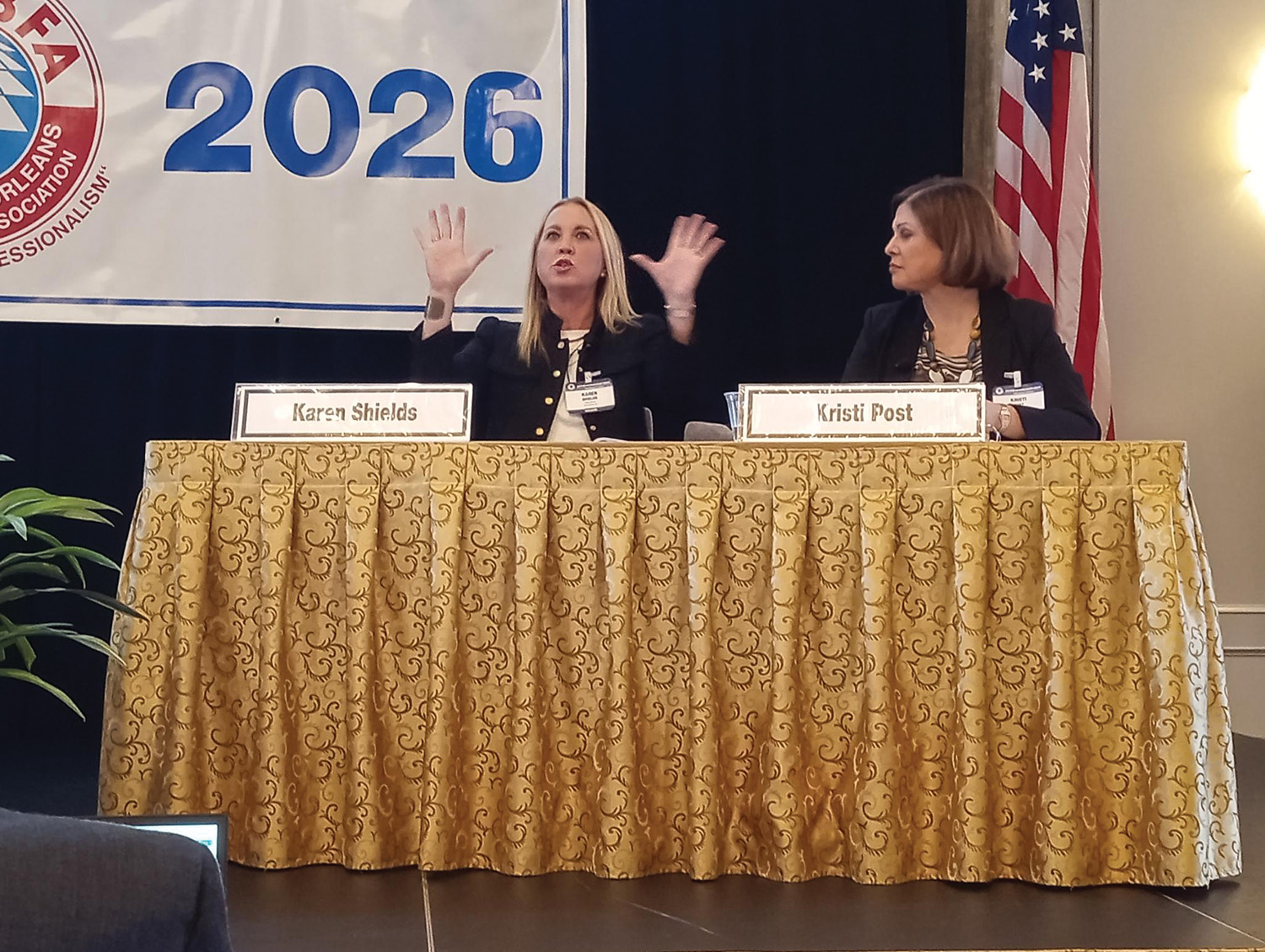
Featured photo caption: Attorney Karen Shields makes a point during a session on Maintenance and Cure at the recently concluded River and Marine Industry Seminar in New Orleans. (Photo by David Murray)