
Relationships Key To Kearney Companies Warehouse Deal
A recent deal for The Kearny Companies to lease a Jefferson Parish warehouse from the Port of New Orleans and expand its Foreign Trade Zone came together in about three weeks.
Kearney, president of The Kearney Companies, said it would have been impossible to finalize the deal and receive the first delivery so quickly without years of trust built through relationships between his business and the port.
The Kearney Companies is a third-party logistics company specializing in barge, rail and containerized cargoes. It handles bulk, breakbulk and packaged commodities for shippers. The company has leased various properties from the Port of New Orleans, according to its needs, since 2004. Kearney’s family has been involved in the maritime industry for five generations, so he is able to quickly make decisions about what is right for the business when presented with opportunities. Sometimes those opportunities come when least expected.
Kearney was having lunch with members of the port’s real estate team one Friday in April when he happened to mention his need for warehouse space to be used for the storage of non-ferrous metals, like nickel, copper and tin. He had been looking for space in Jefferson Parish and needed to find one quickly. It turns out the port had a building he wasn’t aware of previously.
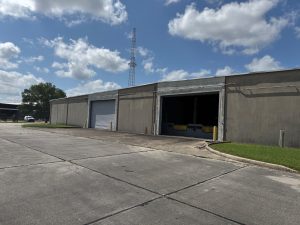
Kyle Gilmore, director of real estate for the Port of New Orleans, said the port had 120,000 square feet available in a 200,000-square-foot warehouse in Jefferson Parish. The warehouse is older, without the room between columns of a more modern design, and needed some electrical and security upgrades to qualify as part of the port’s Foreign Trade Zone, but the port immediately sent over the warehouse specs, and Kearney decided that, on paper, it looked like a perfect fit.
“That happened on a Friday, and by Monday I was in the building, looking at the space,” Kearney said.
The metals The Kearney Companies ships come in on vessels from international and domestic sources and are traded on the commodities market. Having the warehouse designated as a Foreign Trade Zone provides flexibility for customers. Instead of paying customs duties upon arrival, it allows duties to be paid only as individual cargo shipments are moved out of the warehouse to become part of the supply chain.
Kearney and Gilmore had worked closely together before, which helped to speed the process.
“Kyle and his team really jumped through hoops,” Kearney said.
The lease was signed May 4, with work quickly beginning to prepare the space for the first shipment, which arrived barely a week later.
“We were able to help him out and get it in place pretty quickly,” Gilmore said of the deal, which he noted took a lot of internal coordination, as well as working closely with Kearney.
“It was a big team effort,” he said.
The arrangement helped Kearney to quickly obtain suitable storage, the port to find a tenant for a nearly half-empty warehouse built in the mid-1950s. It also supported cargo-handling jobs and the region’s economy.
“It’s a win-win for everybody,” Gilmore said.