

Horizons: Covered Fleet Adjustments Drove 3% Drop
The 3 R’s of the inland barge fleet have been a theme for more than a year: retire, replace and resurge the fleet. The industry has moved forward with retirements, but replacements have lagged, with no expansion or resurge.
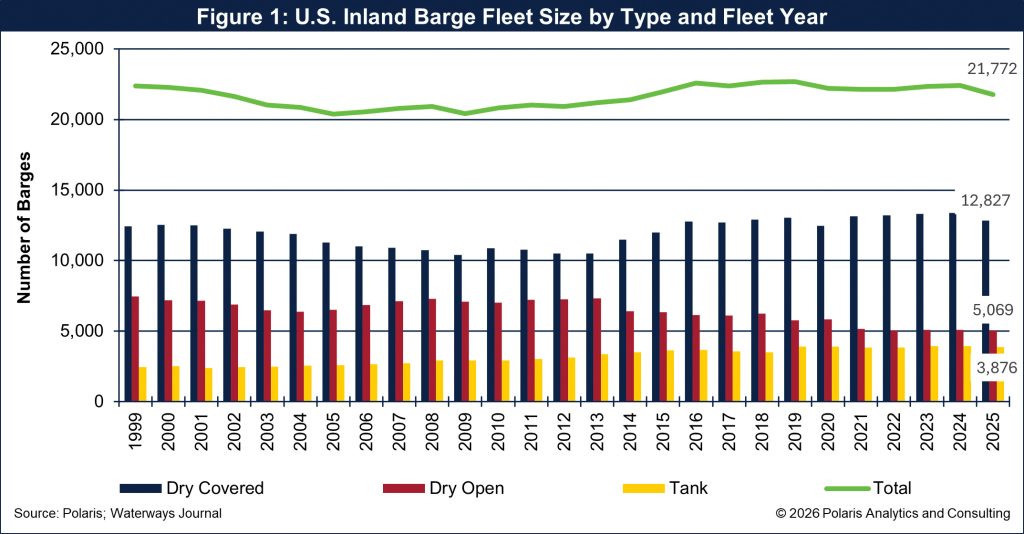
The annual survey of barge operators revealed that the 2025 fleet totaled 21,722 barges on December 31, down 625 or 2.8% from 2024 as published in the IRR Barge Fleet Profile. Covered barges led the way lower, down 552 or 4.1% to a fleet totaling 12,827 barges. The open fleet was essentially unchanged, down 14 barges to 5,069. The tank fleet totaled 3,876 barges, down 59 or 1.5%. The evolution of the U.S. inland barge fleet by barge type is shown in Figure 1.
The 2025 dry fleet had retirements totaling 141 barges and newbuilds of 294, for a presumed net increase of 203 barges. However, after an extensive effort to eliminate double counting among operators, 769 dry barges were removed from the totals.
IRR Barge Fleet Survey
The Waterways Journal has released the results of the annual IRR Barge Fleet survey. The survey strives to identify the line haul, commodity-carrying fleet of inland barges operating on the inland rivers by barge operator. The key data gathered is the number of barges in revenue service at the end of the calendar year by barge type and by year of construction. Operators were also asked how many barges were retired during the year, what is the value of a vintage aged, covered barge and what was the average number of trips per year, among other questions.
Barge Fleet Age Profile
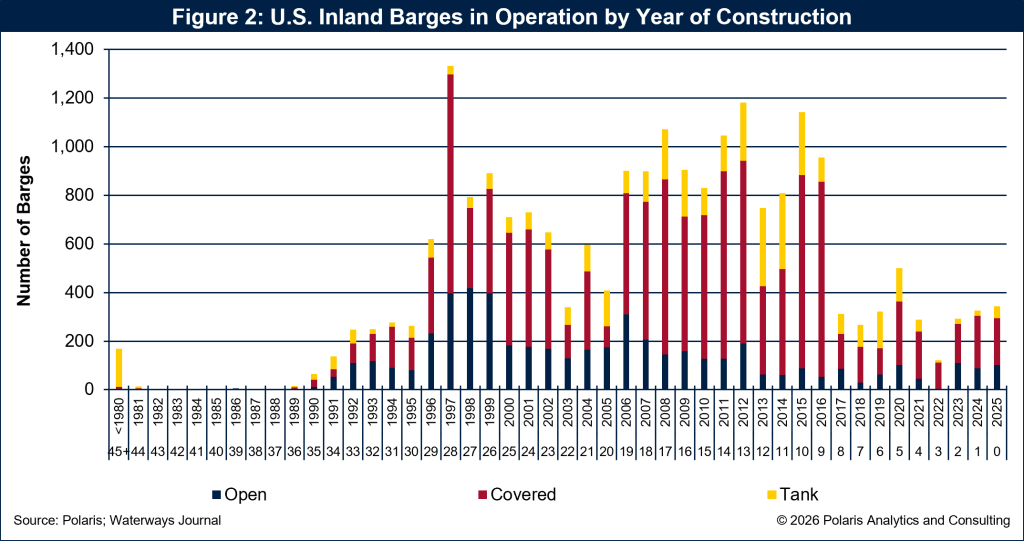
The 2025 barge fleet reflects two active build periods with more than 600 barges in operation each year, 1996 to 2002 and 2006 to 2016, and a less active period since 2017 when annual construction was less than 500 barges and averaging closer to 300.
Barges in the first period are older than 23 years of age with 5,725 barges. The second period had 10,488 barges between the ages of 9 and 19. The number of barges in operation since 2017 and less than 8 years old totaled 2,773.
The more immediate attention is on the spike of barges built in 1997. During that year, more than 1,600 were put into operation. By the end of 2025 and now 28 years old, there were 1,333 of those barges from 1997 in operation. The number of barges built by year and type during 2025 is shown in Figure 2.
Average Age Rising
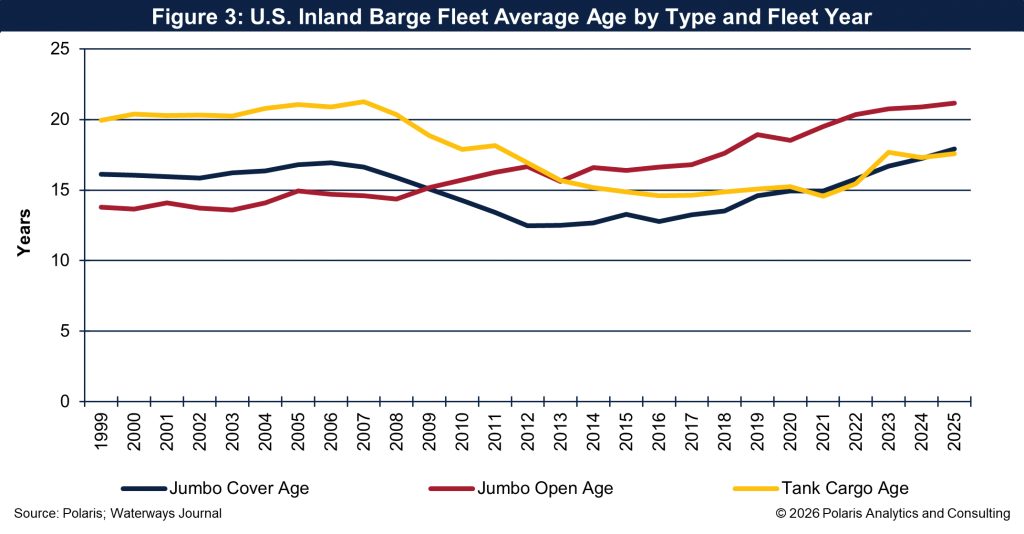
As the fleet continues to age, how gracefully will it age? The dry covered fleet was its youngest, averaging less than 13 years of age from 2012 to 2016. Since then, its average age has increased 40% to nearly 18 years, the oldest on record.
The age of the dry open fleet has increased steadily since 2009, when it first exceeded 15 years old, breaking through 20 years in 2022. In 2025, the open fleet averaged more than 21 years.
While the tank fleet age is not its oldest, it is quickly aging. The tank fleet peaked at 21 years from 2004 to 2007. Through replacement and expansion, its age averaged 14.6 years old for three years, 2016, 2017 and 2021. Since then, the age of tank fleet has increased to 17.6 years in 2025.
The next two to three years will be pivotal as shippers and terminal operators will call into account the age of the fleet, its performance and how stable the older barges are. Not all barges are treated the same, with some in more harsh service, such as hauling rock, coal and corrosive materials, while other barges are used in grain service. Additionally, not all barges are operated in the same conditions. Some remain in fresh water, and others are moved through both salt and fresh water. Age can be an elusive mirage, but as barges get older, scratches become gashes.
The average age of barges by type is shown in Figure 3.
Repeating Theme: 3 R’s Of The Inland Barge Fleet
The 2026 IRR Barge Fleet Profile underscores an industry at a fork. The aging fleet and below-average construction rates highlight the need for sustained investment in modernization to enhance efficiency and performance. Repeating what has been a theme for nearly two years, and discussed at IMX 2026 in Nashville, the industry needs to focus on the 3 R’s of the inland barge fleet: retire, replace and resurge.
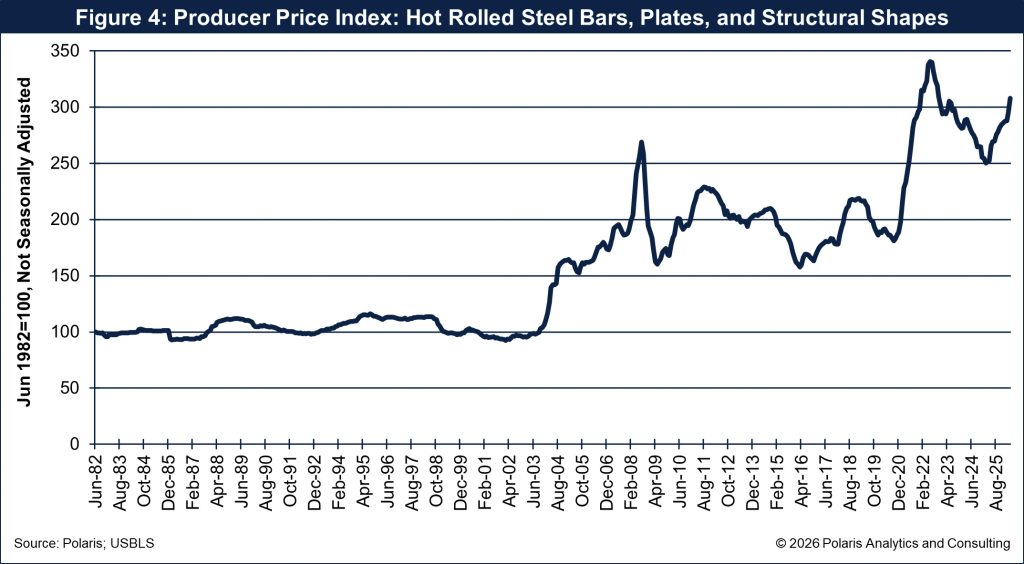
Beyond fleet dynamics, economic headwinds are making the needed replacement cycle more challenging. The capital cost to construct new barges is expensive. Steel costs are firming, which is a major cost component in building a barge. Based on the producer price index, the hot rolled steel bars, plates and structural shape prices have climbed 23% since bottoming in February 2025 to a PPI exceeding 308 in April 2026. The steel index was higher only in 2022, when it reached a record of nearly 341 as shown in Figure 4. However, it is not just higher steel prices. Labor costs are rising through higher wages and being able to attract people into the industry. Moreover, finance costs are higher, with above average interest rates.
While replacing and resurging the fleet is expensive, requiring significant capital outlays, not having an adequate barge fleet is also expensive.
As operators and owners navigate economic uncertainties and regulatory pressures, the data in the IRR Barge Fleet Profile will be crucial for informed decision-making. It is an indispensable resource for operators, owners, financers, suppliers and policymakers. The 2026 IRR Barge Fleet Profile is more than a snapshot. It is a benchmark, guiding the industry through the streams of change. The report and the 2026 IRR Commodities Report are both available from The Waterways Journal at waterwaysjournal.net/store.