

Horizons: Tank Barges And The GIWW ‘Pitch’
The 2026 FIFA World Cup, with its knockout stages generating intense global competition ahead of the July 19 final, offers a compelling lens for the tank barge sector on the Gulf Intracoastal Waterway. National teams advance through disciplined rivalry under shared rules, much as operators, shippers and infrastructure partners navigate supply constraints and market pressures while collaborating to maintain reliable liquid commodity flows. This balance of competition and coordination defines the current state of tank barges on the GIWW and points to scenarios ahead.
Fleet Dynamics:
The Current Roster
Tank barges form the backbone for liquid movements on the GIWW, where petroleum products, chemicals and related cargoes

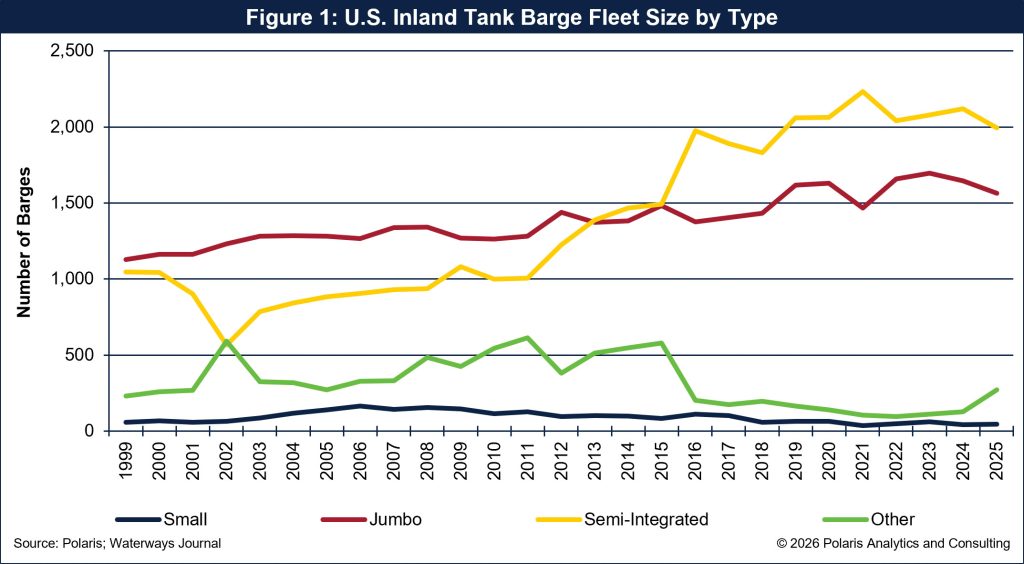
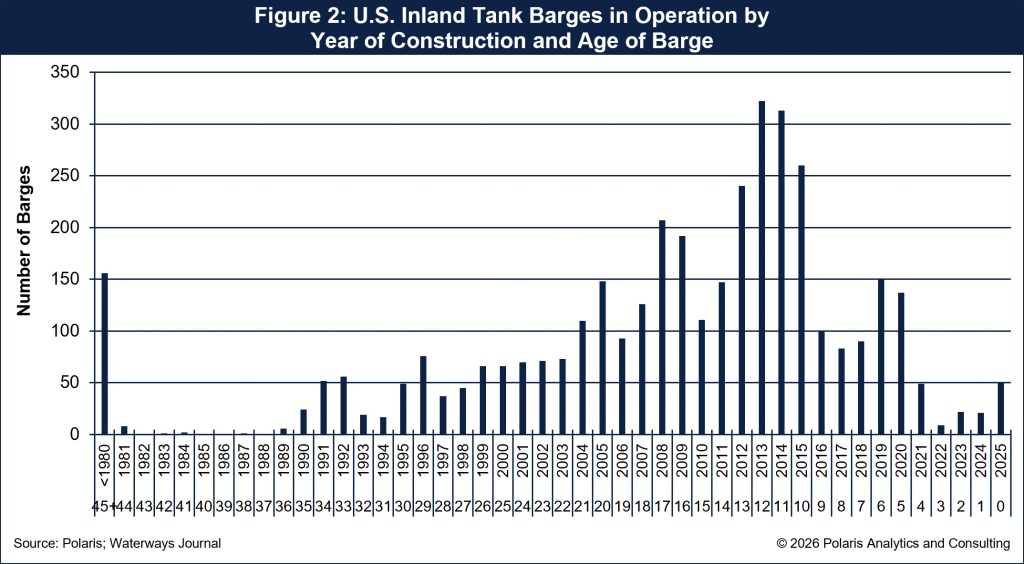
predominate. The fleet exhibits clear dynamics of age and capacity management. Semi-integrated unit tows have grown as a share, yet average ages have risen with the tank fleet average reaching 17.6 years in 2025. At the end of 2025, the tank barge fleet totaled 3,876 barges, down 1.5% from 2024 with fleet by type in Figure 1. Retirements (116) continue to outpace limited new deliveries (50) in many segments, contributing to tight utilization and supporting firmer rates for available tonnage. Nearly 30% of the fleet is 20 years or older as shown in Figure 2.
The tonnage and ton-miles moved by tank barge are estimated to have increased from the COVID-19 lows of 154 million short tons in 2020 to 171 million in 2025 and are forecast to be more than 171 million in 2026, while ton-miles track in similar fashion. The most recent data available through the U.S. Army Corps of Engineers is through 2023.
There has been sustained volumes in key categories such as acyclic hydrocarbons, benzene and toluene, alcohols, carboxylic acids and inorganic compounds. These patterns underscore the fleet’s role in handling diverse liquid cargoes despite aging assets. New construction faces economic hurdles — elevated steel, labor and financing costs — limiting rapid expansion and reinforcing the need for efficient use of existing capacity.
State Of Energy:
Drivers On The Pitch
Geopolitical developments exert significant influence. Disruptions such as those affecting the Strait of Hormuz have elevated Gulf Coast crack spreads and refinery activity, boosting demand for tank barge services in crude and refined product transport. U.S. crude oil production remains robust near recent record levels, providing steady feedstock for PADD 3 refineries with spillover effects along the GIWW.
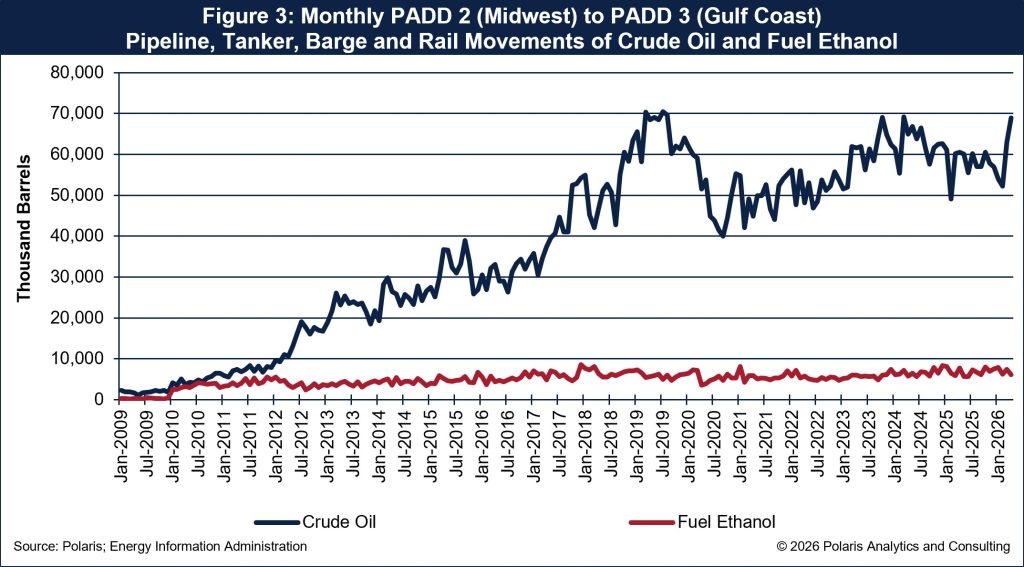
Gasoline and diesel consumption hold steady amid seasonal patterns, while ethanol use, both domestic blending and exports, adds incremental barge requirements. These fundamentals create visible demand signals, though inventory builds and price volatility introduce uncertainty. PADD 2 (Midwest) to PADD 3 (Gulf Coast) movements, as presented in Figure 3, often involving crude and products moving southward, and the reverse flows demonstrate the interconnected nature of inland and coastal logistics from PADD 3 to PADD 2, with barges offering flexibility where pipelines reach capacity or require supplementation.
Gulf Coast refinery margins serve as a direct barometer for tank barge activity on the GIWW. Crack spreads have reflected supportive conditions, with geopolitical factors periodically widening differentials and encouraging robust refinery runs. These dynamics translate into increased crude receipts and product liftings, reinforcing demand for tank barge capacity. Kirby Corporation’s first-quarter 2026 results further illustrate the prevailing market tightness. Inland tank barge utilization averaged in the low-90% range amid improving pricing on contracts and limited new construction. Marine transportation revenues rose year-over-year, prompting the company to raise full-year earnings growth guidance. Such performance underscores the sector’s resilience amid an aging fleet profile and sustained energy-driven demand.
GIWW Commodities:
The Playing Field
The GIWW, stretching 1,200 miles from Brownsville, Texas, to St. Marks, Fla., serves as a critical artery. Commodity data through 2023 (the most current data available through the U.S. Army Corps of Engineers), extended by recent trends, show strong liquid volumes moving via tank barges. Maintenance efforts, including dredging contracts, support navigability, yet infrastructure demands persist. Seasonal factors, such as harvest-related exports or weather vulnerabilities, shape activity in forthcoming months.
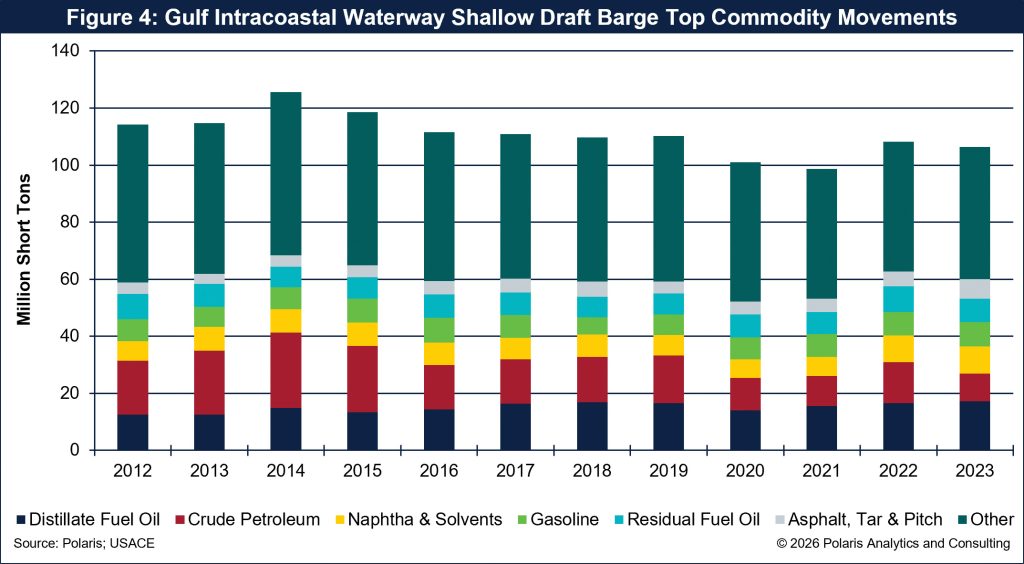
Bidirectional PADD movements highlight the GIWW’s role in balancing regional supply with key commodities moved by barge on the GIWW as shown in Figure 4. Competition among operators drives efficiency gains, while partnerships with the Corps and industry groups, such as the Gulf Intracoastal Canal Association, Waterways Council, Inc. and The American Waterways Operators, ensure channel reliability. This mirrors the World Cup’s emphasis on fair play. Individual strengths yield results only within a well-maintained system.
Over The Horizon:
Scenarios And Sportsmanship
Looking ahead, several scenarios emerge. Sustained energy demand from geopolitical or production stability could maintain tight tank barge markets, rewarding operators with high utilization. Conversely, regulatory shifts or accelerated pipeline development might moderate volumes, requiring adaptation. Infrastructure investments — locks, dredging, and modernization — will prove decisive, as will innovation in propulsion and environmental compliance.
Just as World Cup teams compete intensely yet unite under common standards for the spectacle’s success, the tank barge industry advances through rivalry tempered by collaboration. Coordinated efforts among carriers, shippers and public partners anchor resilience. In this arena, the “winner” emerges as a robust GIWW system delivering economic value, energy security and efficient commerce well into the future.
*Barge fleet and commodity data are available from the 2026 IRR Barge Fleet and 2026 IRR Barge Commodities report through The Waterways Journal. Purchase yours today at www.waterwaysjournal.net/store.