
Tributaries: Flocculation Is A Dirty Word
Editor’s Note: Prepared by the Big River Coalition. Scientific background drawn from published research on cohesive-sediment flocculation, including a 2024 laboratory study of Mississippi River mud; operational details drawn from Associated Branch Pilots transit notices and Mississippi River Ship Channel Dredge Updates.
The Mississippi River Ship Channel is under a transit recommendation — not for the usual suspects of flood or deficient channel, low water, fog or current. Instead, a mysterious “muck” of clumped river sediments is robbing deep-draft vessels of the flow of water they need to cool their engines and float freely. Pilots are responding with transit recommendations for inbound ships with deeper drafts as a century-old challenge pushes farther upriver than ever before.
As the old saying about the Big Muddy goes, the water is “too thick to drink, too thin to plow,” and, in 2026, flocculation is making navigation feel exactly that way. In an 1871 study, geologist E. W. Hilgard explained the strange “mud lumps” that erupted at the mouths of Mississippi River Deltaic passes: small islands of clay forced upward like mud volcanoes by the weight of sand the river dumped at its mouth, shifting position and obstructing the very channels ships depended on.
What Is Happening?
Hilgard’s mud lumps are an old, descriptive explanation for the mystery of flocculation, albeit with a lot less science. Flocculation is a different mechanism, with riverine and saltwater chemistry mixing a dark roux that oddly hovers suspended above the hard bottom of the Ship Channel. The phenomenon has challenged pilots during moderate to higher flows through Southwest Pass for more than a century. Longstanding theories have linked the additional weight of the higher water levels that pushes down on the bottom as a catalyst that forces the suspension of clay particles above the hard bottom. The Associated Branch Pilots of the Port of New Orleans (Bar Pilots), who guide deep-draft ships across the bar from the Southwest Pass Sea Buoy to Pilottown on the Mississippi River Ship Channel, respond by issuing notices that recommend that deeper inbound vessels transit Southwest Pass on a rising tide when the suspended sediment is problematic.
The inbound vessels work harder as they push through the muck, which often fouls the ship’s strainers as the engines must work harder. .
Drafts on outbound vessels remain unaffected, as they transit with the river’s current; inbound ships pushing against the flow and the suspended muck bear the brunt of the double whammy.
Stirring Things Up
Flocculation occurs in a few places around the world, but there is no doubt the impact on maritime commerce is greatest on the Mighty Mississippi due to the number of vessels transiting the system.
On June 16, the Bar Pilots issued their first flocculation-based transit recommendation of 2026 for inbound vessels with drafts of 43 feet or greater to transit Southwest Pass beginning 10 hours before the high tide. Two weeks later, the pilots adjusted the recommendation further, lowering the trigger to 40 feet or greater draft for inbound vessels. The culprit was a mass clumping of river sediments in a ball of fresh and saltwater.
The U.S. Army Corps of Engineers uses the interchangeable term “fluff” to describe this gelatinous ooze. The Corps now has specialized survey equipment, on a frequency that allows it to survey the suspended matter, and has added the “fluff thickness” to normal hydrographic surveys.
In a quick glimpse, there is a high of 15 feet of material suspended above the channel bottom in areas of Southwest Pass, while upriver from the Head of Passes the numbers are smaller. The farthest upriver reading now shows at 2 feet just below Spences Light (Mile 6.7 Above Head of Passes (AHP). A few weeks ago, before the latest rise in river stages, a dredge was working an area of fluff at Mile 8 AHP (and higher). Some areas above the Head of Passes are more than 10 feet thick. Prior to June 2026, fluff above the Head had never been reported.
“Unprecedented” has become a word that is more frequently in use these days on the Big River because the deltaic riverine system is rapidly changing. Who knows what an average river year looks like? A decade ago it was almost predictable. The difference this year is that the flocculation has traveled upriver above the Head of Passes and been reported more than 8 miles AHP or just south of the Venice Jump.
James Buchanan Eads, who fought a dirty battle with mud as the architect of both South and Southwest Pass, focused the power of the river to scour the channel. Eads was the first to open South Pass for routine commercial navigation. He closed off at least one distributary and used willow mats to focus the flow to scour the channel. This is paramount when you want to move dirt with a hose. The desired nozzle setting is “jet,” not “mist” or “shower.” The crevasses rob the stream power from the great river, and the impacts are seen in multiple areas, places where actions for deltaic riverine management are desperately needed.
Clear Like Mud?
The Mississippi carries an enormous suspended load of fine-grained sediment — silts and clays — scoured from a drainage basin covering parts of 31 states, or 40% of the continental United States. Individual clay particles are tiny, with diameters measured in microns, far smaller than the width of a human hair. At that scale, a particle’s behavior is governed less by its weight than by its surface chemistry, the source of a navigational nuisance that demands operational know-how and constraint.
Clay particles carry a net negative electrical charge on their plate-like surfaces. In freshwater, that shared negative charge makes the particles repel one another, so they stay dispersed and drift as individuals. Because each grain is so small and so light, it settles almost imperceptibly. It can travel hundreds of miles in suspension without ever reaching the bottom. This provides the color to the Big Muddy River.
Dissolved salts from the Gulf waters flood the water with positively charged ions. Those ions crowd around each negatively charged clay particle and compress what scientists call the electric double layer, the cloud of counter-ions surrounding each grain. Once that repulsive buffer is squeezed down, short-range attractive forces (the van der Waals forces) take over, and particles that once bounced apart begin to stick together. The clumps they form are called flocs, and the process is flocculation.
The Mississippi’s Unique Recipe
A 2024 laboratory study that used actual Mississippi River mud added an important wrinkle to the classic salinity story. When researchers raised salinity with table salt or laboratory sea salt alone, flocculation did not increase nearly as much as expected. When they added genuine waters from the Gulf, however, floc formation improved substantially. This is evidence that organic matter, including algae and the sticky biological polymers that coat river sediment, play a leading role alongside salt.
Nature’s flocculant jambalaya is a mixture of science, chemistry, biology and complex processes that are another curve ball to be addressed to keep commerce moving. This concoction also emits a strong and stenchy organic smell and looks like a mud pie mixed in a blender with mulch.
When flocs settle in a navigation channel, they do not immediately form firm bottom. Instead, they accumulate as a soupy, high-concentration layer like a fluid mud, denser than water but too fluid to walk on and too soft to register as solid bottom on most hydrographic survey equipment. A ship’s depth sounder reads one depth as does normal survey equipment, while the effective, navigable bottom sits below the muck in the water column.
Deep-draft vessels will feel the resistance — or touch bottom — before the charts say they should. If you have ever walked in a swamp, you will know the extra “umph” required for each step. The fluff has the same impact on engines, making them work harder while choking the free flow of the water used to cool them. Pilots have had to move vessels to one side of the channel to anchor and allow the strainers to be cleared. The location for anchoring is key and skillfully planned to best keep one lane of traffic open while the adjustments are made.
Southwest Pass, the primary deep-draft entrance to the Mississippi, is authorized at 50 feet deep following the recent deepening project, and it handles on the order of 6,000 or more ocean vessels a year. The pilots’ response, timing deep-draft transits to high tide, is a direct workaround. The extra tidal water provides extra water depth, a margin of safety over the fluid-mud layer.
The draft-based triggers in the June 2026 notices reflect exactly which inbound vessels are close enough to the bottom to be impacted.
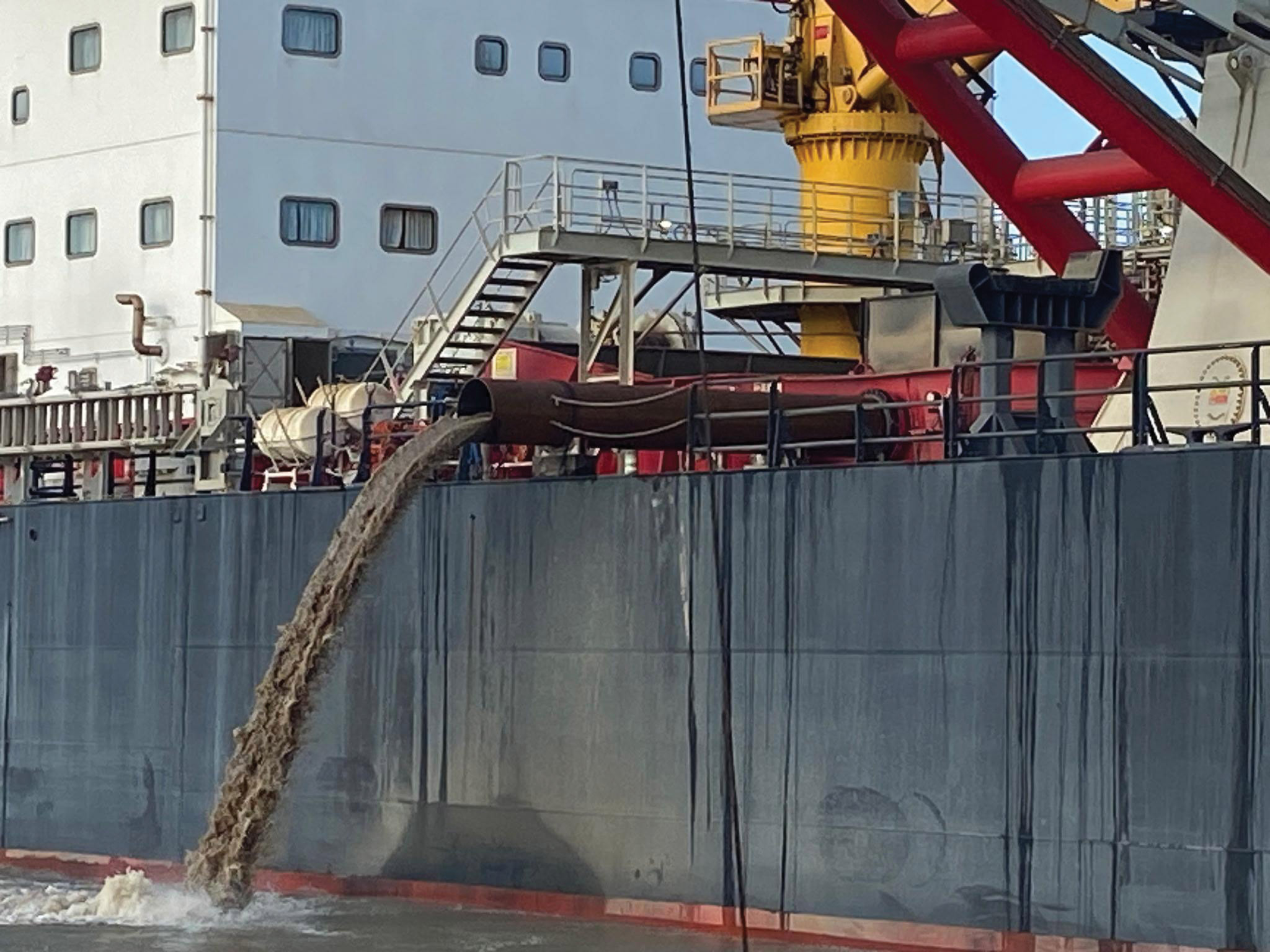
The Corps deploys hopper dredges to fight in the muck with agitation dredging. The hopper dredges are focused on working the channel to mechanically stir and liquefy the settling mud, breaking up flocs and moving the material to be resuspended and distributed by the water column. It is the field-scale application of the same principle the laboratory documented. Turbulence destroys flocs.
What alarms the navigation community in 2026 is not that flocculation exists. It has been managed at the river’s mouth for years, with flocculation-based transit recommendations almost a normal and expected process during mid to high river stage levels. What makes 2026 different is severe flocculation for the first time being reported above the Head of Passes, migrating upriver or north toward Venice.
Loss Of Stream Power
The likely mechanistic cause ties flocculation to a larger crisis on the lower river: the loss of stream power. Along the eastern bank between Bohemia (Mile 43 AHP) and the Head of Passes, a series of widening crevasses, breaches such as Neptune Pass, Mardi Gras Pass and Fort St. Philip, are bleeding water and energy out of the main channel.
As the river loses the current that keeps sediment suspended and holds the salt wedge downstream, two things happen at once. Saltwater pushes farther upriver, and the now-sluggish, saltier water lets flocs form and settle where the river once flushed them through.
The same drought conditions and crevasses that forced the Corps to build emergency saltwater sills five times since 2022 are now allowing mud to floc and drop in reaches that used to scour themselves clean.
The Mississippi River Ship Channel is far more than a regional channel; it moves roughly 500 million tons of cargo a year while providing freshwater to river communities and industry along its banks. Peer-reviewed work on the river’s deltaic reach, including research this coalition has contributed to, warns that continued water loss through crevasses, compounded by relative sea-level rise, threatens both the sustainability of the delta and the ability to maintain the deep-draft channel that the nation depends on. It also threatens freshwater, an essential and fundamental need for life on land. The Big River knows freshwater is more important than navigation.
Flocculation is a useful lens on that larger story because it is where microscopic suspended fine sediment meets macroscopic consequence. A reaction measured in microns and milliseconds — the compression of an electric double layer around a clay particle — now impacts maritime commerce by delaying commercial movements while vessels are prepared to safely coordinate the transit across the bar. Keeping the Mississippi open increasingly depends on understanding and staying ahead of the mud.
Understanding and addressing flocculation requires tackling the root causes of lost stream power. The Big River Coalition urges continued collaboration with the Corps, pilots and industry to implement sustainable delta management solutions before the “muck” becomes more than an inconvenience.
Featured photo caption: The Dredge Frederick Paup at work agitating flocculation on the Mississippi River near New Orleans. (Photo by Sean Duffy)