HFL Takes Delivery Of Mvs. Kelley Reid And Bob Nienhuis
Hines Furlong Line Inc. (HFL), Nashville, Tenn., recently took delivery of its two newest towboats, the mvs. Kelley Reid and Bob Nienhuis.
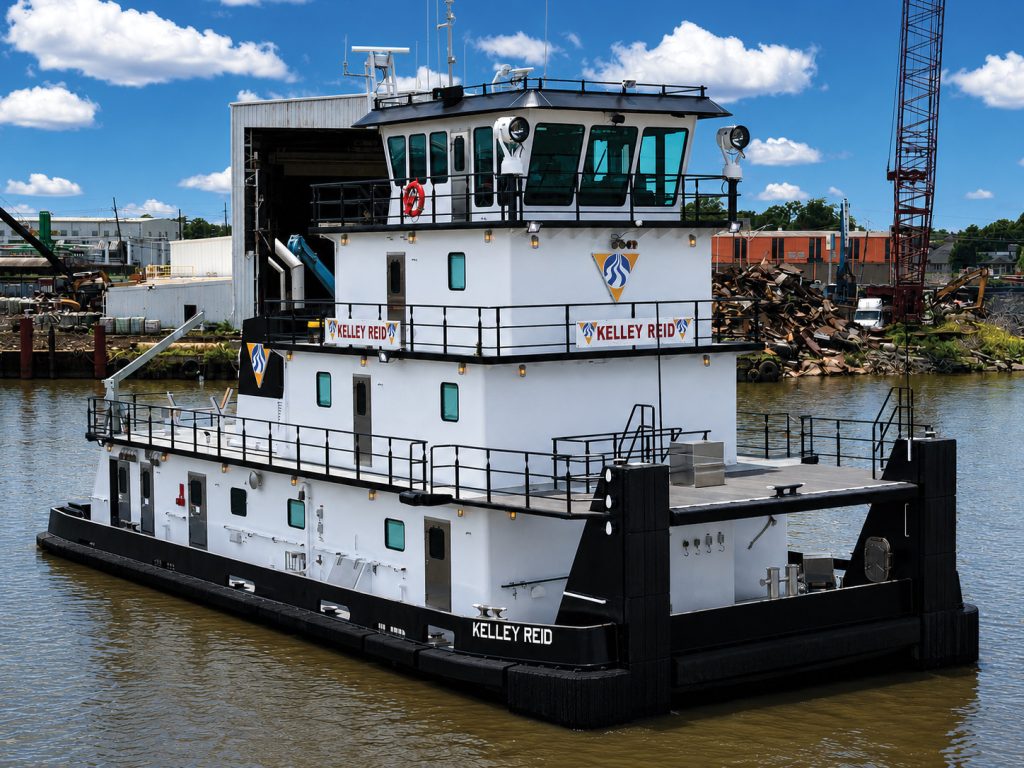
The mv. Kelley Reid was built by Eymard Marine Construction & Repair, Inc. The vessel is named in honor of Kelley Reid, the cherished friend of Kent Furlong, president and founder of Hines Furlong Line, and longtime companion to his mother, Donna Furlong. He passed away in 2025.
Though Kelley did not work in the maritime industry, he held a deep appreciation for the inland waterways and the towboats he would watch go by while fishing on the Ohio River. Some of Kelley’s best memories were made aboard trips on HFL vessels, particularly the mv. Donna H. Furlong. His passion for the HFL fleet and crews was infectious and unwavering.
“To have a vessel of such exceptional quality bear [Kelley’s] name would have been a tremendous honor, one he would have accepted with genuine humility and deep gratitude,” Donna Furlong said.
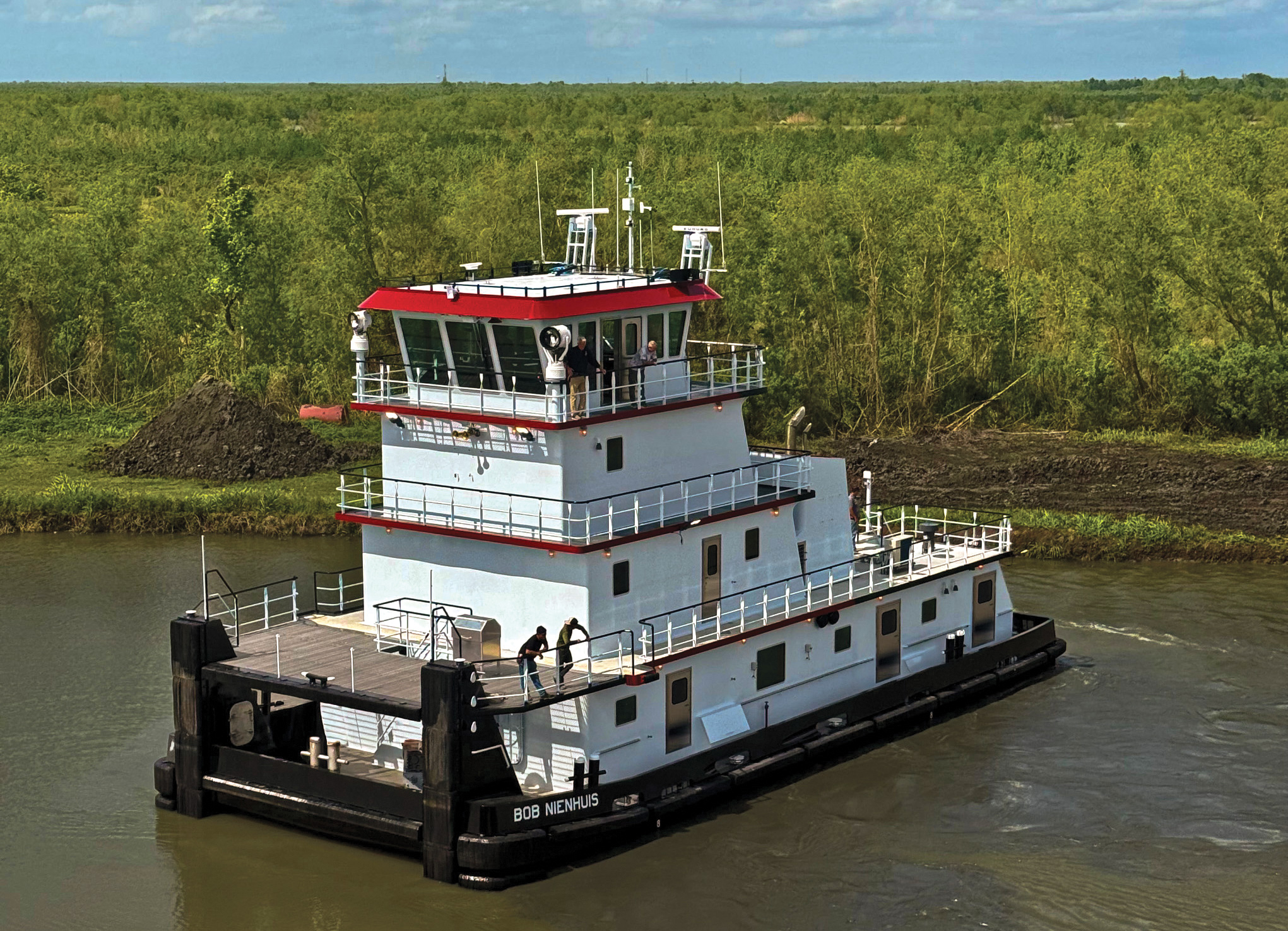
Mv. Bob Nienhuis
Built by Intracoastal Iron Works, Bourg, La., the mv. Bob Nienhuis was christened in honor of the company’s maritime attorney of 16 years.
Nienhuis became interested in admiralty and maritime law in the 1970s after beginning his career at Goldstein and Price. As his career unfolded, Nienhuis’ exposure and interest to the maritime world grew until it eventually comprised his entire practice.
Nienhuis was introduced to Kent Furlong in 2010 by a client, Ron Hunter, and was soon involved in HFL shipyard construction contracts and bareboat charter agreements. After Hunter passed away in early 2017, Nienhuis was made CEO of his company, Hunter Marine Transport Inc., and continued to do contract work for HFL. In 2018, HFL acquired the assets of Hunter Marine Transport, Inc., and Nienhuis has continued to represent the company.
Much has changed in the last 50 years since Nienhuis first became an attorney. One of the biggest changes the namesake has seen is the number and sophistication of companies in the industry. Over the years, it has become more common for larger companies to buy out smaller businesses. These companies tend to have stricter regulations when it comes to safety, Nienhuis said, as well as more selective hiring processes and diligent physical evaluations. While working with smaller companies in the first 20 years of his career, Nienhuis described higher injury rates, passive safety departments and far less government regulation.
“I learned most of what I knew about river operations from personally investigating accidents that happened in out-of-the-way places at dark times of the day,” Nienhuis said. “Accidents were common: everything from unobserved sinkings of old barges, collisions of tows on the rivers, breakaways from fleets, to barge deck fittings or wire cables breaking loose and hurling against deckhands in their way. I once investigated an accident on the Ohio River where a wire had broken and hit a crew member in his leg, leaving a chunk of his flesh on the deck of the dock barge. My first thought was to kick the body part into the river before anyone took a picture of it.”
Since 2000, both injury rates and Jones Act cases going to trial have significantly decreased, Nienhuis said. Fewer and fewer cases are tried before a judge and jury compared to when Nienhuis first began his career.
“In the 1980s, I tried two Jones Act cases to jury verdicts in one week; now that is more likely to be two cases to verdicts in a decade,” Nienhuis said. “All in all, this has been good for the industry, but it has made for a much different practice for attorneys – both plaintiffs’ and defendants’.”
Nienhuis said that he did not expect a new HFL vessel to bear his name and is honored that his 50 years of service to the maritime industry have been commemorated in this way.
“This obviously is unique and a very high honor, especially for me as an attorney,” Nienhuis said.
The furnished vessel can accommodate a crew of seven with five staterooms and three-and-a-half bathrooms, and is equipped with a first deck lounge and workout room. The deckhouse is fitted with FRP and Marline paneling, poured floors and acoustic ceiling tiles.
“It is first class in every respect, from its beautiful lines and wide decks to its large, beautiful galley, to its radar equipment on the roof that can be electronically lowered to go under bridges if necessary,” Nienhuis said. “It shows that Kent and those who designed and built the boat have a high regard for the safety and comfort of its crew members. And it even has my last name spelled correctly, which is not always the case.”
Vessel Specs
The new vessels are identical to the mv. Oxford, which was delivered to HFL last year, though modifications were made to reduce the air draft in the mvs. Bob Nienhuis and Kelley Reid. Each triple-screw vessel measures at 78 by 34 by 10 feet with a draft of 7 feet, 9 inches. Powered by three Mitsubishi S6R2 Tier 3 diesel engines provided by Laborde Products Inc., the boats operate at 2,400 hp with Reintjes gears at 5.381:1 reduction.
Featured photo caption: The mv. Bob Nienhuis, built by Intracoastal Iron Works. (Photo courtesy of HFL)