WEDA Summit Focuses On Faster Delivery, Sustainable Dredging
The Western Dredging Association’s 2026 Dredging Summit & Expo took place in Montreal from July 20 to 23, bringing together dredging contractors, port officials, consultants, regulators, researchers, vendors and U.S. Army Corps of Engineers personnel for a program focused on faster project delivery, beneficial use, sustainability and emerging technologies.
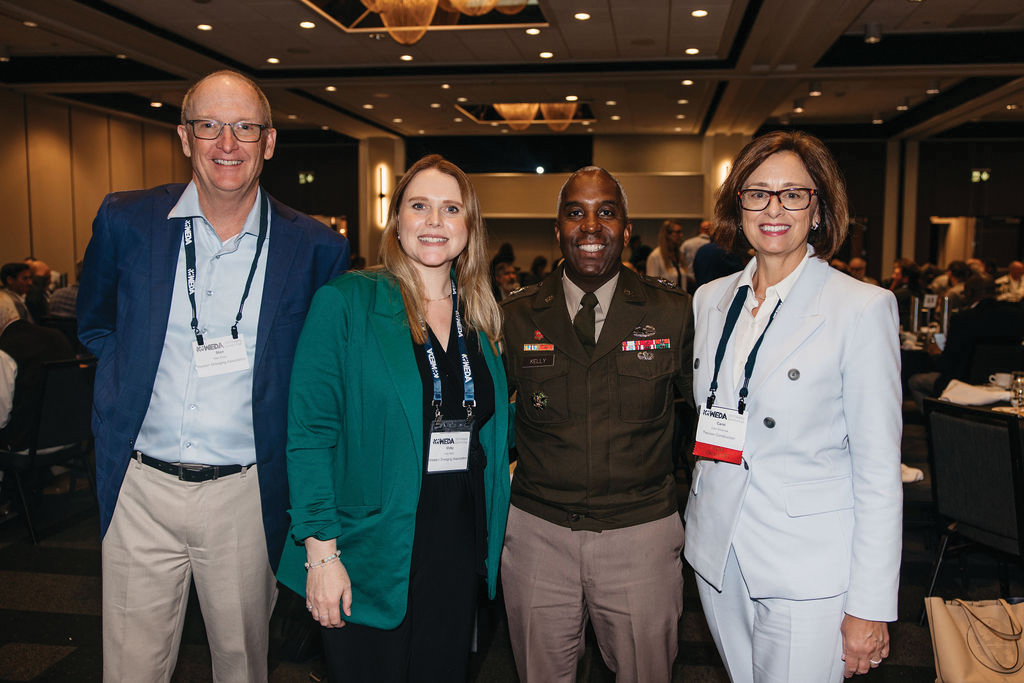
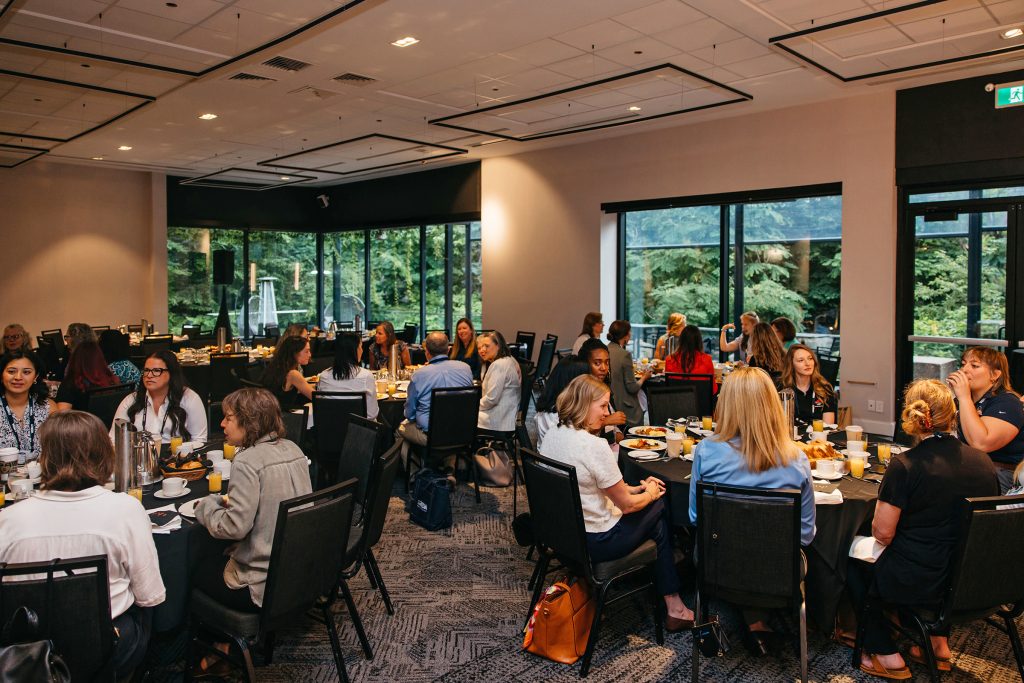
WEDA Executive Director Stan Ekren and WEDA President Carol Shobrook delivered welcome remarks at the start of each day, recognizing the association’s members and sponsors and outlining the summit’s technical sessions, networking events and industry discussions.
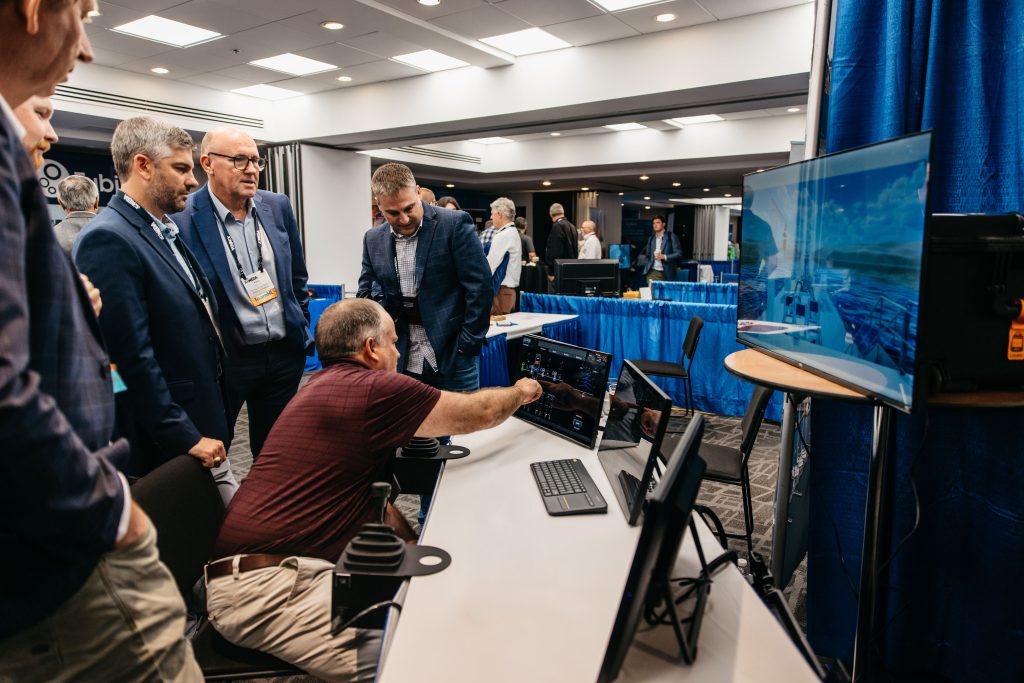
The annual meeting also included Corps breakout sessions for contractors, ports and consultants, along with technical tracks and networking events. The exhibit hall featured displays from vendors, operators and contractors serving the dredging and marine construction industries.
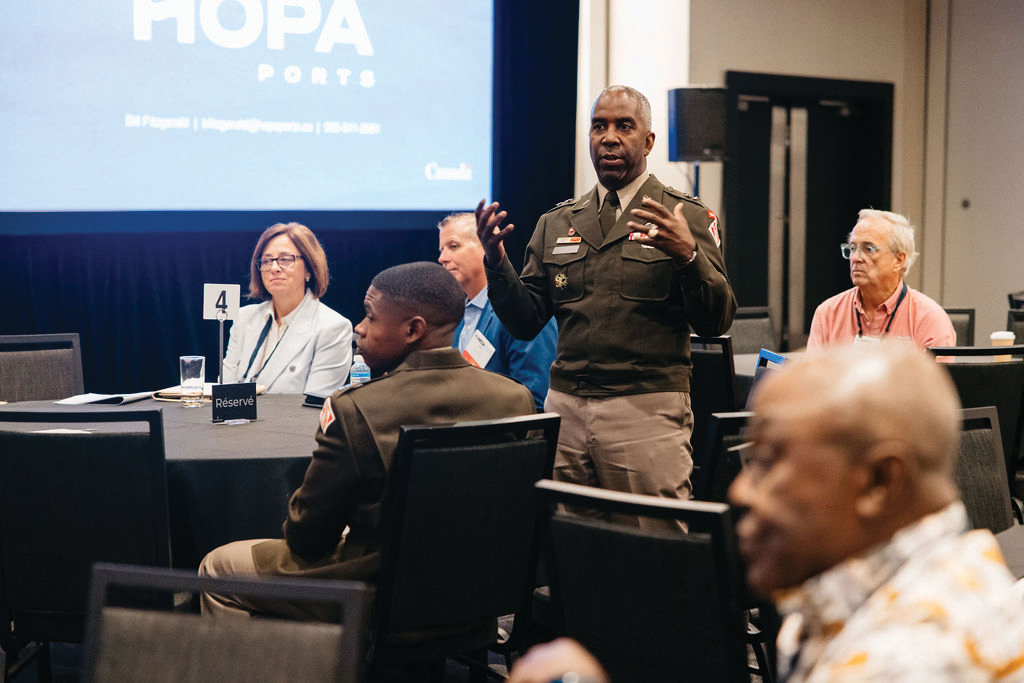
Maj. Gen. Jason E. Kelly, the Corps’ deputy commanding general for Civil and Emergency Operations, delivered the opening keynote and challenged the dredging industry and the Corps to rethink how projects are planned, contracted and executed. Kelly emphasized the Corps’ “Building Infrastructure, Not Paperwork” initiative, intended to reduce administrative delays and move authorized projects into construction more quickly.
A central part of that message was the need to expand alternative delivery methods, including design-build approaches that allow design and construction activities to overlap. Kelly also stressed larger, coordinated contracts and closer collaboration with industry. Rather than prescribing every detail, he said the Corps should identify the required outcome and give qualified contractors more control over means, methods, equipment and sequencing.
That theme resurfaced throughout the summit. Contractors and project owners said overly restrictive specifications can limit innovation, increase costs and make beneficial use more difficult. Participants urged agencies to draw on contractors’ knowledge of equipment and local operating conditions, particularly when determining placement methods, production schedules and the most efficient way to manage dredged material.
Kelly also challenged the industry to help the Corps produce more measurable work for each federal dollar, including more cubic yards dredged and more infrastructure placed into service. With maintenance needs growing faster than available resources, speakers said the industry will have to combine smarter contracting with better data, more advanced maintenance and a stronger focus on long-term outcomes.
Sustainability Beyond Dredging
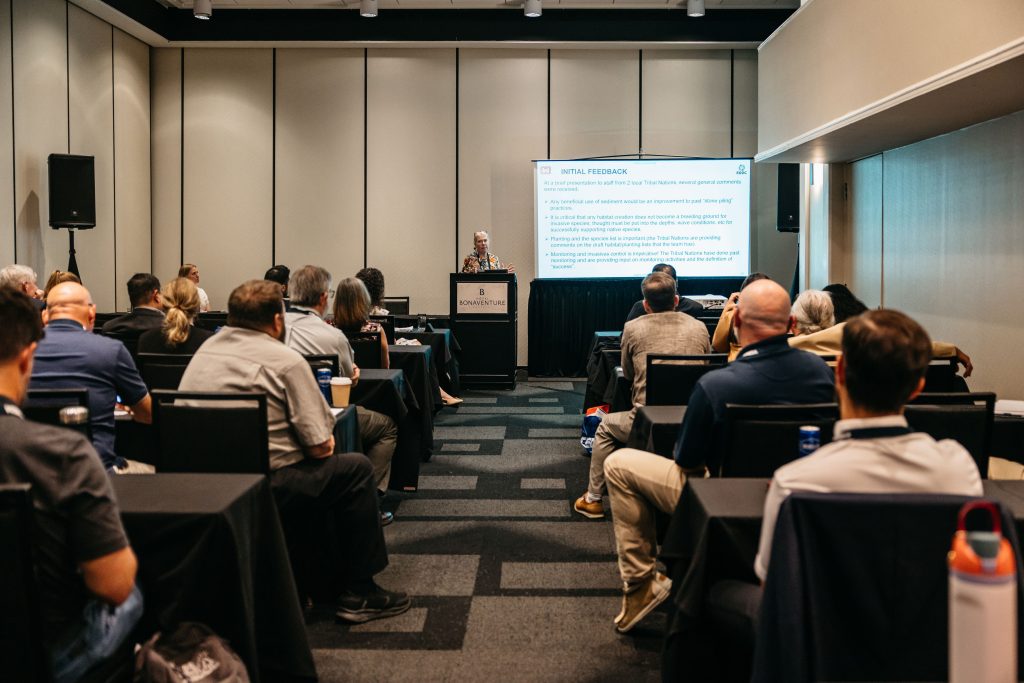
A plenary session, “From Aspiration to Execution: Integrating Sustainability Into Dredging Project Delivery,” examined how dredging projects can provide environmental, social and economic benefits simultaneously.
Panelists included Lori Brownell, chief channel infrastructure officer at Port Houston; Roger Santiago, head of the sediment remediation unit at the Canada Water Agency; Dr. Jennifer Miller of the Corps’ Engineer Research and Development Center; and Garrett Gibson, senior vice president of contract operations at Great Lakes Dredge & Dock Company.
The panel rejected the idea that sustainability can be measured only by emissions, fuel consumption or placing dredged material for beneficial use. Instead, speakers called for examining the full project life cycle, including why a project is needed, how sedimentation can be reduced, what happens to the material, how nearby communities are affected and whether the project produces lasting value.
Brownell pointed to Port Houston’s effort to maintain reliable, unrestricted navigation while avoiding decisions that create recurring sedimentation problems. She also described work with the Corps’ Galveston District to combine historical dredging records, sedimentation modeling and geographic information system data. The goal is to connect those tools with a five-year operation and maintenance plan so dredging needs, beneficial-use opportunities and funding decisions can be considered together.
Miller noted that the Corps already considers national economic development, environmental quality and social effects in feasibility studies, but she said the categories are not equally easy to measure. Economic benefits can often be expressed in dollars, and environmental performance can be measured in acres of habitat, shoreline length or ecosystem condition. Social benefits, including green space, recreation, aesthetics and community well-being, remain more difficult to quantify.
Speakers urged project sponsors to measure results after construction rather than relying only on planning forecasts. That could include comparing actual cargo movements, reduced draft restrictions and local economic effects with the original benefit-cost analysis. Long-term monitoring of restored marshes, shorelines and habitat would likewise show whether expected environmental benefits were achieved.
Beneficial Use And Public Trust
The discussion repeatedly returned to beneficial use and the need to assess costs and benefits over a longer time horizon. Participants said traditional comparisons can make confined disposal or other placement options appear inexpensive while failing to account for future capacity needs, environmental losses or missed restoration opportunities.
The summit also highlighted the difficulty of communicating dredged-material projects to the public. Port officials and regulators described persistent concerns about “toxic sediment,” even when material has been tested and found suitable for placement. Speakers recommended using plain language, presenting long-term results and involving trusted third parties, including conservation organizations and local nonprofit groups, before opposition forms around a project.
WEDA’s Sustainability Initiative is developing a library of case histories documenting not only successful projects, but also how they were planned, permitted, contracted and completed. Organizers said the case histories could support technical learning and public outreach, with selected projects presented at the 2027 summit.
One beneficial-use presentation showed how sediment from the Milwaukee Estuary Area of Concern could be processed and reused within a major remediation project. The work includes removal of about 1 million cubic yards of contaminated sediment and about 100,000 cubic yards of soil, followed by caps, residual management cover and habitat restoration.
Testing indicated that hydrocyclone separation and washing could recover a coarse sand fraction meeting project criteria. The material could be used for isolation-cap base layers, habitat benches, sand cover and other restoration features. Reuse would reduce demand for imported material, conserve capacity in the project’s dredged material management facility and potentially allow additional contaminated areas to be dredged.
Data And Technology
Another presentation described a national dredging optimization model intended to help the Corps allocate limited funding across thousands of channel reaches. The mixed-integer programming model considers cargo routes, controlling depths, shoaling forecasts, mobilization costs, unit dredging costs and annual budgets. Researchers said it can identify which reaches should be dredged, when work should occur and where advanced maintenance could reduce future costs.
The results illustrated the cost of deferred maintenance. Once the most restrictive reaches are restored, the model showed the network could be maintained at a more stable annual cost. It also quantified when dredging below the immediate required depth could be justified to delay future mobilizations and preserve route reliability.
Technical sessions explored computational fluid dynamics, sediment separation and improved mapping of fluid mud. Texas A&M University researchers presented modeling tools that simulate particles moving through pipelines and fall pipes. The work is intended to predict deposition, pipeline blockage, rock-placement geometry and impact forces more accurately, connecting particle-scale behavior with full-scale design decisions.
A related study used three-dimensional modeling to evaluate a drop-tube separator that could remove selected sediment fractions from a dredge pipeline. Early simulations produced limited capture for fine material at higher velocities, but researchers said the model provides a framework for testing different particle sizes, velocities and separator geometries.
Norbit presented a layered-media detection system using high- and low-frequency multibeam sonar in the same survey pass. The high frequency identifies the top of a fluid-mud layer, while the lower frequency penetrates to the harder, navigable bottom. Trials in Savannah, Ga., and the Calcasieu River in Louisiana showed the system could provide full-coverage mapping and reveal meaningful differences between the apparent mud surface and actual channel bottom.
Awards Presented
The summit concluded with a gala dinner recognizing several WEDA members for their contributions to the dredging industry and the association.
Jerry Bishop, general superintendent for JF Brennan, received WEDA’s Dredger on Deck Award.
Mike Warwick, senior vice president of Manson Construction Company, received WEDA’s Dredger of the Year Award.
Peggy Derrick, vice president of EA Engineering, Science, and Technology Inc., PBC, and Ancil Taylor, managing partner of Ancil Taylor Dredging Consulting LLC, each received Lifetime Achievement awards.
Carol Shobrook, marketing manager for Trevcon Construction, in addition to serving as WEDA president, received a Special Recognition Award.
Featured photo caption: Pictured from left are WEDA Executive Director Stan Ekren, WEDA Business Manger Vicky Mant, Maj. Gen. Jason E. Kelly and WEDA President Carol Shobrook. (Photos courtesy of La Ptite Photographe)