


Horizons: Training Camp For The Forthcoming Export Season
The U.S. grain and soybean export year for 2025-26 is winding down. At the horizon, by August 31, exports will be the second largest in U.S. history, totaling 158.1 million metric tons, based on the U.S. Department of Agriculture’s August outlook.
While this year’s export program will be 5 percent below the record set in 2020-21, it will be the third consecutive year of increases and more than 5 percent higher than the previous year.
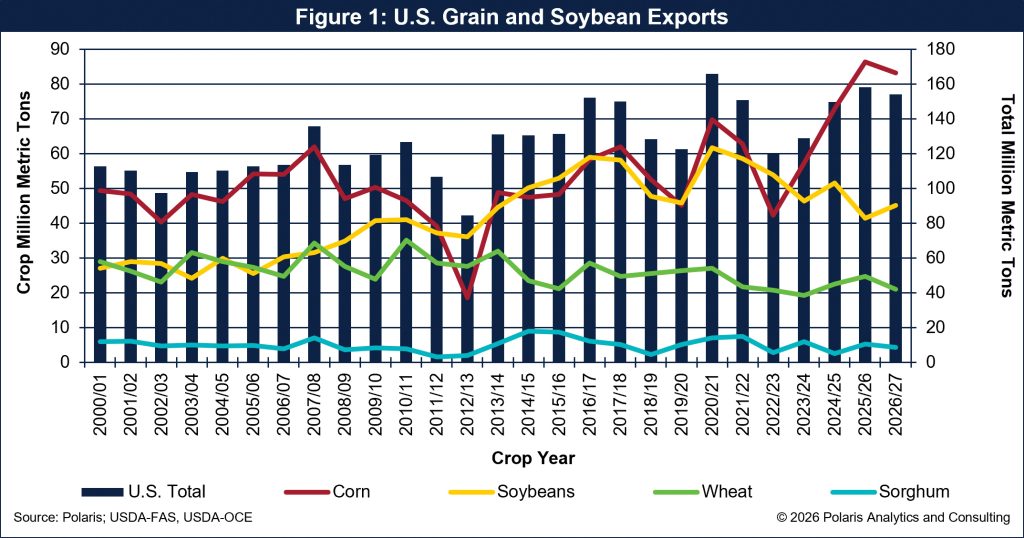
Exports are back as shown in Figure 1. On the horizon, the 2026-27 program remains historically strong.
As NFL and college football teams are in their training camps, preparing for a new season, now is a good time to look ahead to the new crop marketing year that starts September 1 and see what is on the horizon and what concerns are percolating over the horizon.
U.S. Crop Exports Remain Firm
U.S. corn exports are record large for 2025-26, leading grain and soybean exports to historical highs. During the 2025-26 crop marketing year that started on September 1, U.S. corn became attractive throughout the world, surging from a disastrous 2022-23, when corn volumes totaled 42.2 million metric tons, the third lowest level since 2000-01, to a forecast record high this year totaling 86.3 million (or 3,400 million bushels). For the new marketing year, corn exports are forecast to retreat slightly to about 83.2 million metric tons during 2026-27, as shown in Figure 1.
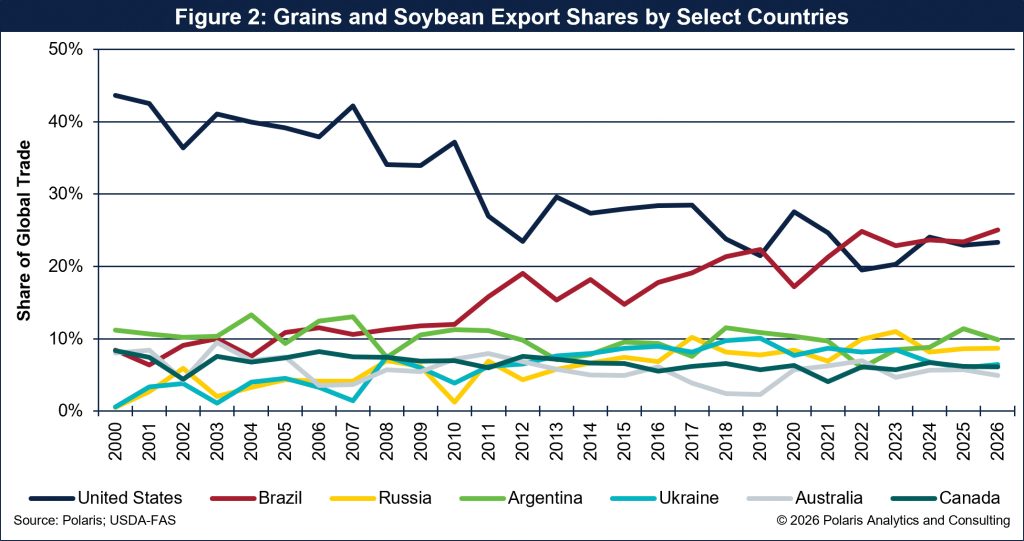
Because of strong corn exports, the United States has regained global market share exporting grains and soybeans, up from 20 percent in 2022-23 through 2023-24, to more than 23 percent in 2025-26 and 2026-27. However, as shown in Figure 2, the U.S. used to have a global market share of more than 40 percent in the early 2000s. It has lost market share as crop production rapidly expanded in Brazil.
Soybean exports had been sliding from a record 61.7 million metric tons in 2020-21 to this year’s 41.4 million. For the new year, soybean exports are expected to rebound to 45.2 million, offsetting the drop in corn.
Wheat exports are expected to weaken from 24.7 million metric tons during 2025-26 (crop year started June 1) to 21.1 million during 2026-27. Together with lower export prospects for oats and sorghum for 2026-27, the drop in wheat exports will pull total U.S. grain and soybean exports down 4.1 million metric tons to 154 million during 2026-27.
The U.S. is enjoying market opportunities from having a plentiful supply of corn from a record harvest that exceeded 16 billion bushels (or 406 million metric tons) last fall. That has combined with crop issues and market access challenges elsewhere, including ongoing mutual strikes on grain export infrastructure in the Black Sea region that continue to constrain shipments from both Russia and Ukraine as well as consumption expansion across many geographies.
U.S. Center Gulf Opportunities
Nearly one-half of the U.S. grain and soybean exports are moved through export elevators in the Center Gulf on the Mississippi River and the East Gulf. Those exports are shipped to nearly five dozen countries. The top destinations for 2025-26 include Mexico, Colombia, China, Japan, Egypt and Spain.
By contrast, grain and soybean exports through export elevators in the Pacific Northwest are shipped to about two dozen countries. During 2025-26, the top destinations through the PNW have included Japan, South Korea, China, Taiwan, Philippines and Vietnam.
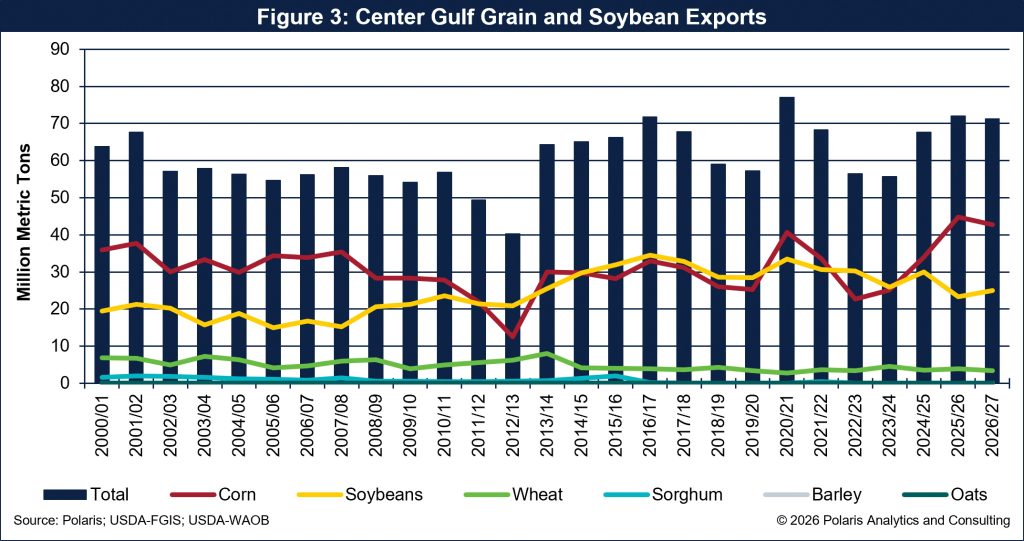
For 2025-26, grain and soybean exports through the Center Gulf are forecast to total 72 million metric tons, the second highest in history. Exports during 2026-27 are forecast to exceed 71 million metric tons. A new level of exports through the Center Gulf has emerged in the past three years, sustaining groundwork from 2017-18 and again in 2021-22 (the historic record) and 2022-23, as shown in Figure 3.
The growth in exports through the Center Gulf is driven by the record corn export program, but when soybean exports regain momentum, the Center Gulf is set to surge to new record levels.
The Center Gulf export position from Baton Rouge, La., to the Gulf is highly dependent on barges to deliver grain to the export elevators. More than 95 percent of all grain and soybean exports through the Center Gulf first arrive by barge from upriver origins.
Headwinds Over The Horizon
As with any training camp, coaches prepare their teams for the unexpected and to be prepared to adjust accordingly. The same is true in the game of grain and soybean exports. On the horizon, the 2026-27 program remains historically strong. Over the horizon, the scenarios that matter most for barge operators are the river and logistics risks outlined below.
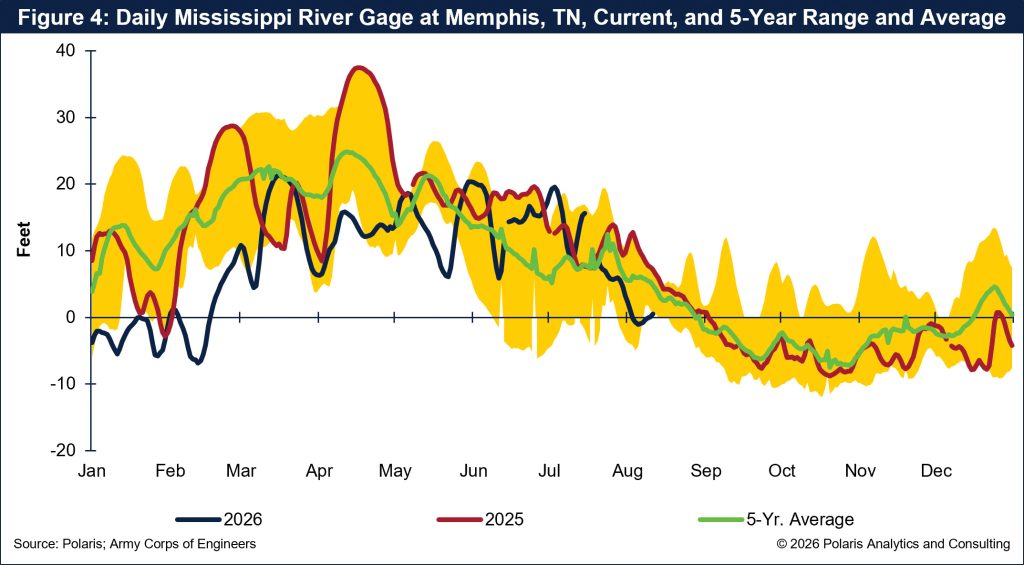
Mississippi River water levels have been bouncing around with sporadic rains but lacking sustained volume across the major tributaries, such as the Ohio River System. While it is summer and river levels tend to drop into the fall and early winter, the gauge in Memphis has been falling fast since the Fourth of July to about a zero-gage reading most recently, a drop of 20 feet over that time, as shown in Figure 4.
Another river concern is the historically small snowpack across the Missouri River Basin this past winter. Low snowpacks threaten the Mississippi River through St. Louis without adequate water flow and lead to low-water conditions during the peak of export season in mid-October through January in the new calendar year.
The record setting El Nino is causing the Panama Canal Authority to exercise caution and restrict traffic using the locks. Coming off a disastrous transit year during 2023 and 2024 due to low water levels in the lakes that feed the Panama Canal, the authority is limiting vessel transits and placing draft restrictions on vessels using the post-Panamax locks. For now, Panama has adequate water levels across the system of lakes, but conditions can and do change rapidly. If conditions worsen significantly, further draft restrictions could extend to the original locks, impacting grain shipments while leading to transit delays. This will add cost to transporting grain and soybean exports from the Center Gulf to Asia.
The inland covered barge fleet is as utilized as it has been in recent years. The combination of stronger demand, a smaller fleet and few new builds entering service has kept the fleet active. With strong grain and soybean exports, and prospects of increased opportunities, utilization levels will improve further.
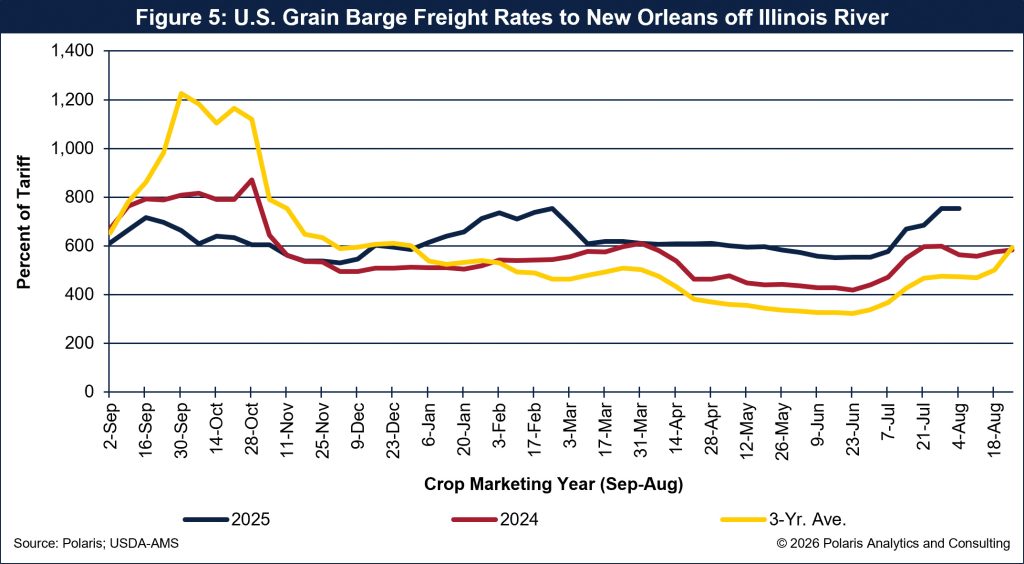
Barge freight rates off the Illinois River reflect the tightness in the fleet, having been above rate levels one year ago and the three-year average since the start of 2026. After the Fourth of July, the rate jumped higher, approaching 800 percent of tariff in August as shown in Figure 5. The deferred months are pointing to stronger rates during peak harvest.
U.S. grain and soybean exports are sustaining new historical levels. Corn has led the way with record volumes and, as soybeans regain ground, exports have an opportunity to remain strong. Over the horizon there are cautionary concerns. But, as with football training camp, teams prepare for the unexpected and adjust accordingly.