
Great Lakes Freight Study Eyes Lakes-Rivers Cargo Growth
A new freight study examining the underused connection between the Great Lakes and the inland waterway system is pointing to opportunities to move more cargo between the two networks while identifying barriers that have kept them largely separate.
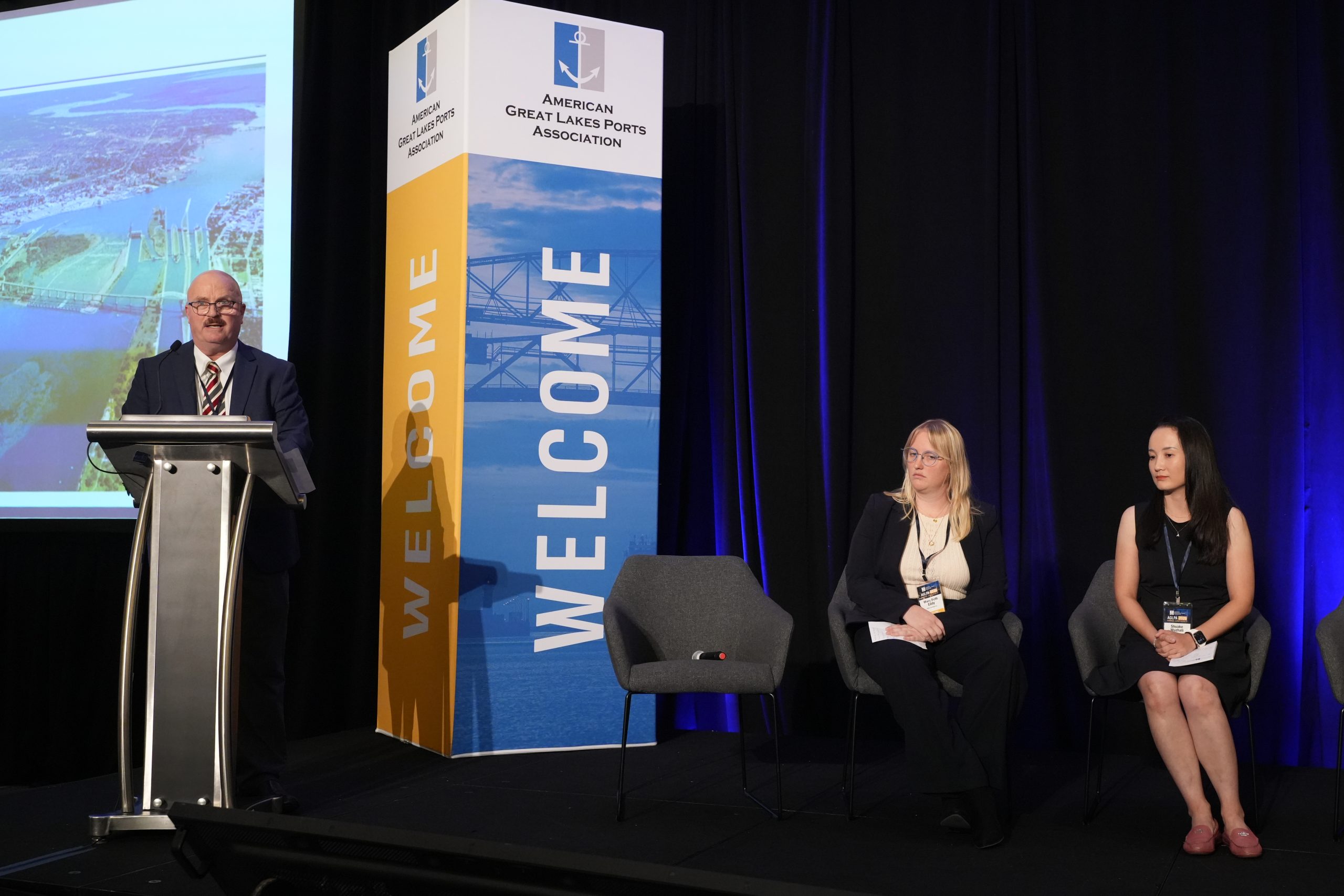
Consultants with CPCS previewed the Great Freight Connection study during a panel at the annual American Great Lakes Ports Association (AGLPA) Conference, held July 30–31 in Chicago. Supported by GLS, Ports of Indiana, Port Milwaukee and the Illinois International Port District, the study focuses on cargo flows between the Great Lakes and the Illinois and Mississippi river systems.
Travis Black, director of inland waterways and acting director of the Great Lakes Gateway for the Maritime Administration, opened by placing the study in the context of the nation’s inland waterway network.
Black said the United States benefits from more than 17,000 miles of internal waterways.
“Our waterways didn’t just move cargo; they united the country into an economic superpower,” Black said.
He pointed to Chicago as a critical link between the Great Lakes and Mississippi River watersheds. Today, Chicago connects two U.S. Marine Highway routes: M-90 on the Great Lakes and Erie Canal system and M-55 along the Illinois and Mississippi rivers to the Gulf.
Black described MarAd’s Gateway offices as the “connective tissue” between federal maritime policy and port operations, helping ports navigate federal programs, jurisdictional issues and funding opportunities.
“A blueprint is useless without the builders,” Black said. “Our geography might have been an accident, but our future of maritime dominance requires intentional partnership.”
Underused Physical Connection
Mary Beth Eddy, senior consultant with CPCS, said the study examined why relatively little cargo moves between the Great Lakes and inland waterways even though the systems are physically connected and serve many of the same industries.
On the Great Lakes, about 80 percent of cargo remains within the system, Eddy said. Roughly 18 percent moves between the Great Lakes and Canada, while only a small share moves onto inland waterways.
On the Illinois Waterway, about 17 percent of cargo remains on that section, while a significant share moves south toward the Mississippi River and Gulf. Only about 5 to 6 percent moves annually between the Illinois Waterway and the Great Lakes. Together, the two systems handle about 138 million tons annually in total.
“What if these common commodities and markets could utilize the two systems as one?” Eddy asked.
A more integrated network could reduce cargo transfers and handling costs, expand market access and provide another option when rail or truck service becomes constrained or less cost competitive, she said.
The study found some cross-system movements are already occurring, including steel, project cargo and liquid bulk. Rather than viewing Great Lakes-inland waterway service as a complete year-round modal shift, stakeholders described it as an additional supply chain option.
“It could be positioned as a relief valve, basically, when other modes falter in their connectivity and their efficiency and their cost competitiveness,” Eddy said.
Great Lakes ports provide access to Canada and international destinations through the St. Lawrence Seaway, while the Illinois and Mississippi rivers connect Midwest markets to Gulf ports. Water transportation also offers low per-ton-mile costs for many bulk commodities, along with fuel-efficiency, emissions and safety benefits.
Commercial Barriers
Despite those advantages, the study identified awareness as one of the leading barriers to expanded cross-system shipping.
“The two systems are physically connected,” Eddy said. “What’s missing is the commercial and market development.”
Ports may need more communication among terminal operators, logistics providers and tenants about available facilities and potential cargoes, while shippers may need more information about the economics of using the two systems as one route.
The study also found shippers can be reluctant to change established supply chains and logistics relationships. Specific examples, cost information and direct connections to ports and terminal operators could help demonstrate that cross-system routing is viable.
Physical constraints remain as well. Bridge clearances can delay or prevent some barge movements, particularly oversized cargo. Eddy said stakeholders repeatedly identified a BNSF-owned bridge on the Calumet as a limiting point where some cargo may have to transfer to a landside mode.
Lock closures and delays, seasonal navigation and extreme weather can affect reliability. Coast Guard requirements involving barge age, load lines, vessel configuration, commodities and weather conditions may also limit which inland barges can operate on the Great Lakes.
Industrial land availability is another concern, particularly in urban port areas where marine terminals compete with residential, recreational and mixed-use development.
Next Steps
The study is intended to move the discussion from the systems’ physical connection toward deliberate market development.
Eddy said the final report includes recommendations for starting those conversations, identifying high-potential commodities and trade lanes and outlining organizations that could help advance cross-system service.
Shuake Wuzhati, PMP, AICP, a CPCS senior consultant, presented the study’s quantitative trade-lane and high-potential commodity analysis. The CPCS team also included Erika Witzke, PE, national director of freight planning and policy, along with Eddy.