
Tenn-Tom Conference Focuses On Growth
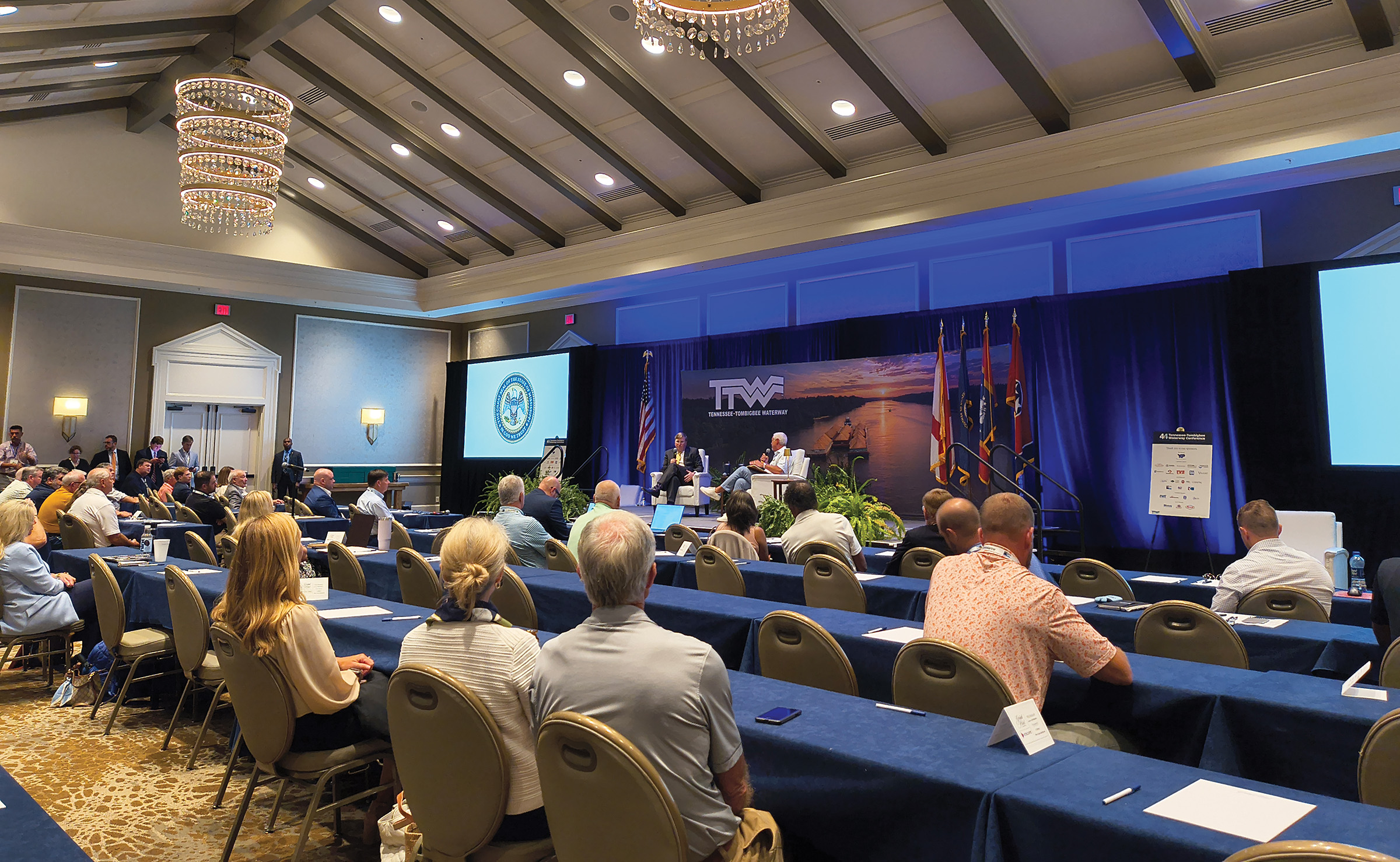
Infrastructure reliability and its connection to economic development dominated the 44th annual Tennessee-Tombigbee Waterway Conference, held August 12–14 at the Grand Hotel Golf Resort & Spa in Point Clear, Ala.
Speakers emphasized that dependable locks, maintained channels, efficient ports and reliable aids to navigation are essential not only to existing shippers but also to attracting advanced manufacturing, defense production and other major investments to the four-state Tenn-Tom corridor.
The conference brought together representatives of ports, towing companies, economic development organizations and government agencies under the theme “Move More. Connect More.”
Marine Highway Funding
Tim Pickering of the Maritime Administration’s Office of Ports and Waterways Planning outlined funding opportunities through the U.S. Marine Highway Program.
The program now includes 35 designated routes reaching 41 states, the District of Columbia and all five U.S. territories. Those routes encompass more than 27,000 miles of navigable waterways.
To date, MarAd has made 80 Marine Highway awards totaling $121 million, leveraging another $123 million in private investment. In addition to states, local governments and port authorities, private companies can apply directly for funding. Proposed projects must receive the endorsement of the appropriate route sponsor, typically a state department of transportation.
Eligible uses can include barges, cargo-handling equipment and other investments that establish or expand waterborne freight service.
Pickering said the fiscal year 2026 program had $5 million in new appropriations and $5.9 million in returned or previously unspent funds, providing approximately $10.7 million for awards. The administration’s fiscal year 2027 request includes $10 million for the Marine Highway Program and $150 million for the Port Infrastructure Development Program.
Corps Shifts Focus To Delivery
Adam R. Telle, assistant secretary of the Army for Civil Works, outlined a broader effort to accelerate Corps of Engineers projects and direct resources toward infrastructure of national significance.
Telle said the Corps has approximately $200 billion in authorized but unfunded projects, along with $46 billion in appropriated or contributed funding that has not yet been spent. The figures illustrate both the demand for Corps projects and the difficulty of moving them efficiently from authorization to completion.
Under an initiative titled “Building Infrastructure, Not Paperwork,” the Corps has adopted 28 internal policy changes intended to shorten project delivery, establish clearer priorities and reduce administrative costs.
Among the changes is an effort to separate employee salaries from individual project accounts. Telle said the traditional funding structure could create an incentive to prolong studies or generate additional work primarily to sustain district staffing. The revised approach is intended to reward project delivery rather than additional processes.
Telle said the Corps should concentrate its engineering and construction expertise on navigation, flood-control and other projects that produce national economic and security benefits. The Tenn-Tom, he said, exemplifies the type of major infrastructure the Corps was created to build and maintain.
Cybersecurity Becomes Infrastructure Issue
Retired Air Force Maj. Gen. Edward “Hertz” Vaughan, chief strategy officer for SEMPRE, a digital infrastructure and national security company, broadened the infrastructure discussion to include cybersecurity, arguing that a waterway’s physical capacity has limited value if its control and communications systems can be disrupted.
Vaughan described the Tenn-Tom as national defense infrastructure because of the commercial and military cargo it supports, including rocket components and materials associated with submarine production. As ports, locks, terminals and manufacturers become increasingly connected, he said, each new digital connection can create another avenue for attack.
Particular attention centered on programmable logic controllers, or PLCs, that operate pumps, valves, gates and other industrial equipment. Such controllers were historically treated as machinery rather than computers, Vaughan said, and some remain connected to networks with factory-default passwords or outdated security protections.
All 10 locks on the Tenn-Tom use PLCs in some capacity, making basic cyber practices relevant to the continued operation of the navigation system. Similar equipment is found at pump stations, port facilities, water-treatment systems and industrial plants throughout the corridor.
Vaughan pointed to previously disclosed intrusions involving water infrastructure and dam controls as evidence that even comparatively simple systems may be targeted. In many cases, attackers did not need highly sophisticated tools because equipment remained accessible through unchanged passwords or older network configurations.
He distinguished between attacks intended to cause immediate disruption and longer-term efforts to gain access to critical systems and remain undetected until a future conflict or emergency. The latter strategy presents a particular risk to waterways because an attacker could seek to interrupt locks, port equipment or communications at the time the transportation network is needed most.
Mobile District Projects
Col. Kelcey Shaw, commander of the Mobile Engineer District, described navigation as a foundation of the district’s economic and national-security missions. The district maintains approximately 1,300 miles of navigable waterways, 22 navigation locks, 28 dams and seven deepwater harbors.
Shaw highlighted the connections among the Tenn-Tom, Black Warrior-Tombigbee Waterway, Gulf Intracoastal Waterway and the ports of Mobile and Gulfport. Those connections allow deep-draft cargo to transfer to inland waterways, railroads and highways serving the Southeast.
Mobile Harbor, deepened to 54 feet in 2025, is now the deepest harbor on the Gulf. Maintaining the new depth will initially require removal of an estimated 4 million cubic yards of sediment annually.
The district is beginning a beneficial-use study to identify opportunities for marsh creation, thin-layer placement and other productive uses of dredged material. Shaw said the district will need a range of placement methods to manage the sediment entering Mobile Bay from the Tombigbee, Black Warrior, Alabama and Mobile river systems.
At Gulfport, the Corps completed a chief’s report supporting a proposed harbor deepening from 36 to 46 feet, with a 48-foot entrance channel. The report was completed in time for potential authorization in the 2026 Water Resources Development Act (WRDA). The project would allow Gulfport to accommodate larger vessels and strengthen its connections to inland and coastal transportation networks.
Shaw also explained the district’s decision to advance a Black Warrior-Tombigbee reliability study before a similar Tenn-Tom study. Because the systems converge near Demopolis, Ala., the Black Warrior-Tombigbee forms the controlling lower portion of the shared route to Mobile.
Completing that study first would allow its economic findings and recommended improvements to support both systems, Shaw said. The district retains authority to proceed with the Tenn-Tom study once additional funding becomes available.
Vern Gwin, chief of the Mobile District’s Operations Division, reported an 18 percent increase in Tenn-Tom funding, largely because dredging funds were restored to the budget. Recreation funding also received a modest increase.
Tennessee River Work
The Nashville Engineer District reported that Wilson Lock has returned to service following an extended closure caused by cracking near the main chamber’s pintle assembly. The closure forced traffic through the much smaller auxiliary chambers, sharply increasing transit times.
The main chamber measures 600 by 110 feet and can accommodate nine barges, while the 300- by 60-foot auxiliary chamber generally handles one barge at a time. A dewatering inspection is planned in fiscal year 2027 to evaluate the repairs.
Kentucky Lock had returned to operation following a June closure, while Barkley Lock was undergoing lower miter gate repairs at the time of the conference. Additional fiscal year 2027 work is proposed at Kentucky Lock and Wilson Lock.
At Chickamauga Lock, the Corps terminated its contract with Shimmick Construction in May after determining the work could not be completed within an acceptable cost and schedule. C.J. Mahan Construction is taking over remaining work needed to place the new chamber into operation, with operational completion targeted for 2028.
The Nashville District also discussed underwater imaging equipment that can inspect lock chambers and submerged components where diver access is difficult. The remotely operated equipment produces clear images in deep or turbid water, allowing the Corps to assess conditions more quickly while reducing risks to divers.
About $10.5 million also has been provided for deterrent systems intended to slow the movement of invasive carp through locks on the Tennessee River and Tenn-Tom system. Initial work includes systems at Barkley and Kentucky locks, with additional installations planned as partnership and cost-sharing agreements are completed.
Coast Guard Modernizes Inland Fleet
Capt. Mike Vega, commander of Coast Guard Sector Mobile, called the Tenn-Tom a critical component of the marine transportation system and emphasized coordination with the Corps during lock failures, hurricanes and other disruptions.
Sector Mobile personnel also outlined the Coast Guard’s Waterways Commerce Cutter program, which will replace 35 aging inland tenders with 30 new cutters. The legacy fleet averages nearly 60 years old, with some vessels more than 80 years old.
The new Chief Petty Officer-class fleet will include 16 river buoy tenders, 11 inland construction tenders and three inland buoy tenders. The first three cutters — the Allen Thiele, Fred Permenter and Samuel Wilson — are under construction at Birdon America’s shipyard in Bayou La Batre, Ala.
The first inland construction tender and first river buoy tender are expected to be completed in fiscal year 2027 and placed into service following acceptance, trials and crew preparation. An additional $162 million in federal funding is allowing the Coast Guard to accelerate production and deliver three cutters earlier than originally planned.
Unlike the tug-and-barge configurations used by portions of the current fleet, the new cutters will be self-propelled monohulls with modern propulsion systems, improved reliability and better crew accommodations. The river buoy and inland construction variants will share major design features, reducing differences in training, maintenance and spare-parts requirements.
Those improvements are expected to increase operational availability and allow crews to complete more aids-to-navigation work during each deployment. The inland fleet maintains more than 28,200 navigation aids across 12,000 miles of waterways that carry approximately 630 million tons of cargo annually.
River buoy tenders set, retrieve and reposition buoys as river stages and channel conditions change. Inland construction tenders drive and remove piles, erect towers and make major structural repairs to fixed navigation aids.
By reducing maintenance downtime and improving endurance, the new cutters should allow the Coast Guard to respond more quickly to displaced buoys, damaged structures and changing channel conditions, limiting disruptions to commercial traffic.
Safety And Inspection Updates
Vega said Sector Mobile is working with industry to establish an Alabama-area Harbor Safety Committee. The committee would provide ports, operators and regulators with a standing forum for developing consensus-based responses to navigation and safety concerns.
The Coast Guard is also seeking industry input regarding the Fowl River Land Cut, where marina and waterfront development could conflict with commercial navigation and use of the channel as a heavy-weather holding area.
Lt. Cmdr. Carl Hendrickson, Sector Mobile’s chief of inspections, urged towing vessel operators to communicate with inspectors well before certificate renewals, drydock periods or equipment replacements.
Recent deficiencies have included inoperable bilge systems, missing engine-alarm test records and binding or broken emergency fuel shutoffs. Hendrickson also cautioned that replacements of engines, steering systems, generators or other machinery may require plan review if they do not meet the regulatory definition of replacement in kind.
Hendrickson also reviewed phased Coast Guard cybersecurity requirements. Cyber incidents affecting vessel or facility control systems must be reported without delay. Training and recordkeeping requirements took effect in 2026, while additional requirements, including designation of a cybersecurity officer and completion of documented assessments, are scheduled for July 2027.
Infrastructure Supports Development
Mississippi Gov. Tate Reeves framed transportation infrastructure as a prerequisite for industrial recruitment. Mississippi’s Department of Transportation budget has grown from $1.1 billion before he took office to $2.2 billion in the current fiscal year, along with more than $1 billion invested in new federal-highway capacity during the past three years.
Manufacturers may produce goods efficiently, Reeves said, but an investment cannot reach its full value without reliable connections to market.
Sen. Tommy Tuberville urged Congress to complete WRDA and called for long-term repairs and replacements rather than temporary responses to recurring lock failures.
Featured photo caption: Mississippi Gov. Tate Reeves discusses the role of transportation infrastructure in attracting industrial investment and connecting manufacturers to markets during the 44th annual Tennessee-Tombigbee Waterway Conference in Point Clear, Ala. (Photos by Zac Metcalf)