
Okie Moore Completes Fourth A-Frame, Honors Longtime Employee
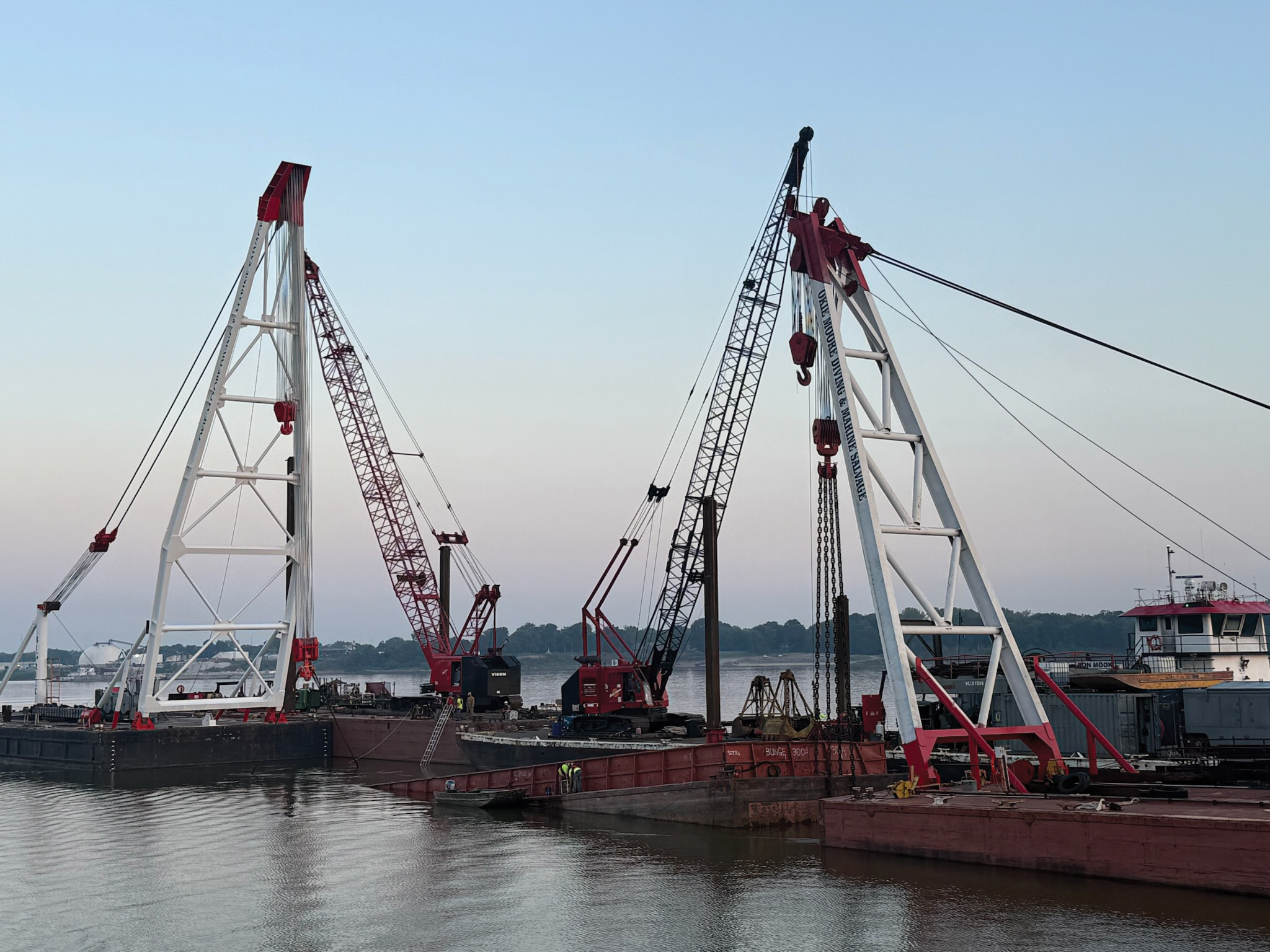
Okie Moore has completed its fourth A-frame crane, adding heavy-lift capacity for marine construction while strengthening its ability to respond quickly to salvage operations, minimize disruptions to commercial navigation and keep channels safe.
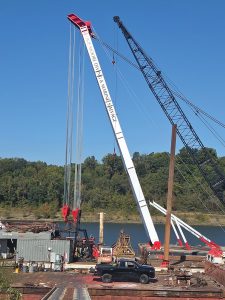
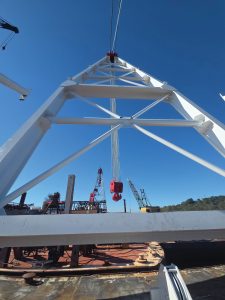
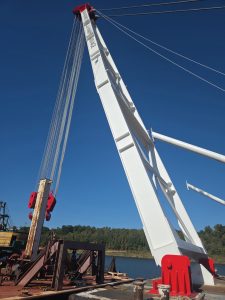
Named Big Rick for longtime employee Rick Allen, the new crane is the company’s largest A-frame. Built for a design capacity of 600 tons, it carries two 300-ton blocks and provides 120 feet of headroom from the water to the bottom of the blocks when fully raised.
The project took about two years, with employees working on it between assignments. Designed around the company’s own equipment and operating needs with engineering assistance, Big Rick joins a fleet intended to support both emergency salvage and planned construction work throughout the commercial waterways.
For Okie Moore, part of Wepfer Marine, the investment addresses a practical problem: construction customers need firm commitments, but a sunken barge or another navigation obstruction can require an immediate response.
With additional equipment, the company can field two separate rigs rather than depend on one set of equipment to serve both needs. Walter Wepfer, vice president of Wepfer Marine, said preserving the ability to answer salvage calls is central to the investment.
“Our goal with the two separate rigs is to make sure we take care of salvage,” Wepfer said.
That readiness serves both the customer whose equipment needs recovering and the commercial traffic that depends on a clear channel. A major part of the company’s work is responding quickly to remove obstructions, minimize navigation disruptions and keep the waterway safe for other operators.
“A big aspect of that is making sure that we keep the rivers, the channel open,” Wepfer said. “The big picture of why we’re there is ensuring safe navigation.”
“Anywhere we can get to with a crane and a boat on the commercial waterways is where we go,” Justin Gentry, vice president of salvage operations, said.
Building For Two Markets
An A-frame uses a large derrick mounted on a barge to lift heavy loads. The equipment can recover submerged barges, handle cranes and bridge components and perform other lifts that require substantial capacity over the water.
Although salvage was a primary consideration in Big Rick’s design, construction applications helped shape the project. The longer boom and greater capacity expand the range of work Okie Moore can undertake, including setting equipment for contractors, handling heavy components at locks and dams and assisting with bridge demolition cleanup.
Previously, committing a rig to a construction project could leave the company facing a difficult choice when a salvage call came in. Moving equipment to an emergency job meant explaining to a construction customer why the crane had to leave.
The additional rig gives the company room to pursue scheduled work while preserving its response capability. Employees train to operate the equipment’s different functions, and maintenance keeps the rigs prepared for deployment.
The expansion also has a connection to Wepfer Marine’s history. Wepfer said his grandfather and Johnny Murphy once divided harbor and salvage operations between them, with his grandfather taking the harbor business and Murphy the salvage business.
Wepfer Marine’s acquisition of Okie Moore in 2015 brought salvage back into the organization.
“It was kind of us going back to where we started,” Wepfer said.
Finding And Raising A Wreck
For Gentry, salvage begins before the equipment leaves the yard. The rigs are kept ready to move, and his phone stays on around the clock. When a customer calls, office personnel work through contracting and necessary plans while the crew prepares for departure.
At the site, the first task is locating the wreck and positioning the equipment. A customer may already have marked a sunken barge with sonar. If necessary, Okie Moore uses its own sonar to find it, then enters GPS coordinates into Rose Point to bring the crane barge alongside.
“Rose Point’s been an unbelievable game changer for that,” Gentry said.
Finding a submerged barge once could take two or three days, he said. Sonar and electronic positioning have shortened that search and helped crews establish their working position.
After securing the rig with anchors or spuds, Gentry uses crane-handled equipment to feel out the barge’s corners, hopper and surrounding conditions. He checks for accumulated sand, remaining cargo and covers before deciding how to proceed.
Cargo may have to be removed before the lift. The crew then works to get lifting wires beneath the hull and raise the barge.
A priority throughout that process is limiting the need to put divers in the water.
“We try to do everything we can to protect our divers the best we can,” Gentry said. “There’s many a time that I can pick a barge up without ever using divers.”
Experience operating the crane and interpreting what its equipment encounters underwater can allow him to locate the hull and arrange a lift from above the surface. Each wreck presents different conditions, however, and the recovery must account for cargo, damage and the barge’s position.
Once the hopper reaches the surface, a barge with manageable damage may be patched and pumped out so it can float again. More severe damage can require cutting the hull into sections, installing bulkheads to make the sections float or placing it aboard another barge.
The job continues through securing the recovered equipment and arranging its movement. Okie Moore works with the Coast Guard or other governing authority, the surveyor and the responsible company. Salvage and transit plans may be required, and the destination depends on whether the barge will be scrapped, repaired or otherwise handled.
The company can provide transportation as well, sometimes delivering recovered equipment to a scrap facility or repair yard along its return route. Gentry emphasized that the basic sequence only outlines a process that can become considerably more complicated in practice.
Okie Moore also has performed salvage work on tank barges. Across its salvage assignments, the company’s approach ties readiness at the yard to careful work at the wreck: locate the equipment, determine its condition, plan the lift and secure it for movement while protecting the people carrying out the recovery.
A Name Earned Over Decades
The decision to name the crane Big Rick grew out of Gentry’s respect for Rick Allen’s commitment to Okie Moore. Allen arrived about two years before Gentry, who started in 1999, and became both a coworker and a teacher.
“Rick is probably one of the most devoted guys I’ve ever seen,” Gentry said.
Whether the call came during the night or on Christmas, Allen could be counted on to answer. His contributions extended beyond the equipment to the everyday work that kept the operation going, including preparing meals, running errands and checking on boats over the holidays.
He also helped introduce Gentry to crane operation. After a day’s work, Allen would take him to the crane and sit with him as he practiced lifting, lowering and swinging. With repetition, Gentry became comfortable enough to begin handling spuds and other equipment.
Those lessons helped start a career that now includes building and operating the company’s largest A-frame. Naming it for Allen recognizes the employee who helped Gentry develop those skills and remained available when the company needed him.
“What better way to name it than after a guy that’s been so devoted to Okie Moore through the years,” Gentry said.
A Summer Job That Stuck
Gentry’s own introduction to the river came at 16 through a family friend named Bruce Gibson, president of Okie Moore, whose family had hunted on Gentry’s Missouri farm for years. Gibson, who used to run Okie Moore and is still active in the company today, asked whether he wanted to spend a summer working for the company.
“I’d never been around a river in my life,” Gentry said.
The prospect meant leaving home for work about three hours away. When Gibson called to say a job was ready and Gentry needed to decide, he accepted and caught a ride to St. Louis.
His first trip took him to the Missouri River. An extended assignment on a cement barge followed, and he returned home just before school resumed. The older equipment, demanding work and experienced river hands made that first summer an education of its own.
One of those men was Donnie Wagner, whom Gentry remembered as rough around the edges but resourceful enough to fix almost anything. At summer’s end, Wagner shook his hand and urged him to work hard in school so he would not have to return.
“You don’t have to worry about that,” Gentry recalled replying. “I’ll never be out here again.”
The next summer, he came back to earn more money. Twenty-seven years later, he has a different view.
“In reality, I don’t think I’d have it any other way now,” he said.
Ryan Johnston, chief operating officer, also entered the industry through an unexpected opening. While attending the University of Mississippi, he accompanied his girlfriend to a Wepfer boat christening in Memphis. The visit introduced him to Wepfer Marine, and an invitation to try an internship followed as he approached graduation.
“I just received a notification on our payroll system,” Johnston said. “Twenty-one years ago Tuesday, I’ve been here.”
Gentry shares his story with young people who are unsure where the industry might take them. He started with little, he said, even wearing shoes held together with tape. Work, persistence and help from experienced river people gave him a path forward.
“There’s a lot of good people out here on the river that [are] willing to help you move up the line,” he said.
Big Rick carries the name of one of them.
Featured photo caption: Big Rick joins Okie Moore’s fleet of A-frame cranes for marine construction and salvage work. The additional rig allows the company to take on scheduled construction projects while remaining ready to respond to emergencies and keep navigation channels clear.