A Look At NABRICO’s Rich History
A storied barge-building company deeply intertwined with the history of the towing and barge industry is renewing its brand and continuing to modernize for an expanded future.
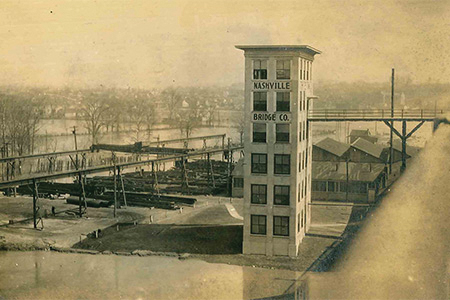
Nashville Bridge Company (NABRICO) began when Arthur J. Dyer, a Vanderbilt University engineering graduate (class of 1891), founded the company. After working for various bridge firms in the 1890s, he borrowed $750 to partner in the H.T. Sinnot Company. In 1902, he bought out his partner and reorganized it as the Nashville Bridge and Construction Company (later simply Nashville Bridge Company).
The company responded to demand after major floods in the early 1900s destroyed many Tennessee bridges. Its first major project involved the steel framework for Nashville’s Arcade. In 1908, Dyer built a six-story headquarters on the east bank of the Cumberland River in Nashville (now known as The Bridge Building).
The firm gained a strong reputation across the Southeast, building 73 bridges in Tennessee and more than half of Florida’s movable bridges. It was closely associated with the industrial rebirth of the South during this period. It even exported bridges to Central and South America.
Marine Construction, Wartime Shift
In 1915, NABRICO built its first floating equipment: a small derrick hull for the U.S. Engineer Department (predecessor to the U.S. Army Corps of Engineers). This marked its shift from bridges into shipbuilding and marine work on the Cumberland River. The company gradually increased its focus on vessels for inland waterways. It produced steamboats early on and expanded capabilities at its riverside yard.
NABRICO contributed significantly during both world wars, building nearly 100 combat vessels and barges. Its World War II output included 14 U.S. Navy subchasers. two U.S. minesweepers, five barracks vessels and various lighters, deck barges, oil barges, water barges and cargo barges for the Navy and Quartermaster Corps. These efforts highlighted its manufacturing capacity and supported the war effort while building expertise in barge and vessel construction.
Post-World War II Barge Boom
After World War II, NABRICO pivoted toward inland marine construction, building fewer bridges and focusing on towboats and barges instead. It became renowned for high-quality, efficient and stylish vessels that offered strong performance and longevity. Many operators (e.g., Chotin, Hougland and Ingram) preferred NABRICO builds.
By the 1960s, NABRICO was said to be the world’s largest builder of inland barges. It used innovative production-line methods, including launching barges from pivoted arms. Its tank barges featured distinctive “spoonbill” rake designs on the bow for better efficiency. The company built large unit tows, such as three-piece sets with 264-foot by 50-foot barges (including bow steering units) for operators like Jordan River Line. It delivered specialized barges for sanitation departments (e.g., 45 barges for New York City) and asphalt service (double-skin rake tank barges).
NABRICO also built notable towboats, such as the Winchester (1951, 1,800 hp. for Jordan River Line), praised for workmanship, design and features like radar and gyro compasses. Its public barge launchings became community spectacles along the Cumberland River.
NABRICO has always prided itself on being an innovator in the barge space. Its many products include constant tension winches and other special winches using state-of-the art electric motors and controls. It offers a complete line of hatches, castings (bitts, kevels, chocks, D-Rings, Panama Canal chocks, etc.), watertight doors and tank barge fittings (expansion trunks, drip pans, warning signs, small tanks, etc.).
In a 2012 retrospective article in the S&D Reflector, the publication of the Sons and Daughters of Pioneer Rivermen, Capt. Robert Reynolds noted, “Many considered a Nashville Bridge boat to be the ‘Cadillac’ of towboats, and several towing companies were fiercely loyal to NABRICO for both towboats and barges.”
Steinbrenner Years
In 1969, George Steinbrenner—who later became better-known as the hands-on owner of the New York Yankees baseball team—purchased the company. Steinbrenner’s family owned and operated a shipping company on the Great Lakes.
Steinbrenner presided over expansion, adding a second yard in Ashland City, Tenn., in 1977. In 1995, he sold NABRICO to Trinity Marine Group. Trinity closed the Nashville yard in 1996 when the city redeveloped the downtown riverfront property for what became Nissan Stadium (Adelphia Coliseum). Most of its facilities were demolished, but the original 1908 office building and additions (1923 and 1965) were preserved.
Bridging The Gap
The NABRICO name — too respected to let lapse — endured as a registered trade name of Trinity Marine and eventually Trinity spinoff Arcosa Marine Products, Inc. It “bridges the gap” to connect Trinity, Arcosa, and Wynnchurch ownership. The brand remains a respected supplier of marine deck hardware, winches (including the NABRICO deck winch and “Big Blue” barge-moving winches), hatches, castings, fittings and other barge accessories for river and offshore use. The company emphasizes innovation, quality and more than a century of engineering expertise.
NABRICO’s impact on the barge industry has been, and continues to be, deep and lasting. The company helped standardize and scale efficient inland barge designs that supported the growth of American inland commerce, moving commodities like petroleum, chemicals and bulk goods. Its vessels are known for durability, with some still operating decades later (including internationally). Its former headquarters, The Bridge Building, stands today as a symbol of Nashville’s industrial and maritime heritage.
A list of barges and vessels built by NABRICO through 2012 is available at http://shipbuildinghistory.com/shipyards/small/nashvillebarges.htm.