

Kentucky Lock Construction Project Advances
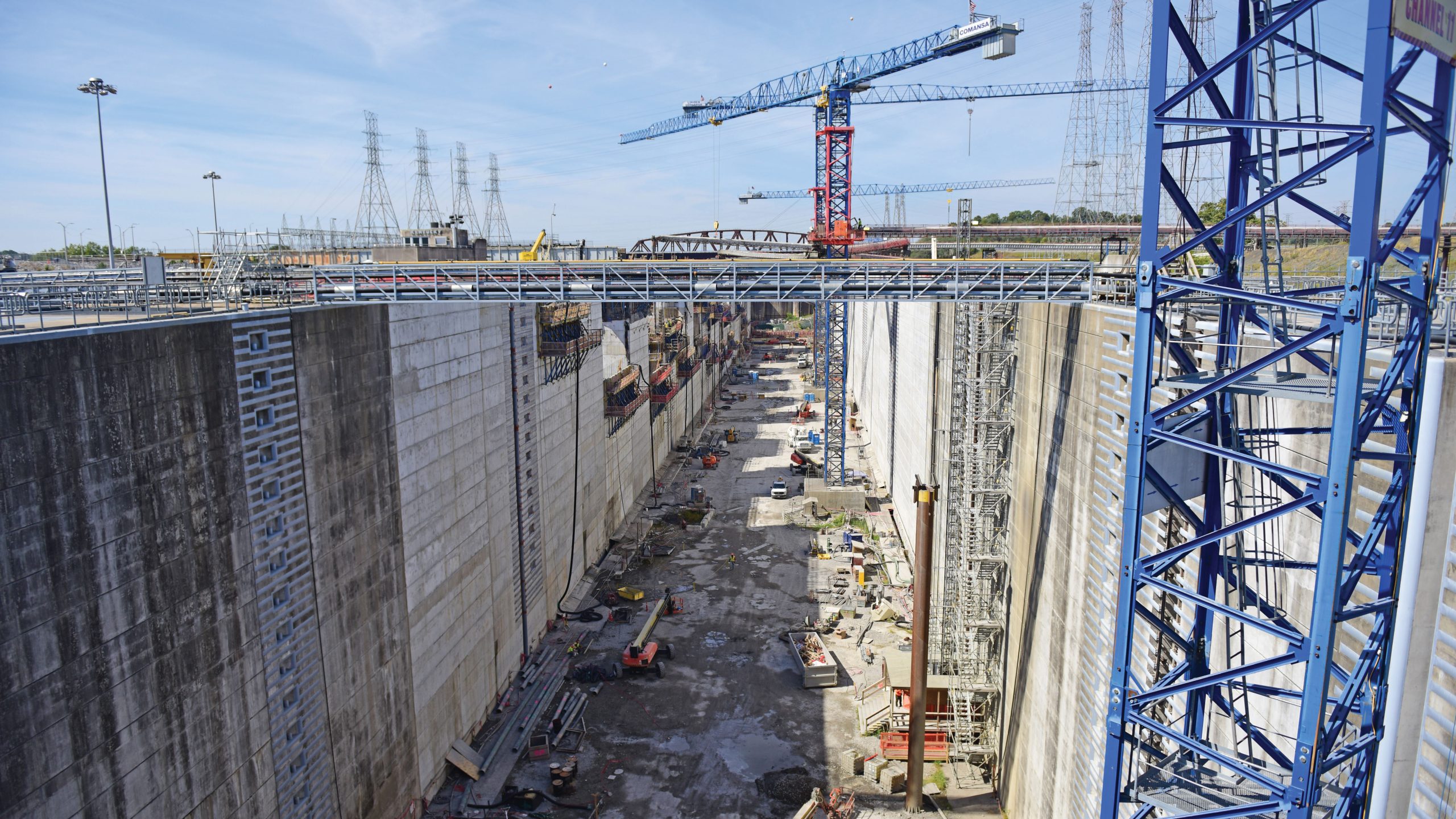
With 82,000 cubic yards of concrete placed since January, the Kentucky Lock Addition Project is now 65 percent complete.
Putting the amount of concrete placed into perspective, Project Manager Wendy Shaw said, “It’s about the amount of concrete you would need to build the U.S. Capitol dome.”
Shaw highlighted some of the accomplishments since the Pittsburgh Engineer District took over the project in August 2025 from the Nashville Engineer District.
The project involves the construction of a 1,200-foot navigational lock beside the existing 600-foot lock built in the 1940s at the facility at Tennessee River Mile 22.4 near Grand Rivers, Ky. Project managers say the new chamber should significantly reduce lengthy waits for commercial and recreational traffic to transit the lock, which is one of the country’s busiest.
Successful Transition
Shaw began by noting that the project’s transition to the Pittsburgh District was “really more about the Corps and its effort to be more efficient as to how we do construction.” She mentioned the Corps’ new Building Infrastructure Not Paperwork initiative multiple times.
The Pittsburgh District completed a new lock chamber at the John P. Murtha Locks and Dam on the Monongahela River in August 2024 and is continuing construction work at Montgomery Locks and Dam, where the small 56-foot by 360-foot auxiliary chamber is being replaced with a new 110-foot by 600-foot primary chamber as part of the Upper Ohio Navigation Project. Those projects mean the district has recent lock and dam construction experience, Shaw said. Additionally, she said the district is working closely with the Corps’ Inland Navigation Design Center, headquartered in Rock Island, Ill., and the Engineer Research and Design Center in Vicksburg, Miss.
One of the methods the Pittsburgh District has put into place to help advance the completion of the design is creating a 3D computer model of the project. It includes both the existing chamber and the new chamber and allows crews to “walk through” the project in virtual reality to help resolve any issues before they take place in the real world. Shaw said that technology has also been helpful to share with contractors as they make their proposals.
The major work accomplished this year is the continuation of concrete placement as part of the lock monolith contract. The project requires the construction of 51 monoliths and placement of an estimated 375,000 cubic yards of concrete overall, enough to fill up more than 114 Olympic-sized swimming pools.
Safety Milestone
As of September, lock monolith contractor Thalle Construction Company had safely placed approximately 85 percent of the project’s concrete, Shaw said.
Thalle reached a milestone in August, completing 3 million man hours without a lost time incident. The Corps of Engineers celebrated the achievement during a special contractor-hosted Jobsite safety standdown, which included an appreciation luncheon September 30.
“Delivering a safe and quality project for the American people is huge,” Pittsburgh District acting Commander Col. Albert Butler said at the celebration. “You all are making an impact on our nation through your disciplined efforts. Doing this safely and efficiently is amazing.”
Steve Kohler, Thalle Construction president and chief operating officer, said he was impressed with the milestone and that it was considerable and very meaningful.
“Never have I seen anything like this from a safety perspective,” he said. “I want to say thank you to the safety professionals that are out here that set a standard and a culture. Something like this doesn’t happen by chance or by accident. It’s one decision at a time. It’s one shift at a time. It’s a tremendous achievement, and I thank you for it.”
What’s Next?
The district is also preparing for the next work to be completed.
“We’re getting ready for the delivery of the miter gates,” Shaw said.
The massive steel structures will be 94 feet tall and a total of 110 feet wide when installed. Shaw said that is equivalent to the weight of four 747 jumbo jets.
The gate sections will be transported to the site by highway in five sections each beginning in January and will take several months to assemble, Shaw said.
The Corps is also adding four new mooring cells in the upstream lock approach. Mainly funded by the Tennessee Valley Authority, which owns the facility and oversees its hydroelectric functions, the mooring cells will be important to both the existing chamber and the new one, Shaw said. The contract has been awarded to C.J. Mahan Construction Company, and construction on the cells is expected to begin early next year.
Two more contracts remain for the project to be completed. The approach wall contract will build the walls needed to safely guide tows into the new chamber. The lock operational contract will involve the manufacturing and installation of the electric and mechanical machinery that operates the lock, including its filling and emptying valves.
Funding Needs
Additional funding from Congress is necessary to advance much of that construction as major cost adjustments for locks and dams that exceed initial statutory limits require congressional authorization.
In June, the Corps of Engineers’ Post-Authorization Change Report (PACR) for the Kentucky Lock project indicated that while the project is currently authorized for $1,446,219,000, it will require reauthorization to $2,741,549,000, at the fiscal year 2026 price level. That’s an increase of just over $1.295 billion.
Historically, Congress handles these modifications directly within the Water Resources Development Act (WRDA), which Congress has passed every two years since 2014 after a prior gap in regular enactments. The U.S. House of Representatives passed its version of WRDA 2026 on September 16. The Senate Environment and Public Works Committee advanced its own Senate version of the bill in July. The two bills must be reconciled and voted on by Congress before they can be sent to the president to sign into law.
The Corps has 96 percent confidence in its certified cost estimate, according to a June 11 memorandum from Maj. Gen. Jason E. Kelly, U.S. Army deputy commanding general for civil and emergency operations, to the assistant secretary of the Army for civil works.
Two memoranda from Kelly were enclosed with the PACR for transmission to Congress as a basis for increasing the authorized project costs at both Kentucky Lock and the Chickamauga Lock Replacement Project, where Kelly wrote than an additional $548 million is required to fund that project to completion.
Kelly attributed the increase in the costs to the Kentucky Lock project to the need for contingency funds; design and construction methodology changes and cost increases resulting from design maturity; changes in construction schedule and acquisition strategy that exceeded initial assumptions and contingencies; escalation required as a result of “the extended duration of the project”; and market conditions, including increases in contractor overhead, electrical and mechanical subcontractor costs and direct labor rates.
The Kentucky Lock Addition Project was first authorized by Congress in 1996. More than $790 million has been spent on it so far, according to the memorandum from Kelly. In it, he also pointed out how the project will contribute to the regional economy through construction expenditures, facilitating commercial navigation and supporting activities, such as cargo-handling services, warehousing and the movement of fuel.
“Notably, remaining construction expenditures through 2034 will support 18,000 full-time equivalent jobs, $1.2 billion in labor income, $1.3 billion in value added and $2.1 billion in economic output within the local four-county region,” Kelly wrote.
Shaw said the continued work toward advancing construction on the project in a safe and efficient manner represents the commitment the Corps of Engineers has to the country and particularly to the navigation community.
Featured photo caption: Pittsburgh Engineer District Commander Col. Albert Butler, Thalle Construction President and Chief Operating Officer Steve Kohler were among those who visited the Kentucky Lock Addition Project on September 30 to celebrate 3 million man hours on the project without a lost-time incident. (Photos by Lee Roberts/Nashville Engineer District)