

WWW Hosts Local Schools At Alton Industry Interaction Day
October is often a busy, fun-filled month for high school students. Football games, dances and even field trips make the fall season one of the most anticipated times of the year before winter finals. For schools across the United States, We Work the Waterways Industry Interaction Days are part of the season’s festivities.
The school year is in full swing, which means We Work the Waterways (WWW) is working diligently to educate America’s young people about the maritime world. The 501(c)3 nonprofit organization brings together students from across the country to connect with maritime professionals within their communities and learn about the career opportunities available to them once they graduate.
Classrooms across the St. Louis and Illinois regions came together on October 21 in Alton, Ill., to take part in one such Industry Interaction Day. Held at the National Great River Museum, more than 120 students across five schools participated in the activities.
The day began with an enthusiastic welcome to all students and teachers by WWW staff, volunteers and the professionals who would spend the morning teaching them about their jobs. The students were then broken into groups to circulate among 15 stations positioned throughout the interior and exterior of the National Great River Museum. Stations showcased a variety of skills and careers across the industry, and many of the participating businesses and schools were repeat attendees.
“It’s a good time for (students) to learn about something that’s right here in the city that they’ve probably never heard or knew about, and to see those things firsthand,” a returning teacher said. “It’s an opportunity to even stay local and to hear about the careers that are right here in their back yard.”
“Each year we have different kids with different experiences,” another educator said in further comments to The Waterways Journal. “We had one student who attended as a junior, and she asked to come back as a senior as well. She wants a trade job, so this was a great thing for her.”
Stations are timed to ensure that all students visit each one, meaning each student is exposed to all activities and career information provided to them throughout the day. Teachers who attended the event shared that the timed stations helped students stay engaged and focused throughout the day, with enough time to ask questions but not so much time to be bored.
As the name suggests, students are not lectured to at each station. Instead, they are encouraged to interact directly with each activity, engaging in the industry on land to pique their interest toward the water.
“It was very comfortable for our kids,” one teacher said. “It didn’t feel too overwhelming, and they were able to ask questions.”
One station, run by Osage Marine, included a short presentation on the maritime careers the company offers. Students then observed an Osage Marine employee lift and carry three different kinds of rigging equipment before giving students the opportunity to try it themselves. Many students were surprised by how heavy the equipment was and that someone could carry it daily for their jobs; others were equally encouraged and surprised by their own strength. For many, it was their first time up close to the kinds of equipment maritime professionals handle on a daily basis.
The founders of Mike’s Inc., Alton, Ill., got their start offering fabrication and welding services. At the company’s station at the WWW Industry Interaction Day, the company gave students a hands-on encounter with the welding industry. Students used canned spray cheese to weld crackers together and followed specific welding patterns commonly found in the maritime industry. Students enjoyed the task of “welding” in a safe, low-stress environment, and they were pleased to be able to eat their creations as well.
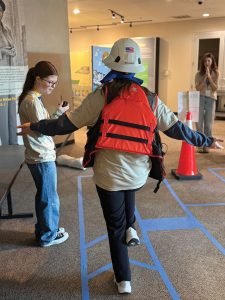
A third station highlighted how integral good communication is while working in the maritime sector. At the Riverview Companies station, students learned the value of radio communication. One student was handed a radio, while another was blindfolded. It was the job of the radio-equipped student to guide the blindfolded peer through a diagram of a river taped to the floor. One student cautioned the other to avoid drift piles, dams and other hazards that towboat captains navigate through daily. The kids learned to work together to make it down the “river,” and they left understanding that even captains cannot work alone.
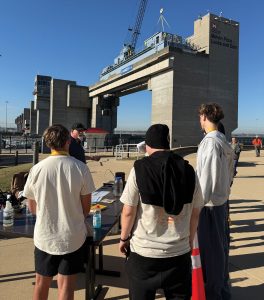
After lunch, students divided into groups to tour Melvin Price Locks and Dam. Attendees were able to see the Mississippi River from above, as well as learn how the lock serves the industry and how it works. Coincidentally, the mv. Crimson Glory, a 5,000 hp. towboat operated by ARTCo, locked through with a 15-barge tow while tours were taking place, and students and the captain got to greet each other.
Only after the students had spent the day physically involved in the maritime world did they sit for a presentation. At the day’s conclusion, Errin Howard, executive director of WWW, showed students the statistics behind the careers they had just learned about, proving their importance. Students learned about the kinds of commodities that move on water to eventually make their way into stores; how tows impact the environment compared to rail cars and tractor-trailer rigs; and the vital contributions the maritime industry makes toward the nation’s economy, $100 billion each year.
After the presentation, Howard invited three panelists from different maritime backgrounds to answer student questions. One panelist, Colton Schmitt, described his career at Riverview Companies. Schmitt explained the different kinds of positions he’s held within Riverview Companies, and all panelists encouraged students to always ask questions and use all the resources available to them. In the eyes of high school students, a career such as Schmitt’s, who is just 22 years old, no longer seemed so dauntingly far away.
Students left that afternoon with a greater understanding of an industry they may not have thought of before, and with the knowledge that the world is perhaps a little bigger than they may have once thought. A participating high school commented that students left the event with lots of questions, particularly about the careers available to them right after graduation.
“They wanted more information on which areas they’d be best suited for if they pursued a career,” a teacher said.
WWW has developed a Career Hub on its website to address this specific need. The Career Hub is an online database that details nine different career pathways and nearly 100 job descriptions, as well as the steps it takes to enter a particular profession. Students can navigate through the website to determine which career might suit them best based on their skills, compare salary ranges and even see which companies are currently hiring for selected positions. Howard introduced students to the Career Hub during her presentation, and each student left with a QR code to easily access to the website at their convenience. Multiple students also left with business cards handed out by the industry leaders who ran the stations that day.
We Work The Waterways hosts several events throughout the year, and its next Industry Interaction Day will take place in Reserve, La. Schools can navigate to the WWW calendar on the organization’s website to register for an upcoming event.
Featured photo caption: WWW Executive Director Errin Howard moderated a panel discussion during the end-of-day presentation. Students heard how panelists got into their professions, what made them stay in the field and advice and encouragement. Panelists (from left to right) included Dawn Lamb, hydraulic engineer for the St. Louis Engineer District; Colton Schmitt, Riverview Companies facility manager; and Brandon Hansen, surveyor at the American Bureau of Shipping (ABS).