

This Boat Ran 34 Years Without A Name Change
The John I. Hay Company of Chicago operated two steam sternwheel towboats in the mid-to-late 1930s. One of these was the former packet Betsy Ann, made famous by the writings of Capt. Frederick Way, Jr, and the other was the Altair. The company acquired a tug named Stark D. Whiteman that had been built at Boston, Mass., in 1872, and was converted to diesel in 1929.
In 1940, the company had two new diesel towboats built by Calumet Shipyard & Dry Dock Company at Chicago. These were a single screw boat of 600 hp. named Chicago Bridge and a 1,200 hp. twin screw boat named Horace E. Horton. They were followed, in 1945, by a large diesel twin-screw boat that was also a Calumet product. This was the George T. Horton, rated at 2,000 hp. from a pair of National Superior engines turning 275 rpm. The hull measured 150 feet in length with a width of 35 feet and a depth of 7 feet.
In 1947, the John I. Hay Company turned to St. Louis Shipbuilding & Steel Company for another large addition to the fleet. This boat had a hull that was 154 feet by 35 feet and had a 10-foot depth. It boasted 3,000 hp. from a pair of Fairbanks-Morse opposed piston engines turning 720 rpm. The propellers turned in kort nozzles that increased the thrust.
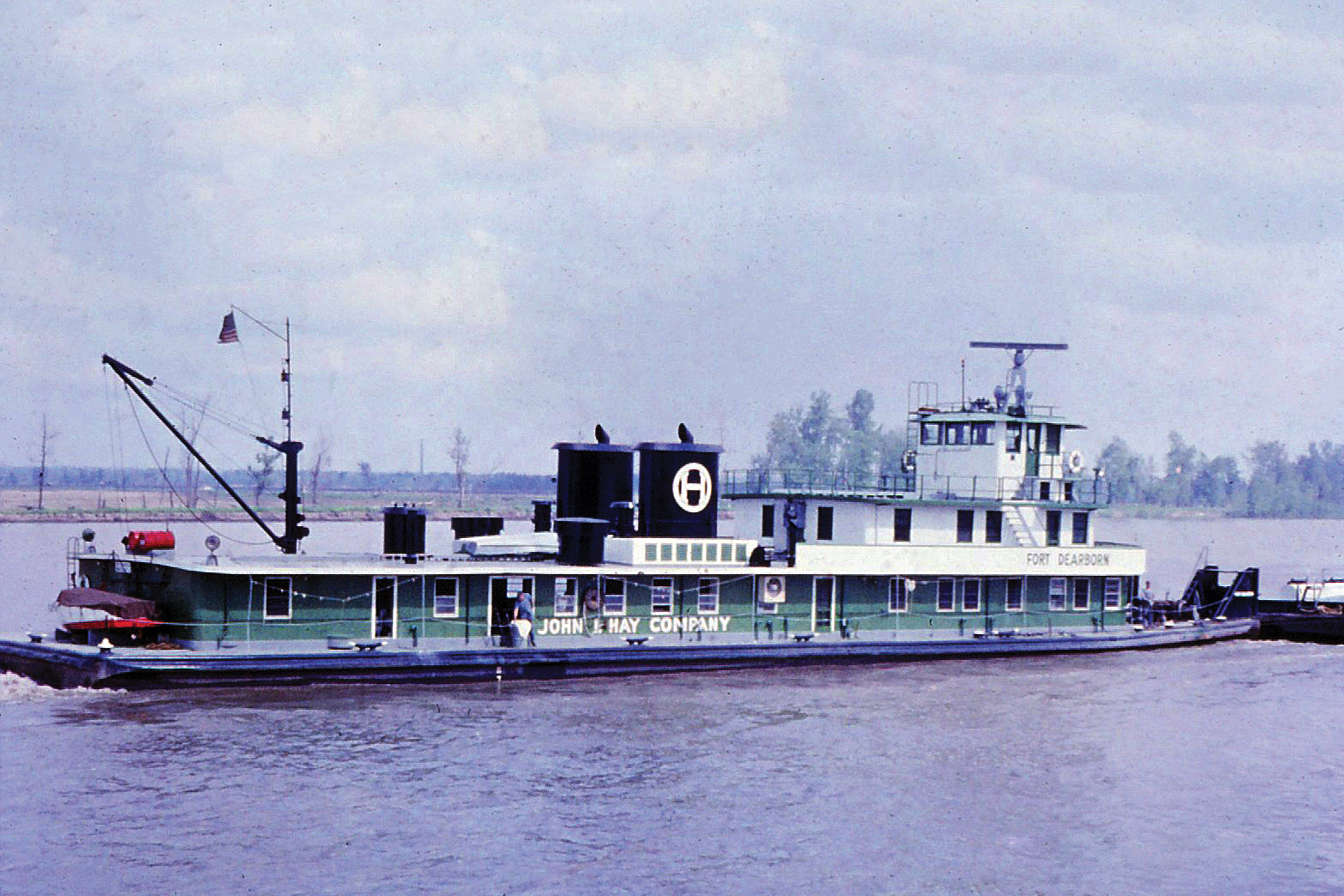
The new boat was christened Fort Dearborn. It had a full main cabin, a shorter upper cabin and a slightly elevated pilothouse above that. Two smokestacks of the signature St. Louis Ship “stovepipe” design were on the roof behind the second cabin. Even though the inland towing industry had been moving away from engineroom control of the main engines in favor of direct pilothouse control, the Fort Dearborn had a mechanical engine order telegraph mounted in the center of the pilothouse console by which the pilot would convey to the engineer what he wanted the engines to do. An RCA radar was also located in the pilothouse.
Quarters were provided on the main deck for four cooks and 14 crew, as well as the galley, dining room and crew lounge. On the upper deck was an officer’s lounge, and rooms for the captain, pilot, chief engineer, two assistant engineers and two guests. The radio call letters WA 5072 were assigned to it.
The Fort Dearborn was joined in 1951 by a near sister vessel named Fort Jackson (The Waterways Journal October 2, 2023). Also built by St. Louis, the Fort Jackson had a slightly deeper hull, larger propellers and 200 more horsepower. In 1953, the Fort Dearborn was fitted with a set of Farrel-Birmingham gears of 3:1 reduction, and the horsepower rating increased to 3,200 hp. At some point, it was converted to pilothouse control of the main engines.
In 1963, the floating stock of the Hay company was transferred to A.L. Mechling Barge Line, Joliet, Ill. According to the 1966 edition of the Inland River Record, the Fort Dearborn was sold in February 1964 to Rose Barge Line, Inc., Marseilles, Ill. Rose sold it in February 1966 to O.F. Shearer & Sons River Transportation, Cincinnati.
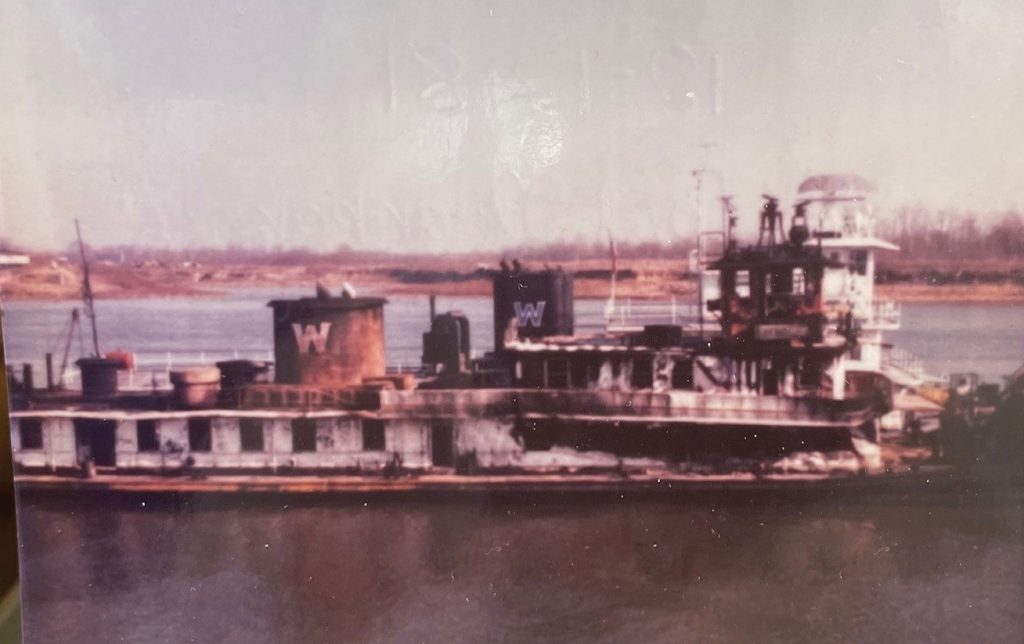
In September 1973, the Shearer river assets were sold to Indiana & Michigan Electric Company (AEP), Lakin, W.Va. In 1979, the Fort Dearborn was sold to G&C Towing, Point Pleasant, W.Va., headed by Capt. Bob Bosworth. G&C kept it for only a few months, and, in November 1979, it was sold to Walker Towing Corporation, Paducah, Ky.
On December 9, 1981, the Fort Dearborn was downbound with two loaded tank barges on the Ohio River at Wolf Creek Bend, Mile 677, when it collided with the upbound Bruce Brown, which was towing a four-piece unit. The Fort Dearborn and the barges it had in tow caught fire. The boat was a total loss. The barges, one loaded with diesel fuel and one with gasoline, burned for days before the fire was extinguished, resulting in a river closure of four days. Thankfully, there were no fatalities or serious injuries.
2027 Sternwheel Boat Calendar
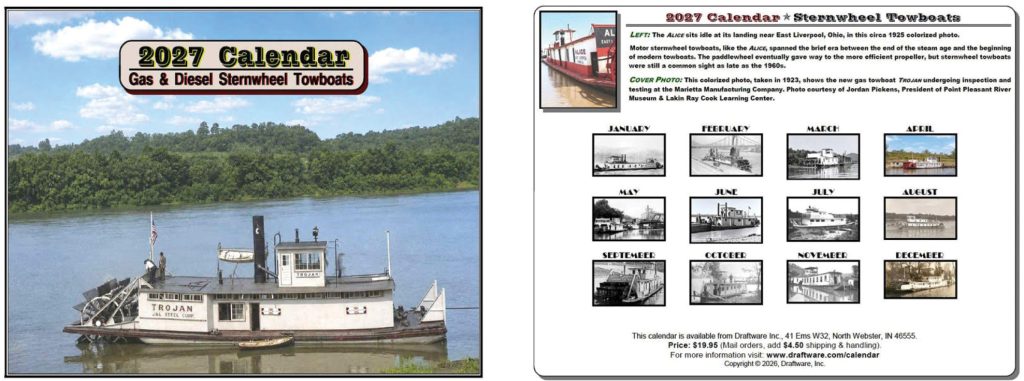
Back by popular demand, Draftware, Inc. has released the 2027 Sternwheel Boat calendar that features early photos of gas & diesel sternwheel towboats. The calendar contains 13 large photos printed on heavy card stock, suitable for framing.
Each month features a specific boat along with its history, and a complete calendar page, with holidays marked. The boats featured for 2027 include the Trojan, Chickasaw, Jos. Smith,
Van M, Helen F., Dorcas Bowman, J.S. McKee, Kentuckian, R.W. Turner, Little Eddie, Brownie, Deem Bros., W.C. White and Alice.
The calendar costs $19.95, plus $4.50 shipping for one calendar and $1 for each additional calendar. Mail a check or money order to Draftware Inc., 41 EMS W32, North Webster, IN 46555. Credit card orders can be placed online at www.draftware.com/calendar.
Featured photo caption: The Fort Dearborn while owned by John I. Hay Company on May 14, 1959. (From the Capt. Jeff Yates collection)