
The Indiana Helped Usher In A New Era
The last column was inspired by a near century old pay ledger that had been repurposed into a scrapbook by riverman Palmer Fisher, a friend of many years to the family of Richard Dale James, originally from the Gallipolis, Ohio, area. The scrapbook contains many clippings from newspapers, magazines and The Waterways Journal. One clipping is of the christening of the steam prop towboat Indiana just before it slid down the launching ways at the Charles Ward Engineering Works, Charleston, W.Va., in 1930.
The Indiana was one of four large twin-screw steam towboats built for the Mississippi Valley Barge Line in 1930. The company would soon come to be known as simply the “Valley Line” and grow to prominence in the inland river industry. The concern had its beginnings in a company known as the Standard Unit Navigation Company that had built an innovative towboat at the Nashville Bridge Company in 1929. It was named SUNCO A-4 and had caterpillar type paddles on the sides (WJ September 21, 2021).
Early drawings of the big prop steamers indicate that they were designed for the Standard Unit Navigation Company, but by the time they went into service they were owned by the Valley Line. Both companies were created with the involvement of Carl J. Baer, a native of Gallipolis, Ohio, who was a resident of St. Louis at the time. Two of the big towboats were built by Dravo at Neville Island, Pa., named Ohio and Tennessee and equipped with Skinner Uniflow reciprocating engines. The other two boats, named Indiana and Louisiana, would be built by Ward and have steam turbines powering electric motors.
The Ward firm had been in business since 1872 and had been an early proponent of the tunnel stern propeller towboat. The company also built some of the earlier towboats equipped with diesel engines, both sternwheel and prop driven. The big Valley Line boats attracted a lot of attention throughout the river system, given their large size of 191 by 40 feet, and substantial power, exceeding 2,000 hp.
While these new boats were under construction, some significant steam sternwheel towboats were still being built (and would be for the next decade). The July 5, 1930, issue of the WJ was full of news about the Wm. Larimer Jones that had been built by Howard at Jeffersonville, Ind., for the Jones & Laughlin Steel Corporation. It was a steam sternwheel boat with a steel hull 162 by 34 feet. It was rated at 800 hp. and was innovative in the fact that it only had one smokestack behind the pilothouse and had no pilot wheel in the pilothouse, only steering levers.
The Indiana was the first completed at Ward and was christened by Mrs. Carl Jeffries. Carl Jeffries was also a Gallipolis native and was the chief engineer of the Valley Line. He was identified in news columns of the WJ as being “a relative” of the previously mentioned Carl Baer, who himself was identified as vice president of the firm. Jeffries had designed the SUNCO A-4 and probably had a hand in the design of the large steamers.
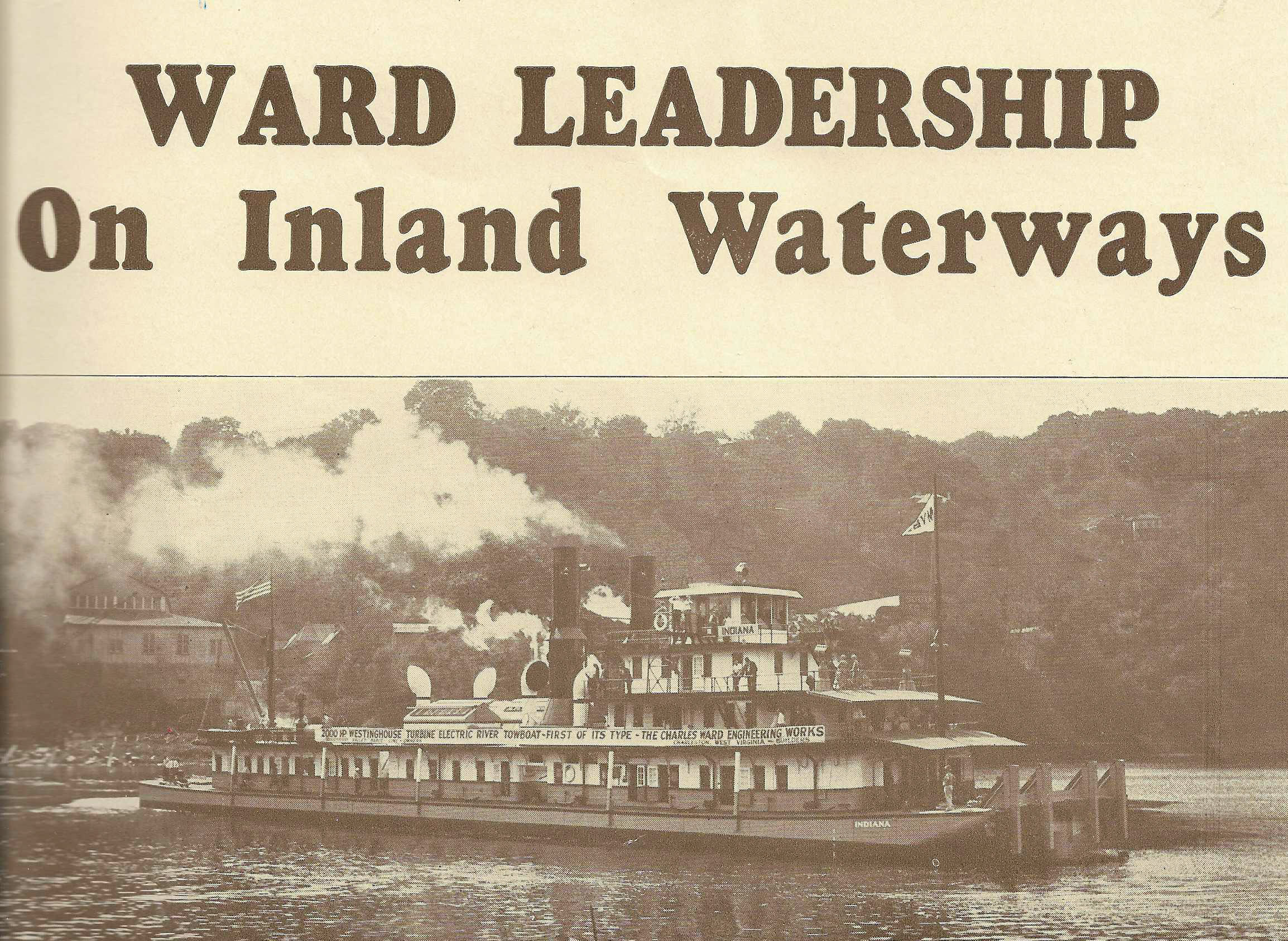
The Indiana was the first of the boats built by Ward to be completed. It was christened and launched on June 16, 1930, and was delivered to the Valley Line in September of that year. It burned oil to fire the two water tube boilers that made the steam for the turbines that powered the electric motors turning the shafts. A long banner stretched along the second deck railing proclaiming “2000 HP WESTINGHOUSE TURBINE ELECTRIC TOWBOAT – FIRST OF ITS TYPE – THE CHARLES WARD ENGINEERING WORKS – BUILDERS.”
A Ward ad on the inside back cover of the November 15, 1930, WJ featured a photo of the boat and listed numerous achievements by the company as having the following firsts: “Tunnel Towboat on Western Rivers; Twin-Screw Tunnel Towboat, Dieselectric Sternwheel Towboat; Large Diesel Twin-Screw Towboat, Large Diesel Sternwheel Towboat, Twin-Screw Towboat Using Pulverized Coal Fuel AND NOW First Turbo-Electric Twin-Screw Tunnel Towboat.” Despite all this success, the yard would close in 1932 due to succession issues and the effects of the Great Depression.
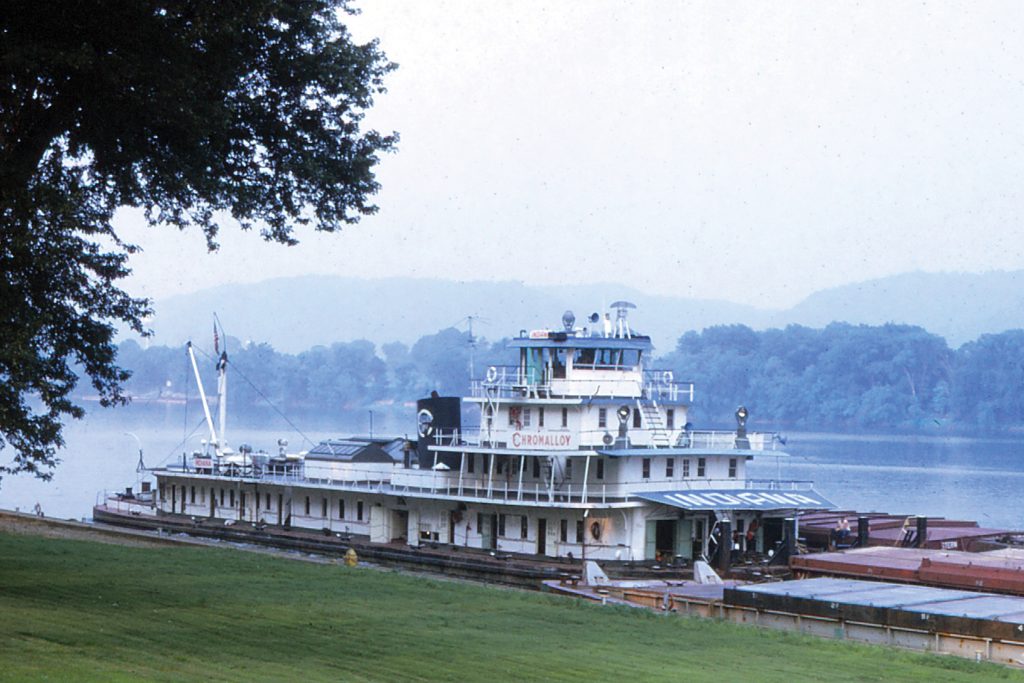
All four of the big Valley Line boats were successful. In 1941, the Ohio was fitted with a new kort nozzle stern at Dravo. Plans were made to retrofit the rest of the “state” boats, but, due to World War II, it would be 1946 before the new stern was placed on the Indiana. It then measured 202 by 40 feet. In 1949, it was converted to diesel at the Cincinnati shops of the Valley Line. A pair of GM 16-278 A engines totaling 2,600 hp. at 750 rpm. were installed, and it was then diesel – electric. A few years later, the Inland River Record listing had dropped the “diesel-electric” notation, and it was rated at 3,200 hp.
Capt. Emil “Red” Goering, a long-time Valley Line captain, once told me that there were few other boats he would rather be on than the Indiana when coming out of the upper end of the Ohio in high water. Valley sold the two Dravo-built state boats (both of which have been detailed in this column) in the early 1960s, but he continued to operate the Indiana and sister Louisiana, which had also been converted to diesel. The Louisiana was laid up and dismantled in 1968, but the venerable Indiana continued to run until 1981.
It was dismantled at Cincinnati and sold to interests at Aberdeen, Ohio, who converted it into a floating restaurant called the Lively Lady. It was later taken to Cincinnati, where it served as a landing for an excursion boat and was called Star Landing. It was eventually moved to Madison, Ind., and was tied in a fleet there, where it sank in 1998 and was raised in pieces.
Featured photo caption: The steamer Indiana in a Ward ad in the November 15, 1930 WJ. (From the author’s collection.)