

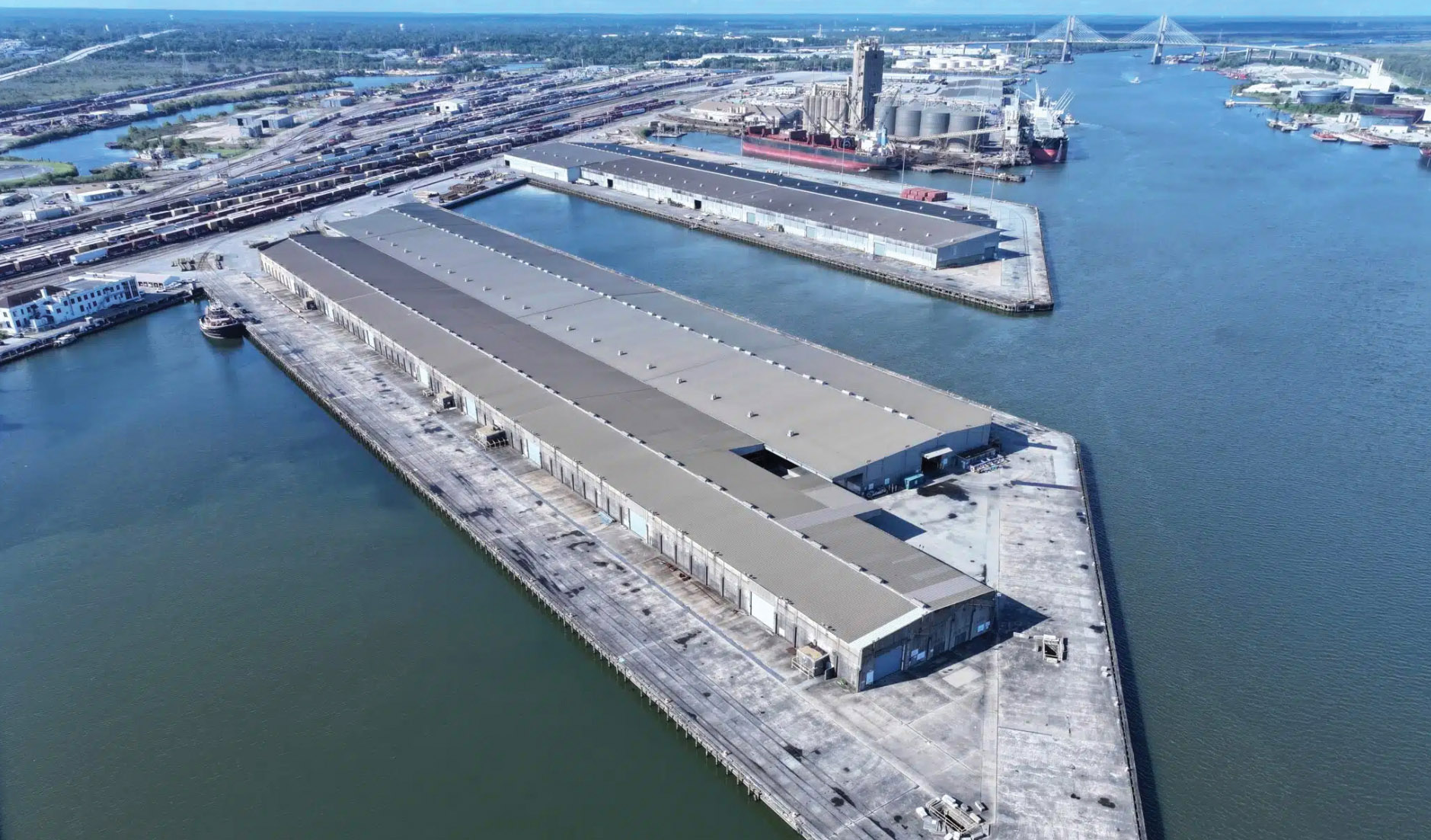
Alabama Port Authority Launches $100M Pier Redevelopment
The Alabama Port Authority has begun demolition and reconstruction of Pier B South, launching a multi-year, multi-phase program to modernize the Port of Mobile’s general cargo terminal—one of the port’s oldest and most versatile assets.
Built in the 1920s, Pier B South has served Alabama industries for nearly a century. Through a $100 million federal investment championed by former Sen. Richard Shelby (R-Ala.), the port is transforming the facility into a modern, high-capacity berth to support the state’s growing breakbulk trade.
“Pier B South has stood for nearly a hundred years as a symbol of Alabama’s global trade gateway through the Port of Mobile, and now we’re investing to ensure it remains an engine for the next hundred years,” said Doug Otto, director and CEO of the Alabama Port Authority. “From steel producers like SSAB, Outokumpu, Nucor and Arcelor Mittal to forest products suppliers like Great Southern Wood Preserving, International Paper and Georgia-Pacific, we are building the port to serve Alabama businesses that continue to invest and expand production right here in our state.”
The new Pier B South will feature 1,500 linear feet of modern dock structure built to handle 1,500 pounds per square foot and accommodate mobile harbor cranes and other advanced cargo-handling equipment. The facility will be rail-served, shore-power capable and designed to be integrated into the port’s general cargo complex.
RJ Baggett Construction is the lead contractor. Buildout is expected to take about three years.
The Pier B South project marks Phase I of the port’s broader General Cargo Modernization Program, a multi-year initiative to enhance capacity, efficiency and sustainability across the Port of Mobile’s breakbulk operations.
Additional program elements already underway include warehouse upgrades, a harbor optimization study and development of a general cargo infrastructure strategy.
Warehouse upgrades will involve modernizing storage and cargo-handling facilities to support higher throughput and improve operating efficiency, targeting an increase of more than 110,000 square feet by next year.
Regarding the harbor optimization study, the port, in partnership with the Corps of Engineers, is pursuing federal funding to leverage existing navigational assets, evaluate barge-lane feasibility and study the depth, flow and tidal impacts related to the Mobile River.
The port is also developing a strategy to prioritize future capital investments, integrate intermodal connectivity and expand the port’s service to Alabama-based manufacturers and exporters.
“From warehouse improvements to a harbor optimization partnership with the Corps, every piece of this strategy ties back to a single goal—serving Alabama industry,” Otto said. “Because when companies invest hundreds of millions of dollars in the state, it’s our responsibility to ensure their port keeps pace with their growth.”
————
Featured photo caption: An aerial view of the Port of Mobile’s Pier B South. (Photo courtesy of the Alabama Port Authority)