
Coast Guard Releases Force Design Update, Lunday Installed As Commandant
The U.S. Coast Guard released its Force Design 2028 Initial Update on January 15, detailing reforms implemented since January 2025. The update underscores “how Force Design 2028 has strengthened the service’s operational effectiveness, improved workforce readiness, accelerated capability delivery and generated unprecedented value for the nation,” the Coast Guard said in a news release.
The Coast Guard has been closely working with the U.S. Navy in stepped-up drug interdiction operations, as well as in the seizure of several sanctioned oil tankers. The Coast Guard has legal authorities to seize sanctioned vessels that the Navy does not. Since January 2025, the Coast Guard has seized more than 466,000 pounds of cocaine—equivalent to more than 176 million lethal doses. In fiscal year 2025 alone, the service interdicted more than 510,000 pounds of cocaine, the highest total in the history of the Coast Guard and an increase of more than 200 percent over FY24.
Also in FY25, the Coast Guard exceeded 110 percent of its active-duty enlisted recruiting goal, enlisting more than 5,200 members—the highest total since 1991. The service also achieved 104 percent of its reserve enlisted recruiting goal and 100 percent of its active-duty officer mission. Part of the Force Design 2028 plan is to expand the force by 15,000 military members to meet evolving operational demands and support new assets.
Structural Reform, Rapid Capability Delivery
Under Force Design 2028, the Coast Guard established new leadership roles, including chief of staff, deputy commandant for systems, deputy commandant for personnel and program executive offices, while eliminating 14 admiral positions (32 percent) to streamline decision-making and maximize efficiency.
The service also created the Rapid Response Prototype Team (RAPTOR) to deliver technology solutions at speed. RAPTOR transitioned a capability from concept to operational use in just three weeks, supporting Operation Border Trident with a contractor-owned, contractor-operated long-range unmanned aerial system employing artificial intelligence, the Coast Guard said.
Additionally, the Coast Guard empowered commanders by revising administrative policies related to non-judicial punishment and delegating surface and airborne use-of-force authorities, increasing operational effectiveness at the tactical level.
OBBB Funds
Capability delivery is being accelerated through Force Design 2028 and resources provided by the One Big Beautiful Bill Act (OB3). More than $3 billion in OB3 funds have already been obligated, with 75 percent of total funding expected to be obligated by the end of FY26. In the coming months, the Coast Guard said, it will implement major structural changes and investments.
Those changes and investments will include establishing a deployable Specialized Forces Command to enhance integration with the Department of War and optimize force employment; expanding training capacity to support a growing force of more than 15,000 additional military members; enhancing maritime domain dominance through Coastal Sentinel, improving sensor integration and operational responsiveness; rapidly identifying, testing and acquiring commercially available boats, cutters and aircraft to empower Coast Guard personnel across all mission areas; and executing a comprehensive force posture and operational concepts campaign to transform how the service organizes, trains, equips and employs forces. Doing so will streamline strategic decision-making, decentralize execution and leverage next-generation technologies in pursuit of U.S. maritime dominance, the Coast Guard stated.
“The United States Coast Guard serves as a vital instrument of national power, advancing security both at home and abroad, safeguarding the American economy and providing rapid response to emergent contingencies,” said Kristi Noem, secretary of Homeland Security. “When I became the secretary of Homeland Security, we took steps to change the Coast Guard in support of President Trump’s America First Agenda. Through the implementation of Force Design 2028, the extraordinary return on investment—the value the Coast Guard provides to our nation—is poised to grow even further. The men and women of the Coast Guard exemplify the very best of our nation. We are immensely proud of their achievements through Force Design 2028.”
“As we deliver the first update on Force Design 2028, the Coast Guard is already a stronger, more agile, capable and responsive fighting force,” said newly installed commandant of the U.S. Coast Guard Adm. Kevin Lunday. “The service is better positioned than it was in January 2025 to effectively control, secure and defend the U.S. borders and maritime approaches, facilitate the uninterrupted flow of commerce and rapidly respond to contingencies. Force Design 2028 is already improving operational outcomes while establishing the foundation for even greater achievements in the future.”
Analysis shows the service generates more than $74 billion in social and economic value through cost avoidance, the Coast Guard said, representing a 6-to-1 return on taxpayer investment of its $12.1 billion annual budget. In FY25, Coast Guard crews saved nearly 5,000 lives and preserved or assisted more than $974 million in property while responding to mariners in distress across the nation’s waterways.
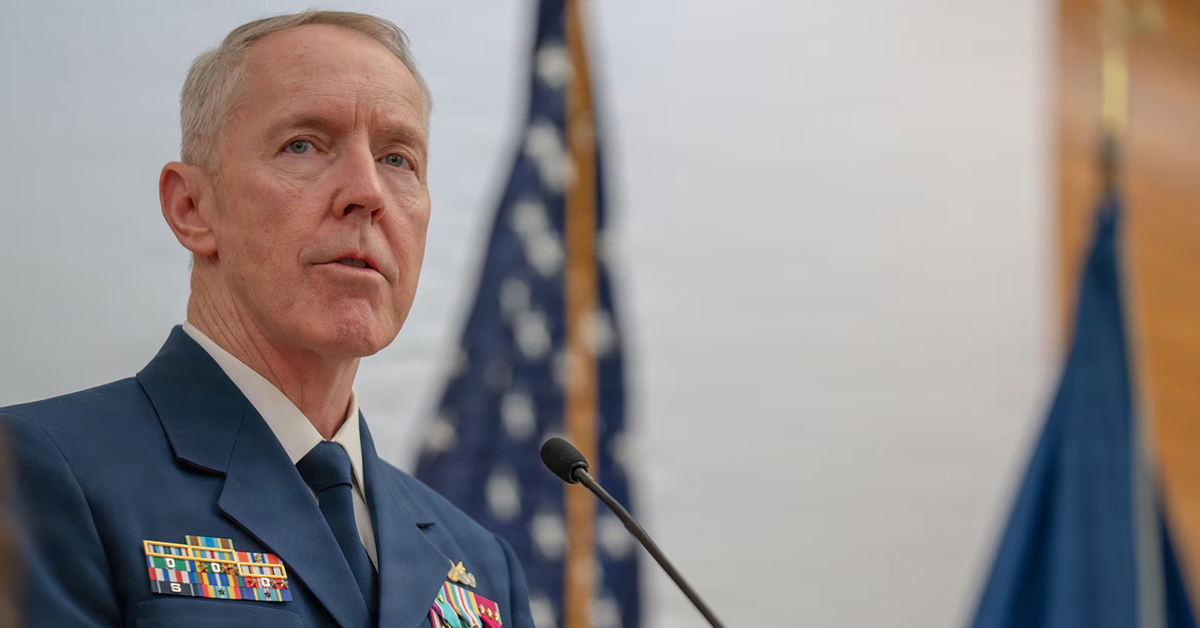
Featured image caption: Adm. Kevin Lunday speaks at the January 15 formal swearing-in and assumption of command ceremony where he was officially installed as the 28th Commandant of the U.S. Coast Guard. (Photo courtesy of the U.S. Coast Guard)