OBC: The Delmar R. Traver
The inland rivers of the United States have been viewed as essential means of transportation since the very beginnings of the nation. George Washington, soldier, statesman and first president of the country, held them in high regard. In a 1784 letter, Washington said of inland navigation, “where it may be useful and practicable…..will not only be of amazing convenience and advantage to its Citizens, but sources of immense wealth to the Country.” He argued for the development of inland navigation to connect the Atlantic states with the Western territories. He also viewed the rivers as a “common highway” and said they should be “forever free” (but that is a topic for the editorial section).
Throughout the ensuing years, a wide range of goods were floated down the waterways (and later, with the advent of the steamboat, they were delivered in both directions). When the automobile initially began gaining in popularity with the general public, highways were virtually nonexistent. It was only natural that manufacturers looked to the rivers as an efficient means of delivering their product to some areas.
Autos were carried by barge in the 1910s and 1920s even with the mighty Sprague, largest towboat ever built. The Sprague once delivered Ford Model Ts to Cincinnati. Commercial Barge Lines Inc. (CBL) was established in 1935 as part of Commercial Carriers Inc., Detroit, according to a company brochure, “for the purpose of undertaking to develop whether or not automobiles could be secured in volume for movement via a slower in transit route but one which would offer a definite per car saving to the manufacturers and dealers.”
CBL initially operated as brokers, with cars placed on barges belonging to other companies. Some oil transporters would place the autos on their barges for delivery to various destinations and terminals in places such as Cincinnati, Louisville, Ky., and Evansville, Ind., on the Ohio River; Guntersville, Ala., on the Tennessee; St. Louis on the Upper Mississippi; and Memphis and New Orleans on the Lower Mississippi.
As the business grew, CBL began utilizing barges of their own, at first converting standard hopper barges to the ability to handle up to 82 vehicles. This eventually led to specialized barges with a capacity of 192 cars. Towboats, such as the diesel sternwheel Irvin S. Cobb (see The Waterways Journal, June 27, 2022) and others of the Iger Inc. fleet were chartered to tow these barges. CBL opened offices at Evansville due to Chrysler being a large customer and having plants there.
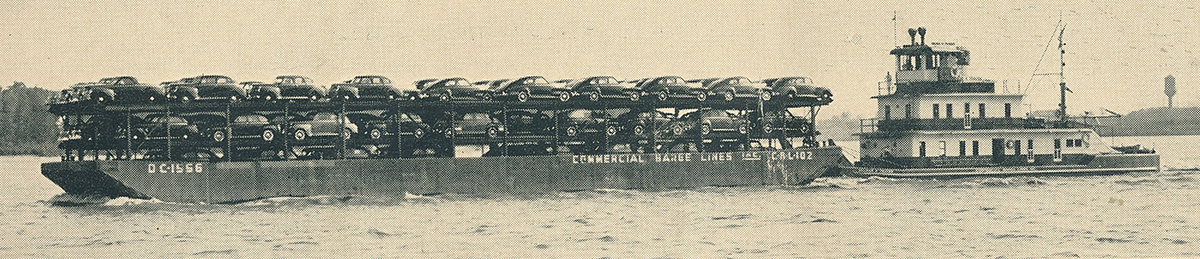
In 1941, CBL purchased the steam sternwheel towboat Chicot, built for the U.S. Engineer Department by Howards in 1925, and named it Jerome D. Beeler. That same year, CBL took delivery of a new diesel towboat from St. Louis Shipbuilding & Steel Company. The new vessel, named Delmar R. Traver after the head of CBL, was single screw towboat with a hull that measured 105 feet by 26 feet. It was powered by a National Superior engine of 655 hp. at 400 rpm turning a 72-inch cast steel propeller. The boat was christened at St. Louis on June 12, 1941, and the next morning it picked up a new car barge at St. Louis Ship and departed for Cairo, Ill. Capt. Nelson M. Broadfoot, operating manager of CBL river operations, was aboard as master with Capt. Sam Feltz, pilot; James Mackenzie and Leroy Koyen, engineers; Tuttle Lockwood, mate; Ernest Werner, steward, and Clarence Paschner, cook. The Traver loaded at Evansville and departed for Guntersville, Ala., on June 15 in the trade the boat had been designed for.
In 1943, it was renamed Jerry Beeler, and in December 1945, it was sold to Arrow Transportation Company, Sheffield, Ala., and renamed ATCO. In 1950, a kort nozzle was added to increase thrust.
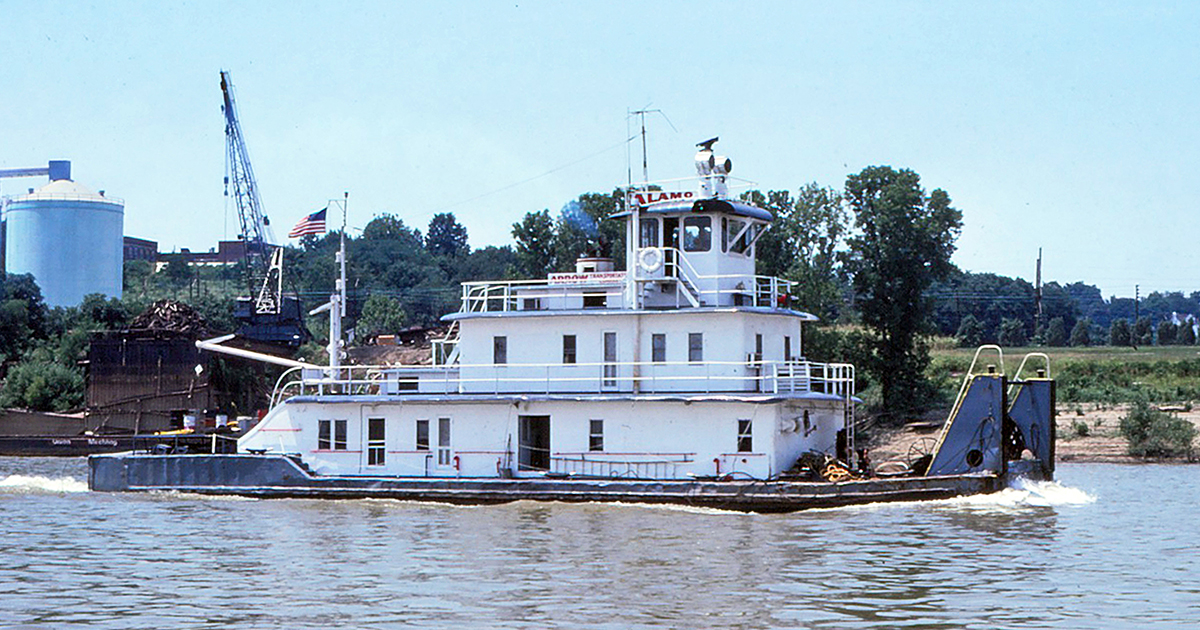
In 1963, the boat was extensively rebuilt and converted to twin screw, though the external appearance remained much the same. During the conversion, it was repowered with a pair of GM 6-278 engines totaling 1,100 hp. and renamed Alamo. It last appeared in the active listings in the 1980 edition of the Inland River Record. In the next year’s edition, it was listed in the OFF THE RECORD section with the notation “burned and sank early 1981 at Birmingham, Ala.”
This column was prompted by a recent conversation with Capt. Cecil Duncan who said that his father once worked on the Delmar R. Traver and that he would like to know more about it.
Featured image caption: The mv. Alamo, formerly the Delmar R. Traver, photographed at Evansville, Ind., on July 13, 1974. (Photo by Capt. Jeff Yates)